

India’s dairy market is changing without abandoning its traditional foundation.
Milk remains a high-frequency household staple, but consumption is gradually moving toward yogurt, cheese, paneer, flavoured milk, functional products and other value-added formats. For dairy companies, this creates a different feasibility question from simply estimating milk consumption.
The opportunity depends on where consumers are trading up, which categories can support higher value per unit, and whether supply, cold-chain and distribution economics can support expansion.
Milk Still Anchors the Market
India produced an estimated 248 million tonnes of milk in 2024–25, up from 239 million tonnes in 2023–24, according to the Ministry of Fisheries, Animal Husbandry & Dairying. The government also reported 117,928 licensed or registered manufacturers in the milk and milk-products category as of February 2026.
Milk therefore remains the foundation of the dairy ecosystem.
But production growth alone does not reveal where the higher-value opportunities lie.
EY’s 2026 analysis of India’s dairy sector, using IMARC data, estimates liquid milk at ₹9.94 lakh crore in 2024 and projects a 12.7% CAGR for 2025–2033.
At the same time, several value-added categories are growing faster.
That divergence is central to dairy-market feasibility.
The Growth Equation Is Moving Beyond Liquid Milk
Different dairy categories are responding to different consumption shifts.
- Yogurt
Western-style yogurt is projected to grow at 19.7% CAGR between 2025 and 2033 in EY’s cited market estimates. Health positioning, convenience and changing breakfast and snacking habits are supporting demand. - Flavoured milk
The category is projected to grow at 20.7% CAGR over the same period, supported by convenience and changing preferences among younger consumers. - Cheese
Euromonitor’s 2025 assessment identifies processed cheese as a growth area, supported by greater consumer awareness, innovation and exposure to dining-out culture. It also expects packaged soft cheese formats to benefit from concerns around the quality and safety of unpackaged paneer. - Organic milk
EY’s cited estimates put organic milk at a 24.6% CAGR for 2025–2033, although from a substantially smaller base than conventional milk.
These categories demonstrate why dairy assessment needs to distinguish volume scale from growth rate.
Health Is Reshaping Dairy Choices
Dairy benefits from a strong association with nutrition and protein, but consumers are becoming more specific about the benefits they expect.
Research found that health consciousness was supporting demand for milk and yogurt, with flavoured yogurt benefiting from its perceived healthier positioning and wider availability.
This creates opportunities around:
- High-protein dairy
- Probiotic yogurt
- Fortified milk
- Lower-sugar products
- A2 and organic milk
- Functional dairy beverages
- Protein-rich cheese and paneer
The feasibility challenge is determining whether consumers will pay the required premium and whether the product can maintain its economics through the cold chain.
Distribution Can Determine Category Viability
Dairy is particularly sensitive to distribution because many products have limited shelf life and require temperature-controlled handling.
Mordor Intelligence estimates that off-trade channels accounted for 90.62% of India’s dairy market revenue in 2025. It also forecasts yogurt to grow at an 8.01% CAGR through 2031 and expects on-trade dairy channels to expand at 7.42% CAGR over 2026–2031.
Digital channels are also changing access.
NIQ’s 2026 commerce research identifies dairy as one of the strongest repeat-purchase categories in India’s quick-commerce marketplace, with dairy accounting for 49% of the category mix in its digital-purchase analysis.
For dairy companies, this means channel strategy needs to be evaluated alongside category demand.
The Supply Side Can Create or Destroy the Opportunity
The promising dairy category still requires adequate procurement and processing capability.
Milk collection density, chilling infrastructure, processing capacity, packaging technology, cold-chain reach and distribution costs all influence the commercial feasibility of a new product.
This becomes especially important for products with shorter shelf lives or stricter temperature requirements.
A value-added dairy opportunity should therefore be assessed from both ends of the market: consumer willingness to buy and the company’s ability to supply profitably.
Nexdigm’s dairy market feasibility study consulting helps companies assess category demand, consumer preferences, premiumization potential, supply economics, competitive intensity, distribution requirements and expansion opportunities.
Nexdigm’s Dairy Market Feasibility Framework
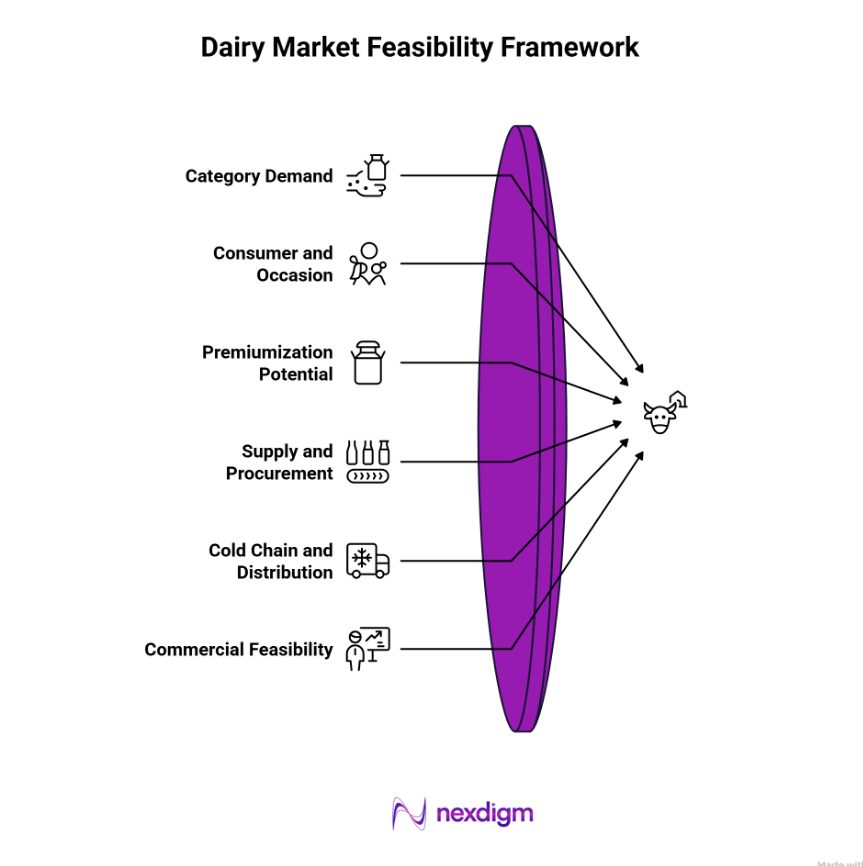
- Category Demand
Size consumption across liquid milk, yogurt, cheese, paneer, ghee, flavoured milk and emerging value-added categories. - Consumer and Occasion
Map household consumption, health priorities, convenience needs, demographics and purchase occasions. - Premiumization Potential
Assess willingness to pay for protein, probiotics, fortification, organic credentials, A2 positioning and other benefits. - Supply and Procurement
Evaluate milk availability, sourcing networks, procurement costs, processing capacity and supplier relationships. - Cold Chain and Distribution
Assess shelf life, chilling requirements, logistics, retail reach, modern trade, e-commerce and quick commerce. - Commercial Feasibility
Model pricing, margins, competitive intensity, investment requirements and realistic market penetration.
This framework separates large-volume dairy categories from smaller but faster-growing opportunities and tests whether the latter can support commercially viable expansion.
Nexdigm Case: Evaluating Dairy Category Expansion Opportunities
A dairy player evaluated milk, yogurt, cheese and value-added categories across 5 cities. Research covering 2,000 consumers and 38 competitors identified yogurt and premium cheese as priority segments, with estimated demand growth of 16% and 13%, respectively.
To take the next step, simply visit our Request a Consultation page and share your requirements with us.
Harsh Mittal
+91-8422857704