

Dairy procurement benchmarking is difficult because suppliers are rarely selling an entirely interchangeable product. Milk, cream, butter, cheese, yoghurt, and milk powder differ in composition, processing requirements, usable yield, shelf life, and storage conditions. Even within one category, differences in fat, protein, moisture, and microbiological specifications can make a direct price comparison misleading.
A proper benchmark evaluates four connected areas: supplier capability, effective price, product quality, and contract economics.
India’s Production Base
India produced 247.87 million tonnes of milk in 2024-25, an increase of 3.58% over the previous year, according to the Department of Animal Husbandry and Dairying. Per-capita availability reached 485 grams per day, compared with 390 grams in 2018-19.
Production is geographically distributed, although several states have significant shares. Uttar Pradesh accounted for 15.66% of national production, Rajasthan 14.82%, Madhya Pradesh 9.12%, Gujarat 7.78%, and Maharashtra 6.71%.
This scale offers buyers a broad production ecosystem, but national output is not the same as accessible processing capacity. A business requiring specialised cheese, consistent cream specifications, or milk powder may face a narrower supplier market than the national production figure suggests.
Supplier Benchmarking: Who Can Meet the Requirement?
Supplier evaluation should begin with product and operational fit.
Assess vendors on:
- Processing capacity and consistency of supply.
- Collection, chilling, and cold-chain infrastructure.
- Geographic coverage and delivery frequency.
- Quality systems, testing, traceability, and rejection handling.
- Backup production and ability to respond to demand changes.
A supplier with a large collection network may offer reliability at scale, while a regional processor may provide better delivery frequency for a local facility. The relevant comparison depends on the product and the buyer’s operating footprint.
Pricing Benchmarking: Calculate the Effective Cost
The purchase price should be normalised for composition, pack size, usable yield, freight, and additional charges. For processed dairy, cost per kilogram alone may not reflect the economic value of the product. Cheese and milk powders, for example, need to be compared using relevant solids, moisture, and performance specifications.
The FAO Dairy Price Index declined 18.8% year on year in September 2026, even as the overall FAO Food Price Index increased 5.8%. This divergence illustrates why buyers should use category-specific indicators. International price movements are useful context, but local procurement prices also reflect domestic milk availability, processing, logistics, contracts, and currency exposure.
Quality Benchmarking: What Does the Buyer Actually Receive?
Quality differences can create hidden costs through rejected batches, inconsistent production performance, and shorter shelf life.
A dairy quality scorecard should consider:
- Fat and protein content.
- Moisture and other product-specific composition measures.
- Microbiological results and testing frequency.
- Temperature compliance and shelf life at receipt.
- Batch consistency and traceability.
For dairy procurement benchmarking consulting, quality results should be connected to supplier invoices and product specifications. This makes it possible to distinguish a genuine price premium from a difference in product quality or usable yield.
Commercial Terms: Where Contract Value Changes
Volume commitments, seasonal pricing, minimum orders, payment periods, freight, rebates, and price-adjustment clauses affect the final cost. Buyers should compare the net delivered price after these terms are included.
Large-volume commitments may secure better rates but can increase inventory exposure for short-shelf-life products. Contracts should also clarify how price changes are triggered and what evidence suppliers must provide when requesting an adjustment.
Dairy Procurement Benchmarking Framework
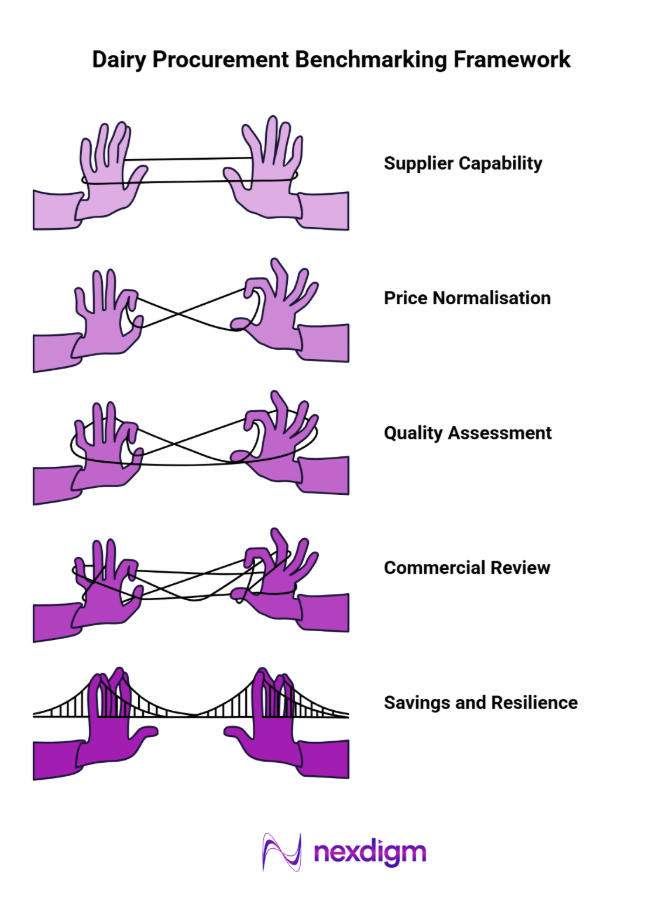
- Supplier Capability: Compare capacity, processing facilities, collection networks, coverage, and backup arrangements.
- Price Normalisation: Standardise composition, quality, pack size, freight, and payment terms to calculate comparable delivered costs.
- Quality Assessment: Review test results, batch consistency, rejection rates, temperature compliance, and traceability.
- Commercial Review: Benchmark rebates, seasonal clauses, minimum orders, credit periods, and price-adjustment mechanisms.
- Savings and Resilience: Identify negotiation, alternative sourcing, specification alignment, and order-planning opportunities without compromising quality or supply continuity.
Nexdigm’s Case Study
An FMCG manufacturer planning to expand its dairy portfolio required a clearer understanding of regional milk availability, processing capacity and supplier competitiveness. Nexdigm assessed 7 dairy-producing states and mapped 35 processing companies across key product segments. The study identified 3 priority sourcing regions, where milk availability and processing infrastructure offered stronger commercial potential, with estimated landed-cost differences of 8–12%.
To take the next step, simply visit our Request a Consultation page and share your requirements with us.
Harsh Mittal
+91-8422857704