

Dairy procurement is shaped by product perishability, seasonal supply, processing requirements, quality specifications, and the distance between production and consumption. Milk, cream, butter, cheese, milk powder, yoghurt, and specialised dairy ingredients cannot be assessed using the same cost assumptions. Each product has different storage needs, processing yields, and supplier economics.
For manufacturers, food-service operators, and retailers, spend analysis must reveal not only where money is going, but also where supplier dependence could disrupt production or weaken negotiating leverage.
A Large Market With Uneven Supply
India produced an estimated 247.87 million tonnes of milk in 2024-25, up 3.58% from 239.30 million tonnes in 2023-24, according to the Department of Animal Husbandry and Dairying. Per-capita milk availability reached 485 grams per day. Uttar Pradesh accounted for 15.66% of production, followed by Rajasthan at 14.82%.
This scale creates a broad supplier ecosystem, but national production figures do not guarantee local availability of a specific dairy product. Processing capacity, chilling infrastructure, collection networks, fat and solids requirements, and transport distance can narrow the practical supplier pool.
Find the Real Drivers of Dairy Spend
Dairy prices are influenced by milk procurement rates, fat and solids content, seasonal supply, feed costs, processing, refrigeration, packaging, and distribution. For cheese and milk powder, conversion yield and product specifications become particularly important. A supplier quoting a lower price may deliver a different moisture level, composition, or usable yield.
A dairy procurement spend analysis consulting exercise should link invoice prices to product specifications, delivery locations, volumes, quality results, and contract terms. It should also distinguish market-wide price movements from supplier-specific increases and differences caused by product mix.
Dairy Procurement Spend Analysis Framework
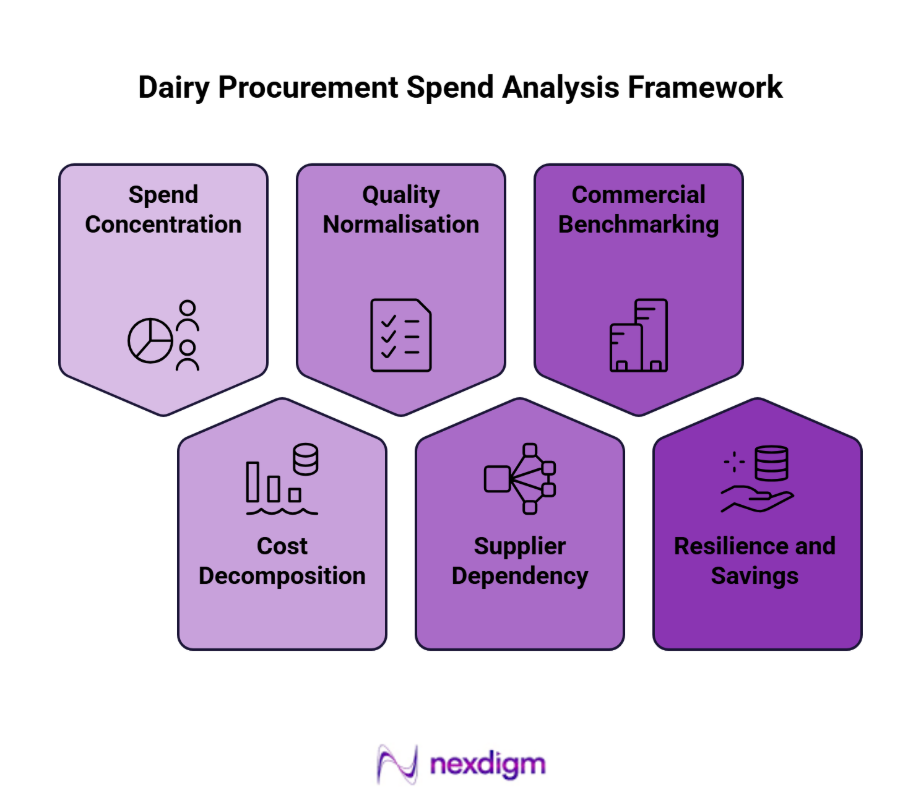
- Spend Concentration: Rank dairy categories, suppliers, plants, and delivery regions by expenditure. Identify products where a small number of vendors account for most purchasing.
- Cost Decomposition: Separate raw milk or ingredient costs, processing, packaging, cold storage, transport, testing, and other charges to understand the full delivered cost.
- Quality Normalisation: Compare fat, protein, moisture, microbiological requirements, shelf life, and usable yield so that quotations reflect equivalent products.
- Supplier Dependency: Map collection networks, processing locations, backup capacity, geographic concentration, and exposure to disruptions affecting a shared upstream source.
- Commercial Benchmarking: Review volume tiers, payment terms, seasonal clauses, delivery frequency, rejection rules, and minimum order requirements.
- Resilience and Savings: Prioritise negotiations, alternative supplier qualification, route optimisation, and contract changes according to spend, feasibility, and food safety requirements.
What the Analysis Should Reveal
A high-spend supplier is not necessarily a problem. It may have the scale, quality systems, and collection network required for reliable supply. The risk emerges when concentration is combined with limited alternatives, long qualification periods, or unclear price adjustment mechanisms.
Buyers should also assess whether buying more volume creates genuine savings after accounting for chilled storage, shelf life, and demand variability. Dairy inventory can become a cost rather than a buffer when orders exceed production or sales requirements.
Nexdigm’s Case Study
A food manufacturer assessed ₹24 crore in annual dairy purchases across four product groups. The review found price variation between plants and high dependence on two suppliers for processed ingredients. Standardised specifications, revised commercial terms, and qualified backup sources reduced addressable spend by 3.4% over six months.
To take the next step, simply visit our Request a Consultation page and share your requirements with us.
Harsh Mittal
+91-8422857704