

India’s dairy market is large enough to make overall volume growth look reassuring. The more useful question is where that volume is moving. Consumers are increasingly choosing dairy products based on nutrition, convenience, indulgence and functionality, creating different growth trajectories across milk, yogurt, cheese and value-added formats.
India produced 247.87 million tonnes of milk in 2024–25, up from 239.30 million tonnes in 2023–24. Per-capita availability reached 485 grams per day.
Yet rising milk production does not automatically translate into equal growth across every dairy category.
Milk Remains the Base, but Value Addition Is Expanding
Fluid milk continues to anchor dairy consumption, but the commercial opportunity increasingly lies in converting milk into higher-value products.
EY notes that value-added dairy products in India have been expanding at approximately 10%–12% CAGR between 2021 and 2025, while urban and aspirational consumers are adopting cheese, probiotic curd, yogurt drinks and whey-based beverages.
This creates a portfolio question for dairy companies: how much capacity should remain tied to high-volume staples, and how much should move toward differentiated products?
Yogurt Is Moving Beyond a Breakfast Occasion
Yogurt increasingly occupies several consumption occasions, including breakfast, snacking and post-workout consumption. High-protein and probiotic variants further expand the category’s functional positioning.
The shift is particularly relevant in urban markets, where consumers increasingly associate dairy with protein intake, digestive health and convenience. The uploaded market report similarly identifies Greek yogurt, skyr and probiotic dairy drinks as growth-oriented formats within the broader dairy portfolio.
Cheese and Flavoured Dairy Add Premiumization
Cheese, flavoured milk and other value-added products can command higher price points while responding to changing food habits.
EY identifies cheese, ice cream and flavoured milk as growing value-added categories, alongside rising launches of artisanal cheese, organic milk, probiotic drinks and high-protein dairy products.
For manufacturers, the issue is therefore less about adding another SKU and more about identifying which consumer segment will pay for which proposition.
Why Category Growth Needs Consumer-Level Analysis
Aggregate dairy consumption can conceal major differences between households. A family purchasing milk daily may rarely purchase yogurt drinks, while a younger urban consumer may buy smaller quantities of milk but purchase premium yogurt, cheese or protein beverages several times a week.
This makes demand assessment dependent on four variables:
- Consumption frequency: How often is each category purchased?
- Need state: Is the product used for nutrition, convenience, indulgence or functionality?
- Price tolerance: What premium can each consumer segment absorb?
- Channel access: Does the category depend on supermarkets, traditional retail, modern trade or digital delivery?
Nexdigm Dairy Demand Assessment Framework
Nexdigm’s dairy product demand assessment consulting can translate these variables into a category opportunity map.
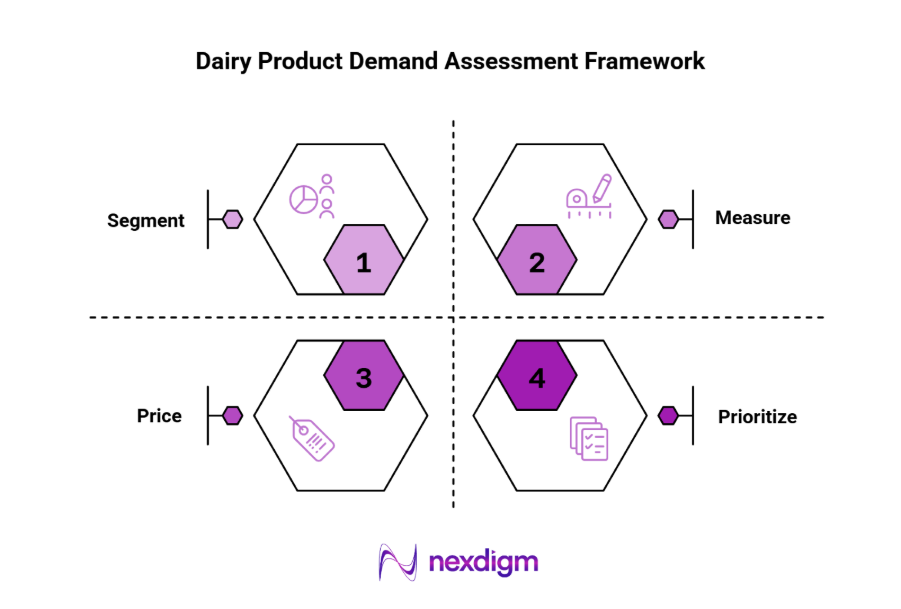
- Segment: Map consumers by household size, life stage, and disposable income against distinct wellness priorities (gut health, protein) and contextual occasions (breakfast, quick snacks).
- Measure: Track purchase cycles, single serve versus bulk format demand, brand substitution rates, and the trade-offs driving final choice (nutrition, convenience, or price).
- Price: Benchmark willingness-to-pay tiers: cost-plus parity for staples, 20%–50% premiums for sensory/organic claims, and 2x–3x markups for specialized functional benefits, avoiding psychological price cliffs.
- Prioritize: Screen categories by growth rate, competitive density, margin resilience against retailer fees, and supply constraints—specifically cold-chain reliability versus shelf-stable distribution ease.
This allows dairy companies to identify whether growth should come from increasing penetration, premiumization, new formats or geographic expansion.
Nexdigm Case: Mapping Dairy Category Demand
Nexdigm evaluated 4 dairy categories across 6 cities, surveying 2,400 consumers and benchmarking 36 brands. The study identified yogurt and cheese as priority growth pools, with purchase frequency 18% and 13% higher among target urban segments and a 10%–15% premium accepted for functional variants.
To take the next step, simply visit our Request a Consultation page and share your requirements with us.
Harsh Mittal
+91-8422857704