

India’s dairy market is entering a phase where increasing milk production is only one part of the growth equation. The larger opportunity lies in converting that expanding milk base into products that command stronger consumer value, support differentiated pricing, and travel through increasingly organized channels.
India produced 247.87 million tonnes of milk in 2024–25, up from 239.30 million tonnes in 2023–24. Per-capita milk availability also reached 485 grams per day. Over the longer term, production has grown at a 5.41% CAGR between 2014–15 and 2024–25.
This creates a substantial supply foundation. The strategic question is where the next layer of value can be captured.
The Dairy Opportunity Is Moving Beyond Fluid Milk
Fluid milk remains the foundation of the category, but consumer demand is becoming more diversified.
Yogurt, probiotic drinks, cheese, whey-based products, flavored milk, dairy desserts, lactose-free products, and protein-oriented dairy are creating additional consumption occasions. EY notes that India’s dairy sector needs to shift from volume growth toward productivity, quality, value addition, and stronger processing infrastructure.
The opportunity is particularly relevant in urban markets, where consumers are increasingly purchasing packaged products that combine convenience with attributes such as protein, digestive health, indulgence, or portability.
The question for dairy companies is therefore not simply which category is growing fastest. It is which category combines demand growth with sufficient frequency, pricing headroom, distribution access, and competitive space.
Higher Value Requires More Than a Premium Label
Moving into value-added dairy can improve realization, but it also introduces additional requirements.
Yogurt and fermented products depend on consistent processing and cold-chain distribution. Cheese requires manufacturing capabilities and quality control. Functional and protein-oriented products require credible formulation and consumer communication. Shelf-stable formats can expand geographic reach but involve different processing and packaging requirements.
Infrastructure therefore becomes part of the market opportunity.
EY identifies processing capacity, cold chains, organized procurement, and traceability as important enablers of higher-value dairy growth.
For companies evaluating a new category, the commercial opportunity needs to be considered alongside these operational requirements.
Which Categories Have the Strongest Expansion Logic?
A useful starting point is to examine dairy categories through four questions.
- Is consumption expanding?
Assess household penetration, consumption frequency, changing occasions, and demographic adoption. - Can consumers pay more?
Test willingness to pay, price elasticity, premium acceptance, and the attributes that justify higher prices. - Can the product scale?
Examine processing requirements, raw-material availability, cold chain, shelf life, and manufacturing capacity. - Is there room to compete?
Benchmark established brands, regional players, product differentiation, pricing, distribution, and consumer perceptions.
This helps separate categories that are merely fashionable from those capable of supporting sustained commercial growth.
The Dairy Opportunity Assessment Framework
Nexdigm’s dairy product opportunity assessment consulting can structure this evaluation through a four-stage process.
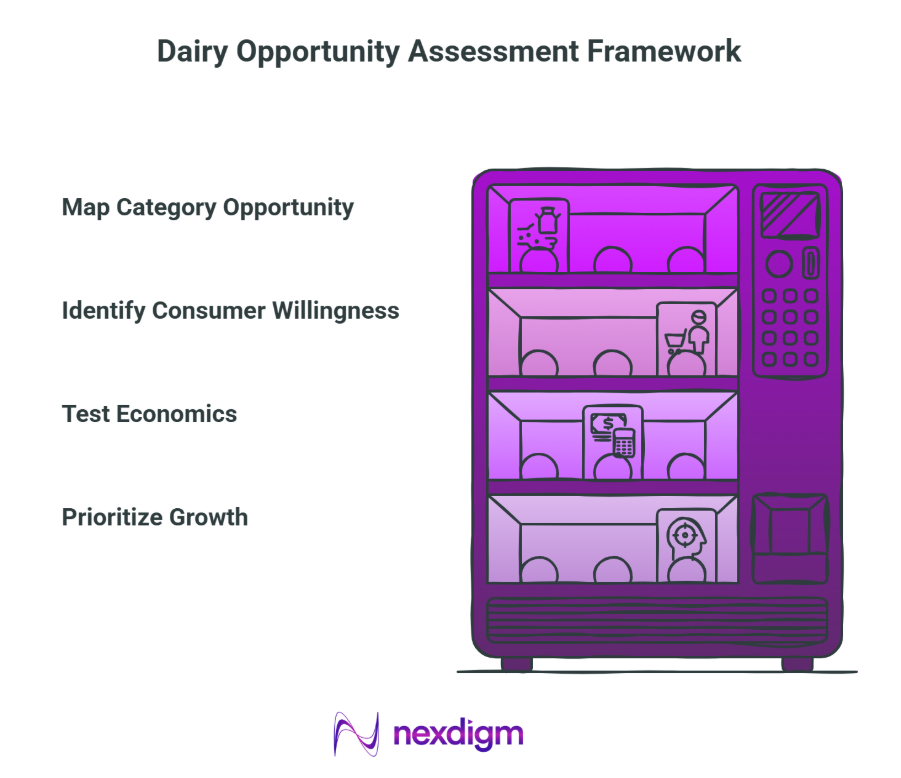
- Map the category opportunity
Begin with market sizing and segmentation across fluid milk, yogurt and cultured products, cheese, dairy beverages, desserts, butter and ghee, whey, and other value-added categories.
The analysis should establish historical growth, projected demand, household penetration, regional differences, and consumption frequency. - Identify the consumer willing to trade up
Primary research can identify the consumers driving incremental demand and the attributes they value.
For a protein-oriented dairy product, this could include nutritional content and convenience. For premium cheese, it may involve taste, provenance, format, or usage occasion. For dairy desserts, indulgence and ready-to-eat convenience may matter more. - Test the economics of the category
Demand alone does not establish attractiveness.
Nexdigm can assess pricing, margins, input requirements, processing costs, distribution economics, cold-chain requirements, and expected volume to determine whether a category can deliver commercially viable returns. - Prioritize the growth opportunity
The final assessment connects consumer demand with competitive intensity and execution feasibility.
This allows companies to identify whether the opportunity lies in expanding an existing portfolio, developing a new product line, entering an adjacent category, targeting a specific geography, or pursuing a partnership or acquisition.
Building Value from India’s Expanding Dairy Base
India’s dairy opportunity is increasingly defined by what happens after milk is produced. Stronger processing, organized procurement, cold-chain infrastructure, and consumer-led product innovation can determine how much value companies capture from the underlying volume growth.
For dairy manufacturers and investors, this makes category selection a strategic decision. The strongest opportunity may not necessarily be the largest dairy segment. It may be the category where consumer demand, pricing headroom, processing capability, and competitive whitespace converge.
Nexdigm’s Dairy Portfolio Assessment
A Nexdigm assessment of 5 dairy categories across 8 cities, using 3,200 consumer interviews, 45 competitor brands, and 120 SKU price points, identified protein yogurt and functional dairy beverages as priority segments after testing demand, willingness to pay, competition, and channel economics.
To take the next step, simply visit our Request a Consultation page and share your requirements with us.
Harsh Mittal
+91-8422857704