
India’s dairy market is entering a structural divergence. Liquid milk remains the largest source of dairy volume, but its growth is increasingly constrained by mature urban consumption, intense price competition, and the economics of daily chilled distribution. At the same time, value-added dairy products such as curd, paneer, cheese, fermented beverages, and frozen desserts are generating faster revenue growth and significantly higher margins.
The opportunity is therefore shifting from simply increasing milk volumes to deciding where those milk solids should create the greatest commercial value.
Liquid Milk Is Still the Volume Anchor, But Its Economics Are Tightening
Liquid milk provides predictable, recurring demand, but its economics leave limited room for margin expansion. Toned and full-cream pouch milk operate within a low-margin structure shaped by consumer price sensitivity, short shelf life, daily distribution requirements, and intense competition between organized and regional dairy players.
Processors need high plant utilization, efficient collection networks, reliable chilling infrastructure, and dense distribution routes to protect profitability.
Packaged curd, paneer, cheese, and fermented dairy products can command higher realizations because consumers are paying for convenience, processing, formulation, packaging, quality consistency, and brand differentiation.
The same litre of raw milk can therefore produce very different economics depending on how it is processed and where it is sold.
The Margin Pool Is Moving Toward Value-Added Products
The faster expansion of VADPs is being supported by several overlapping demand shifts. Urban households increasingly favour convenient formats, while modern trade, quick-commerce, QSRs, and organized foodservice are creating new routes to market.
Paneer benefits from both household consumption and institutional demand. Cheese has a stronger connection with QSRs, restaurants, and westernized food formats. Fermented products and packaged curd benefit from high consumption frequency and growing penetration of organized retail.
Shelf life also matters. Products such as ghee and certain processed cheeses allow processors to hold and move milk solids with considerably more flexibility than fresh liquid milk. This creates a strategic trade-off between volume, realization, shelf life, processing investment, and distribution complexity.
Procurement May Decide How Much of That Margin the Processor Keeps
Higher-margin products do not eliminate raw milk procurement risks. India’s fragmented supply networks and seasonal swings, from flush surpluses to lean price spikes, create severe cost volatility.
At the same time, high-value products and institutional buyers demand strict testing for adulteration, antibiotics, and fat content.
Direct farmer relationships, village-level collection, bulk milk coolers, and automated testing are essential to stabilize raw milk economics and quality.
Geography Determines the Cost of Turning Milk Into a Market
India’s major consumption centres do not always overlap with its strongest milk procurement basins. Large urban markets such as the NCR and Mumbai-Pune corridor create concentrated demand for packaged dairy products, while major procurement ecosystems extend across Gujarat, Maharashtra, Karnataka, Punjab, and other dairy-producing regions.
For liquid milk, the resulting distance is particularly important because the product must move rapidly through a chilled network. Value-added products provide more flexibility, allowing processors to transport products over longer distances and balance regional milk surpluses against consumption centres.
The location of processing capacity therefore becomes part of the product strategy itself.
Foodservice Is Creating a Different Kind of Dairy Demand
The expansion of QSRs, hotels, restaurants, institutional kitchens, and organized foodservice is creating demand for products that are different from household dairy consumption.
Mozzarella, processed cheese, paneer, butter, cream, and other dairy ingredients increasingly require consistent specifications, predictable supply, standardized packaging, and reliable delivery.
For processors, institutional demand can provide larger contracted volumes while also encouraging investment in specialized processing and packaging capabilities.
The resulting opportunity is not simply about selling more dairy. It is about building a product portfolio around distinct consumption occasions and channels.
Where to Allocate Processing Capacity
A meaningful dairy sector demand analysis therefore needs to connect category growth with milk procurement, conversion economics, processing utilization, channel realization, cold-chain requirements, and geographic demand.
The critical decision is which products should absorb incremental milk volumes, which markets justify additional processing capacity, and where procurement and distribution economics can support those investments.
Nexdigm’s Dairy Product-Channel Prioritization Framework
Nexdigm evaluates dairy growth opportunities by connecting product economics with the underlying supply and distribution structure:
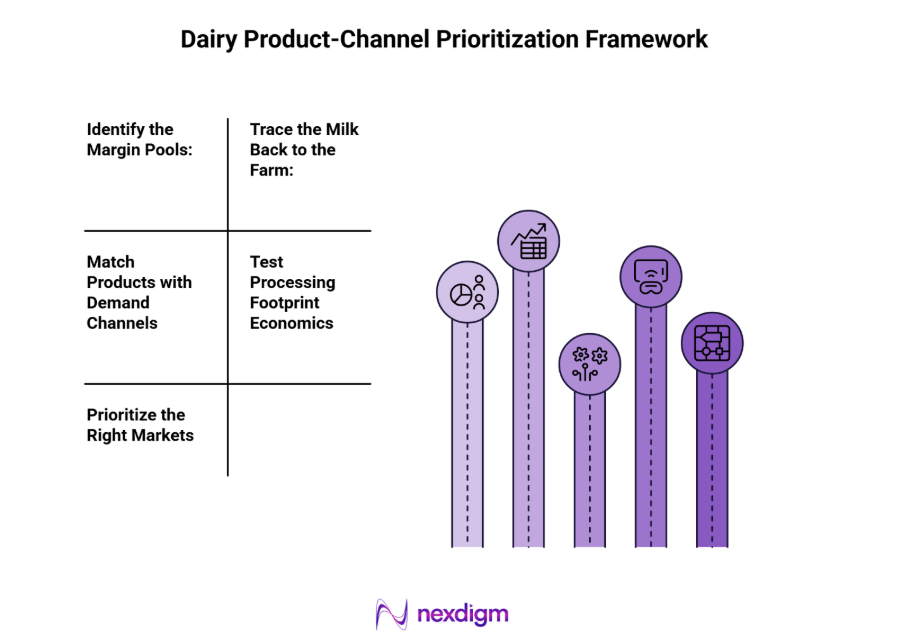
- Identify the Margin Pools: Compare liquid milk and VADP categories on growth, realization, processing requirements, shelf life, competitive intensity, and margin potential to identify where incremental milk volumes can generate greater value.
- Trace the Milk Back to the Farm: Map procurement basins, seasonal availability, farmer connectivity, chilling infrastructure, milk quality, and procurement costs to determine where supply reliability can support processing expansion.
- Match Products with Demand Channels: Assess household consumption, modern trade, quick-commerce, HoReCa, QSR, institutional, and export demand to identify the right product-channel combinations and volume pools.
- Test Processing Footprint Economics: Evaluate plant utilization, conversion yields, packaging requirements, cold-chain investment, transportation distance, and inventory requirements before committing capital to new capacity.
- Prioritize the Right Markets: Overlay consumption density, procurement availability, competitive intensity, logistics economics, and channel growth to identify the geographies where product expansion can generate sustainable returns.
Nexdigm’s Dairy Processing Footprint Optimization
A regional private dairy in Western Maharashtra processing 500,000 litres per day faced significant margin erosion, with EBITDA declining to 2.1% amid rising raw milk procurement costs and intense competition in liquid pouch milk.
Nexdigm restructured the company’s product mix, diverting 180,000 LPD of raw milk from low-margin liquid pouches into automated vacuum-packed paneer and block mozzarella production. The engagement also included the installation of 45 direct Bulk Milk Coolers across rural collection centres to reduce dependence on local vendor networks.
Within 18 months, blended EBITDA margin improved by 410 basis points to 6.2%. Procurement-testing rejections declined by 78%, while inventory spoilage fell to below 0.8% of gross output.
To take the next step, simply visit our Request a Consultation page and share your requirements with us.
Harsh Mittal
+91-8422857704