

Dairy market entry is governed by an uncomfortable combination of high daily demand and extremely limited product flexibility. Liquid milk can generate substantial volumes, but its short shelf life and refrigeration requirements can make distribution expensive. Value-added products offer better shelf life and potentially higher margins, but require different processing capabilities, consumer positioning, and route-to-market infrastructure.
A new entrant therefore needs to design the product portfolio and supply chain together.
Start With Where Consumption and Supply Actually Sit
The source material places India’s national milk availability at 471 grams per person per day, while highlighting substantial regional differences.
Northern markets including Punjab, Haryana, and Rajasthan are described as high-consumption markets, with availability exceeding 800–1,100 grams per day. Western and southern markets such as Gujarat, Maharashtra, Karnataka, and Tamil Nadu show strong demand for packaged curd, buttermilk, and dairy fats. Eastern markets, including West Bengal, Bihar, Odisha, and the Northeast, are described as relatively lower-consumption markets where packaged UHT and value-added products may offer a route to wider distribution.
These differences affect both sourcing and product selection. A market with strong raw-milk availability does not automatically have the same economics as a market with high consumer demand.
The Product Mix Determines the Margin Pool
Liquid pouch milk provides velocity and immediate consumption but carries estimated gross margins of only 4%–8% in the source material. Curd, yogurt, and buttermilk move into the 16%–24% range, while paneer and fresh cheese are estimated at 20%–28%.
Ghee and butterfat offer another strategic advantage because their 6–12-month shelf life allows processors to convert seasonal milk-fat surpluses into inventory. High-protein and UHT functional dairy products can provide even longer shelf life and estimated gross margins of 28%–38%, although they require greater consumer education and brand investment.
The question for an entrant is therefore how much volume should be anchored in liquid milk and how much processing capacity should be directed toward products that provide greater shelf-life flexibility.
Cold Chain Economics Begin at the Collection Point
Raw milk procurement requires more than a processing plant. The source proposes a two-tier collection structure in which Village Level Collection Centres feed Bulk Milk Coolers within a 20–30-km radius before milk is transported to processing facilities.
The plant model also needs to be tested against the scale of market entry. A modern 200,000-litre-per-day multi-product facility is estimated in the source at ₹80–₹120 crore in capital expenditure. During initial market testing, co-packing or third-party processing can offer a lower-commitment alternative.
The correct choice depends on expected throughput, procurement density, product mix, and the time required to build distribution.
Nexdigm’s Dairy Market Entry Framework
Nexdigm can structure dairy sector market entry consulting around five linked dimensions:
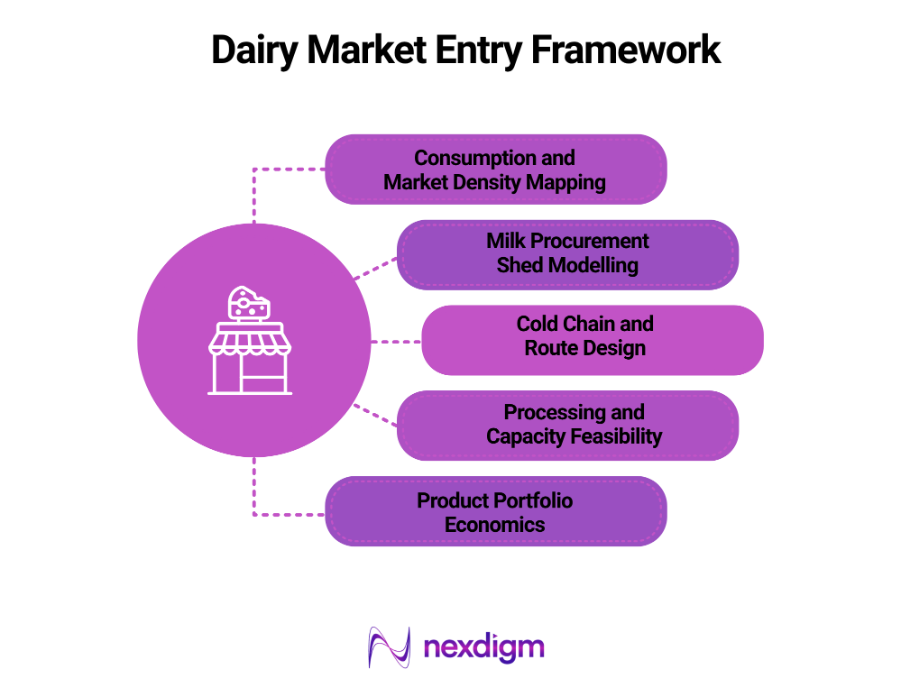
- Consumption and Market Density Mapping: Consumption levels, urban concentration, category preferences, retail formats, food-service demand, and competitive intensity are assessed to identify priority markets and product categories.
- Milk Procurement Shed Modelling: Cow and buffalo population density, collection radius, milk availability, seasonal supply, collection-centre requirements, and transportation costs are modelled to determine whether a viable procurement base can support the proposed operation.
- Product Portfolio Economics: Liquid milk, curd, yogurt, paneer, ghee, butterfat, UHT, and functional dairy products are compared on margin, shelf life, processing requirements, working capital, and distribution complexity.
- Cold Chain and Route Design: Chilling infrastructure, reefer capacity, distributor storage, route density, temperature compliance, and last-mile delivery requirements are evaluated to identify where perishability could erode margins.
- Processing and Capacity Feasibility: Greenfield, co-packing, leasing, and phased investment models are compared against expected throughput, utilisation, capital expenditure, and market ramp-up requirements.
Nexdigm Case Study: Cold Chain Distribution Assessment
Nexdigm evaluated regional dairy distribution networks for temperature compliance, route density, and product degradation risks. The resulting distribution design delivered a 22% improvement in delivery consistency while protecting product shelf life, demonstrating how cold-chain optimisation can strengthen dairy market expansion and distribution performance.
To take the next step, simply visit our Request a Consultation page and share your requirements with us.
Harsh Mittal
+91-8422857704