

Dairy supply chains operate under conditions that leave little room for weak handling practices. Milk is perishable, collection volumes fluctuate, processing requires strict hygiene controls, and temperature management must continue through storage and distribution. A supplier’s ability to deliver consistently depends on several linked activities, from procurement at the farm gate to processing and final dispatch.
For manufacturers using milk, cream, butter, cheese, whey or milk powder, supplier resilience has direct implications for production planning and product quality. A disruption at the collection or chilling stage can affect downstream processing even when the supplier’s factory has sufficient installed capacity.
India’s Milk Supply Is Large, but Highly Distributed
India produced approximately 247.87 million tonnes of milk in 2024–25, compared with 239.30 million tonnes in the previous year. The increase was around 3.6%. The country’s milk production base is geographically distributed, with Uttar Pradesh contributing approximately 38.82 million tonnes and Rajasthan 36.74 million tonnes in 2024–25.
This scale creates a broad supplier ecosystem, but national production figures do not automatically indicate that a particular manufacturer can access dependable supply in its operating region. Collection infrastructure, chilling capacity, processing facilities and transport distances influence how much milk can reach a buyer at the required quality and cost.
As of February 2026, 117,928 food businesses held FSSAI licences or registration certificates under the manufacturer category for milk and milk products. The number illustrates the scale of the formal manufacturing ecosystem, while also making supplier comparison more important.
Where Dairy Supplier Risk Develops
Milk Collection and Adulteration Controls
Milk quality can be affected before it reaches a processing facility. Collection practices, testing at procurement points, storage time and handling conditions influence the quality of incoming milk.
FSSAI data for FY2024–25 recorded 33,405 milk and milk-product samples analysed, with 12,780 found non-conforming. These findings include different types of non-conformity and should not be interpreted as the proportion of dairy suppliers failing compliance. They do, however, underline the importance of validated testing and supplier-level quality controls.
Chilling Infrastructure and Temperature Management
The time between collection and chilling is a significant operational consideration. Suppliers should be assessed on the location and capacity of bulk milk coolers, chilling centres, insulated transport and processing facilities.
A supplier operating across a wide collection area may face greater temperature-control challenges than one sourcing from a compact network. The assessment should therefore consider the actual geography of milk collection rather than relying only on the supplier’s stated processing capacity.
Processing Capacity and Equipment Reliability
Processing facilities need to maintain consistent output while meeting product-specific standards. Manufacturers should examine installed capacity, utilisation, maintenance practices, laboratory facilities and the supplier’s ability to accommodate changes in demand.
The distinction between raw milk availability and usable processing capacity matters. A region may produce large volumes of milk but lack the infrastructure required to convert it into the specific ingredient or product a buyer needs.
Delivery and Geographic Exposure
Dairy products have different shelf lives and handling requirements. Liquid milk, chilled cream, cheese and milk powder cannot be assessed using identical logistics criteria. Delivery frequency, route length, refrigeration, packaging integrity and distribution coverage should be evaluated according to product type.
Dairy Compliance Requires More Than a Valid Licence
A supplier’s regulatory standing is an important starting point, but manufacturers also need to examine operating records. These may include raw milk testing, microbiological results, cleaning schedules, equipment maintenance, batch traceability and corrective-action reports.
The wider enforcement environment reinforces this need. FSSAI carried out 26,267 risk-based inspections in FY2024–25, compared with 18,098 in FY2023–24. Higher-risk food businesses receive more focused regulatory attention, making documentation and operational discipline relevant considerations during supplier evaluation.
Nexdigm’s Approach to Dairy Supplier Risk Assessment
A dairy supplier compliance and risk consulting engagement can examine the supplier ecosystem across production regions, collection networks, processing capacity and distribution infrastructure. Nexdigm’s market assessment capabilities can help businesses compare dairy-producing regions, identify supplier concentration and understand differences in infrastructure and operating conditions.
For a manufacturer planning to expand its dairy portfolio, this research can also help identify regions where production volumes are supported by suitable processing and logistics infrastructure.
Dairy Supplier Resilience and Food Safety Assessment Framework
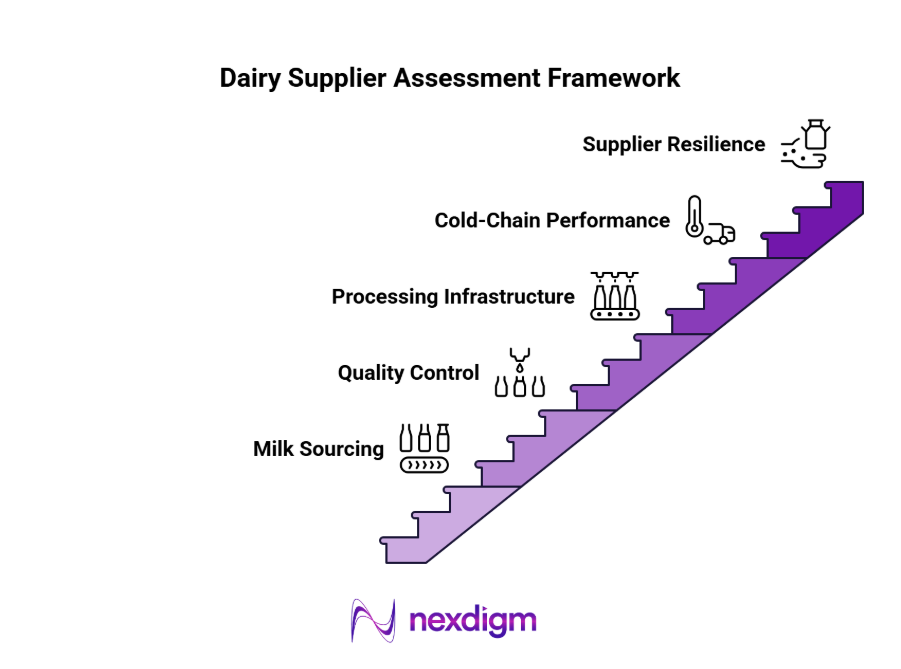
- Milk Sourcing Assessment: Map collection networks, production regions and dependence on individual supply clusters.
- Quality Control Evaluation: Examine raw milk testing, adulteration detection, laboratory procedures and quality consistency.
- Processing Infrastructure Review: Assess chilling facilities, processing capacity, equipment reliability and plant utilisation.
- Cold-Chain Performance Assessment: Evaluate storage conditions, refrigerated transport, delivery frequency and temperature controls.
- Supplier Resilience Classification: Rank suppliers according to food safety compliance, infrastructure readiness and continuity of supply.
The framework helps management distinguish between a production-rich region and a commercially accessible supply market. It also identifies where additional suppliers, or infrastructure may be required before expanding procurement volumes.
Nexdigm’s Case Study
A dairy ingredients manufacturer assessed 26 suppliers across 5 states, covering raw milk, cream and milk powder. The review identified 6 vendors with material gaps in chilling infrastructure or quality documentation. The client added 4 alternate suppliers and increased qualified regional supply coverage from 68% to 89%.
To take the next step, simply visit our Request a Consultation page and share your requirements with us.
Harsh Mittal
+91-8422857704