

Dairy procurement depends on more than the availability of milk. Buyers must assess fat and solids content, microbiological quality, processing capability, chilling infrastructure, packaging formats, and delivery frequency. Requirements differ between liquid milk, cream, butter, cheese, milk powder, and specialised dairy ingredients.
Supplier identification should therefore connect production geography with processing capacity, quality controls, and the economics of delivering a perishable product.
Map Production and Processing
India produced 247.87 million tonnes of milk in 2024-25, up 3.58% from the previous year, according to the Department of Animal Husbandry and Dairying. Uttar Pradesh accounted for 15.66% of output and Rajasthan 14.82%, making state-level production data a useful starting point for mapping supplier markets.
However, high milk production does not automatically mean a location can supply every dairy product competitively. Buyers should distinguish milk-producing regions from areas with the required chilling, processing, packaging, and distribution infrastructure.
Verify Product Capability
Dairy suppliers differ in their product portfolios, plant capacity, collection networks, and ability to maintain specifications across batches. A liquid milk supplier may not have the same capabilities as a cheese producer or a manufacturer of specialised ingredients.
For dairy supplier identification consulting services, screening should include product specifications, plant locations, processing capacity, quality systems, cold-chain arrangements, certifications, and customer requirements. Buyers should also verify whether quoted volumes represent available capacity or total installed capacity already committed to other customers.
Compare Delivered Economics
Dairy costs can vary with seasonal milk availability, fat and solids content, processing yield, packaging, energy, refrigeration, and transport distance. The relevant comparison is the cost of an accepted product at the receiving facility, not simply the price at the farm gate or factory.
Lead time is especially important for chilled products. Buyers should assess transit duration, temperature monitoring, delivery schedules, shelf life on arrival, and procedures for rejected or temperature-abused consignments.
Dairy Supplier Market Assessment Framework
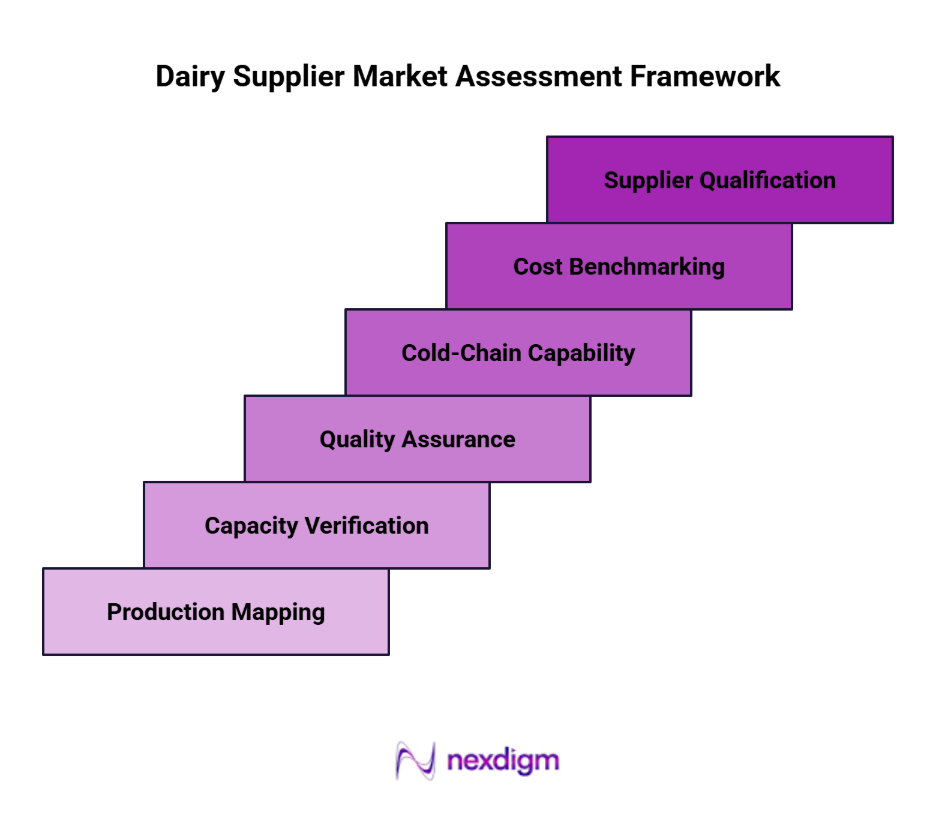
- Production Mapping: Identify major milk-producing regions, collection networks, processing clusters, and suppliers capable of meeting the required product specifications.
- Capacity Verification: Confirm available production volumes, plant utilisation, processing lines, packaging formats, and the ability to support forecast demand consistently.
- Quality Assurance: Review testing protocols, batch records, hygiene controls, traceability, relevant licences, and quality parameters specific to the dairy product.
- Cold-Chain Capability: Assess chilling, refrigerated storage, transport conditions, temperature records, delivery frequency, and contingency arrangements for equipment or transport failures.
- Cost Benchmarking: Compare product composition, processing yield, packaging, freight, payment terms, and wastage to establish the true delivered cost.
- Supplier Qualification: Validate samples, documentation, production capacity, and delivery performance before approving a supplier for regular procurement.
Match the Supplier to the Product
Dairy sourcing should be segmented by product and service requirement. A supplier with a strong regional collection network may suit fresh milk, while a specialised processor may be better positioned for cheese or ingredient applications. The final shortlist should reflect product fit, dependable supply, and landed economics.
Nexdigm’s Case Study
A food manufacturer sourcing 18,000 litres of milk daily assessed four suppliers across two procurement regions. Testing and freight comparisons revealed differences in usable solids and delivered cost. A revised allocation across three qualified suppliers lowered the average procurement cost by 3.6% while maintaining the agreed quality specifications.
To take the next step, simply visit our Request a Consultation page and share your requirements with us.
Harsh Mittal
+91-8422857704