

Data centre infrastructure decisions have become more complex as organisations expand cloud environments, deploy AI workloads and manage increasingly demanding storage and computing requirements. Hardware that performs adequately in a smaller facility may become a constraint when workloads grow, power density increases or uptime requirements become more stringent. Selecting a vendor therefore requires more than comparing server specifications or negotiating equipment prices. It involves assessing how well an entire hardware portfolio supports long-term infrastructure performance.
Infrastructure Requirements Are Changing
Traditional data centre procurement often prioritised computing capacity, storage availability and network performance. These remain essential, but infrastructure planning now involves additional considerations. AI workloads, for example, can place substantial demands on accelerators, memory, high-speed networking and cooling systems. Organisations must assess whether their hardware suppliers can support these requirements without creating excessive energy consumption or operational complexity.
Power availability is another critical concern. The International Energy Agency has estimated that global data centre electricity consumption could reach approximately 945 TWh by 2030, reflecting the growing demand associated with digital services and AI. Although this is a projection rather than a guaranteed outcome, it illustrates why energy efficiency must form part of infrastructure procurement decisions.
Reliability also needs to be evaluated beyond individual component specifications. A server may offer redundant power supplies, but the wider environment still depends on network resilience, storage architecture, backup power, maintenance processes and the availability of replacement components.
What Organisations Should Compare Across Hardware Vendors
Vendor selection should begin with the workloads the infrastructure is expected to support. A business operating transaction-intensive applications will have different requirements from an organisation building an AI training environment or expanding its cloud storage capacity.
Several areas deserve particular attention:
- Compute performance: Assess processor options, accelerator compatibility, memory capacity, workload performance and support for virtualised environments.
- Storage architecture: Compare capacity, throughput, latency, data protection, scalability and compatibility with existing storage platforms.
- Networking capabilities: Evaluate bandwidth, switching performance, network security, interoperability and support for high-density environments.
- Power and cooling: Examine power efficiency, thermal management, rack density and compatibility with facility-level infrastructure.
- Reliability and service: Review component redundancy, warranty coverage, maintenance availability, replacement timelines and technical support.
The comparison should also distinguish between vendors that provide integrated infrastructure solutions and those that specialise in individual hardware categories. Integrated portfolios can simplify procurement and support, but they may introduce greater dependency on one supplier. Specialist vendors may offer stronger capabilities in particular areas while requiring more coordination across the technology stack.
Reliability Requires Evidence Beyond Specifications
Hardware reliability is often presented through product specifications, service commitments and warranty terms. Procurement teams should examine how these claims translate into operational performance.
Useful evidence includes failure rates, firmware update practices, compatibility testing, support escalation procedures and the availability of spare parts. Organisations operating across multiple regions should also evaluate whether the vendor can provide consistent service coverage across all locations.
Uptime Institute’s 2025 Resiliency Survey identified networking and connectivity issues as the most commonly reported cause of IT service outages affecting respondents over the preceding three years, followed by IT system or software issues and power problems. This reinforces the need to evaluate infrastructure as an interconnected environment. Purchasing reliable servers alone cannot compensate for weaknesses in networking, power distribution or operational procedures.
Vendor assessment should therefore examine how equipment behaves within the organisation’s existing architecture, including its compatibility with monitoring systems, orchestration tools, backup infrastructure and disaster recovery arrangements.
Evaluating Lifecycle Cost and Supplier Resilience
Initial purchase price is an incomplete measure of hardware value. Equipment can carry substantial costs after installation through energy consumption, maintenance, software licensing, cooling requirements, upgrades and eventual replacement.
A more useful comparison considers total cost of ownership across the expected operating period. Procurement teams should examine power consumption under realistic workloads, warranty extensions, maintenance costs, upgrade flexibility and the availability of compatible components.
Supplier resilience is equally important. Organisations should assess manufacturing capacity, component sourcing arrangements, regional service networks and the vendor’s ability to respond to supply disruptions. Long lead times for critical hardware can delay data centre expansion and create operational bottlenecks.
Contract terms also deserve attention. Price protection, delivery commitments, service-level agreements, spare-parts availability and end-of-life notifications can influence the long-term value of a hardware relationship.
How Nexdigm Supports Data Centre Hardware Procurement
Selecting infrastructure vendors requires an understanding of both the technology landscape and the commercial conditions shaping supplier performance. Nexdigm supports organisations through market research, supplier intelligence, competitive benchmarking and procurement analysis. Its research can help clients assess hardware vendor capabilities, compare commercial propositions, understand supply-side risks and identify suppliers aligned with their infrastructure requirements.
Data Centre Hardware Vendor Evaluation Framework
A structured assessment can be organised around five stages:
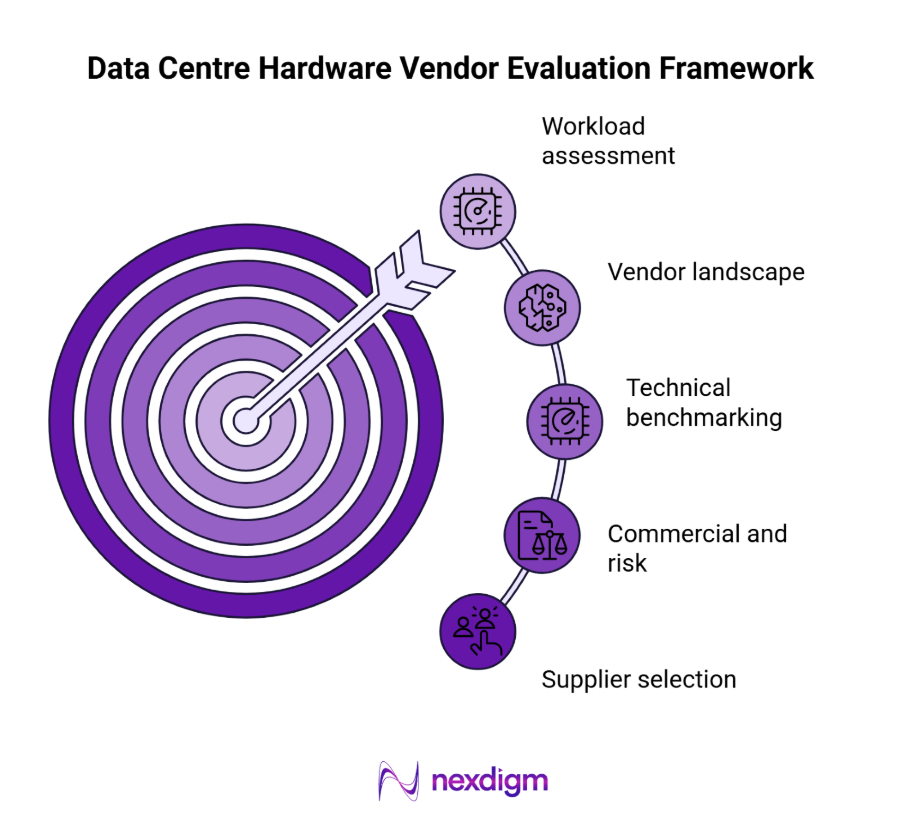
- Workload and capacity assessment: Define compute, storage, networking, power and cooling requirements based on current and projected demand.
- Vendor landscape mapping: Identify established suppliers and specialised providers across relevant hardware categories.
- Technical benchmarking: Compare performance, interoperability, scalability, reliability and energy efficiency.
- Commercial and risk evaluation: Assess total cost of ownership, service coverage, supply continuity, warranties and contractual commitments.
- Supplier selection: Prioritise vendors based on technical suitability, lifecycle economics and long-term support capabilities.
A data center hardware vendor comparison helps organisations understand which suppliers can meet current operational requirements while supporting future expansion. The evaluation should consider servers, storage systems, networking equipment, power infrastructure, cooling technologies and the vendor’s ability to support these components throughout their lifecycle.
Nexdigm’s Case Study: Improving Data Centre Hardware Supplier Selection
Nexdigm’s assessment of 12 hardware suppliers across four infrastructure categories identified three priority vendors, compared lifecycle costs across five years and evaluated 18 technical and commercial criteria to support a more resilient procurement strategy.
To take the next step, simply visit our Request a Consultation page and share your requirements with us.
Harsh Mittal
+91-8422857704