
Data centres are under increasing pressure to support higher computing demand, more intensive workloads and stricter availability requirements. For enterprises planning new facilities, expanding existing capacity or reviewing infrastructure suppliers, procurement decisions now involve more than comparing server and equipment specifications. Power availability, cooling efficiency, network performance, physical security and operational resilience all influence the long-term suitability of a data centre solution.
The scale of the challenge is visible in the energy requirements of the sector. According to the International Energy Agency, data centres consumed approximately 415 TWh of electricity in 2024, representing around 1.5% of global electricity consumption. Its analysis projects that this demand could more than double to approximately 945 TWh by 2030. These figures make power infrastructure and energy efficiency central considerations in data centre procurement.
A structured data center infrastructure supplier analysis helps enterprises compare suppliers across critical infrastructure categories, assess technical capability and understand the commercial implications of different solutions.
Power Infrastructure: Availability, Capacity and Efficiency
Power infrastructure is one of the most consequential components of data centre design. Supplier selection should account for the entire power chain, from utility connections and switchgear to uninterruptible power supply systems, generators and power distribution units.
The assessment should examine available electrical capacity and scalability, UPS architecture and redundancy, battery technology, generator capability, fuel arrangements, power distribution efficiency and monitoring. Maintenance requirements and replacement cycles should also be considered.
Resilience deserves particular attention. Uptime Institute’s 2024 Global Data Center Survey reported that power issues accounted for 54% of impactful outages reported by respondents. Cooling accounted for another 13%. The findings underline why infrastructure procurement should evaluate reliability and failure response, not simply equipment specifications.
Cooling Systems and Thermal Management
As computing density increases, cooling requirements become more demanding. Conventional air-based systems may be appropriate for some facilities, while higher-density environments may require advanced cooling configurations, including liquid cooling.
Supplier comparisons should consider cooling capacity, energy consumption, temperature control, redundancy, maintenance access and compatibility with existing infrastructure.
Procurement teams should also examine the operating conditions under which performance claims are measured. A cooling system’s efficiency depends on facility design, climate, workload density and operating practices.
Metrics such as Power Usage Effectiveness (PUE) can help assess overall facility energy performance. PUE is calculated by dividing total data centre energy consumption by the energy used by IT equipment. It is useful for benchmarking, but should be interpreted alongside workload density, climate and the facility’s design.
Network Infrastructure and Connectivity
Network infrastructure determines how effectively data moves within the facility and between users, applications and external systems.
Supplier assessment should cover switching and routing equipment, bandwidth, latency, redundancy, connectivity options and network management capabilities.
Enterprises should consider whether suppliers can support high-throughput workloads and east-west traffic, redundant network paths and diverse connectivity, integration with cloud and colocation environments, network segmentation and access control, and monitoring and capacity expansion.
Network performance should be assessed against actual application requirements. A solution designed for general enterprise workloads may not be suitable for high-performance computing, real-time analytics or other latency-sensitive applications.
Physical Security and Infrastructure Protection
Data centre security involves multiple layers of protection. These include perimeter controls, access management, surveillance, visitor procedures, fire detection, fire suppression and environmental monitoring.
Procurement teams should evaluate supplier security standards, incident response procedures, audit arrangements and the responsibilities assigned to facility operators and customers.
For enterprises handling sensitive information, security assessments should also cover access logging, equipment handling, asset disposal and the protection of network infrastructure.
Supplier certifications can support due diligence, but they should not replace an assessment of actual facility controls and contractual responsibilities.
Resilience, Maintenance and Lifecycle Costs
Infrastructure resilience depends on how equipment performs during normal operations and how quickly services can recover when something fails.
Redundancy configurations, maintenance procedures, spare parts availability, service response times and disaster recovery arrangements should all form part of supplier evaluation.
Commercial comparisons should extend beyond purchase price. Data centre infrastructure involves installation, commissioning, energy consumption, maintenance, software licensing, replacement and eventual decommissioning.
A supplier offering lower initial equipment costs may create higher lifecycle expenditure through energy requirements, maintenance complexity or limited upgrade flexibility.
Data Center Infrastructure Supplier Evaluation Framework
Use this assessment to compare suppliers across the full infrastructure lifecycle:
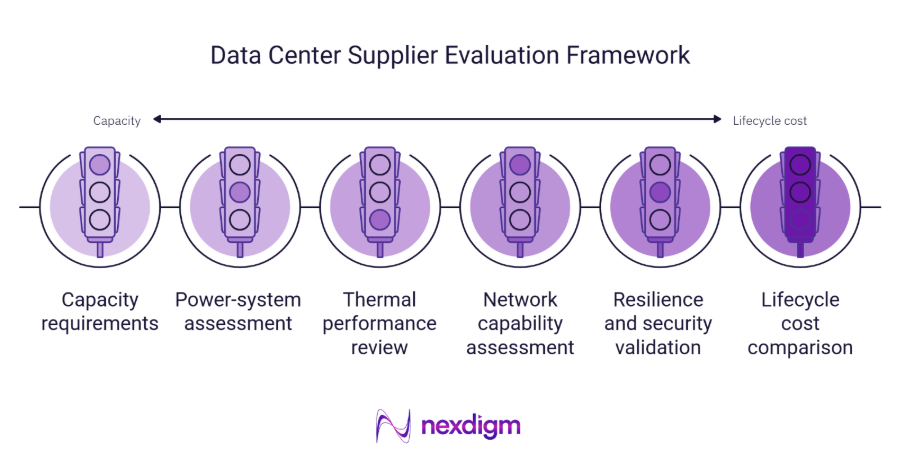
- Capacity requirements: Establish present and projected power density, IT load, rack capacity and expansion needs.
- Power-system assessment: Compare utility interfaces, UPS, generators, distribution architecture and redundancy.
- Thermal performance review: Evaluate cooling technology, energy efficiency, monitoring and suitability for expected rack densities.
- Network capability assessment: Examine bandwidth, latency, connectivity diversity, scalability and security integration.
- Resilience and security validation: Review redundancy, maintenance support, physical controls, incident response and recovery arrangements.
- Lifecycle cost comparison: Model acquisition, installation, energy, maintenance, upgrades and replacement costs.
Nexdigm can support organisations through data centre market research, infrastructure supplier benchmarking, technical capability mapping and procurement intelligence. This helps enterprise buyers compare equipment and service providers, assess market alternatives and make more informed infrastructure sourcing decisions.
Nexdigm’s Case Study: Comparing Data Centre Infrastructure Suppliers
Nexdigm assessed 13 infrastructure suppliers across 5 categories, comparing power, cooling, networking, security and resilience. The study identified a 20% variation in comparable equipment and service costs, shortlisted 4 suppliers and established 8 technical and commercial benchmarks.
To take the next step, simply visit our Request a Consultation page and share your requirements with us.
Harsh Mittal
+91-8422857704