

Data centers have become critical infrastructure for banks, insurers, and financial services companies as digital transactions, cloud adoption, and real-time processing expand. India’s data center market is growing rapidly: latest research reported that operational capacity across the country’s top seven markets reached 1,789 MW in H1 2026, with another 3,860 MW of capacity in the development pipeline through 2030.
This expansion increases the importance of evaluating infrastructure procurement beyond headline colocation rates. Power tariffs, connectivity charges, cooling requirements, redundancy, and technical support can significantly influence total operating expenditure.
Through data center procurement benchmarking services BFSI organizations can compare supplier pricing, assess infrastructure costs, and identify opportunities to improve commercial value while maintaining reliability and regulatory alignment.
The Economics Behind Data Center Procurement
Data center expenditure extends across facility space, power consumption, network connectivity, cooling, equipment, and operational support. Pricing varies with location, rack density, power capacity, uptime commitments, and contract duration. For BFSI organizations, comparing these components individually can obscure the total cost of ownership. A consolidated assessment helps reveal cost differences and understand the commercial implications of infrastructure choices.
Areas That Influence Data Center Sourcing
Procurement teams should evaluate infrastructure arrangements across three connected areas:
- Facility and Colocation Costs: Compare rack charges, space allocation, power capacity, cross-connect fees, and installation costs across facilities.
- Power and Connectivity: Assess electricity tariffs, power usage effectiveness, bandwidth pricing, network redundancy, and connectivity options to understand recurring infrastructure expenditure.
- Technical Support and Resilience: Evaluate maintenance coverage, uptime commitments, disaster recovery provisions, response times, and support arrangements to assess service reliability.
Considering these factors together provides a more complete view of infrastructure value and supplier competitiveness.
Nexdigm’s Role in Assessing Data Center Sourcing and Pricing Structures
Data center agreements often include multiple pricing components and contractual commitments that influence long-term procurement expenditure. Nexdigm can help BFSI organizations examine these arrangements to understand their commercial implications:
- Pricing Model Assessment: Compare fixed, consumption-based, and capacity-linked pricing structures to understand their suitability across different infrastructure requirements.
- Contract Term Evaluation: Review contract duration, renewal conditions, price escalation provisions, capacity commitments, and exit-related charges to assess commercial flexibility.
- Service Commitment Analysis: Examine uptime guarantees, maintenance obligations, response commitments, and service credits to understand the value attached to provider agreements.
Through this assessment, Nexdigm can help institutions improve contract visibility, identify potential commercial constraints, and make more informed data center procurement decisions.
Nexdigm’s Intelligence for Anticipating Data Center Market Developments
Data center procurement decisions must account for changes in infrastructure demand, technology adoption, and provider investment. Nexdigm can help BFSI organizations monitor these developments to understand:
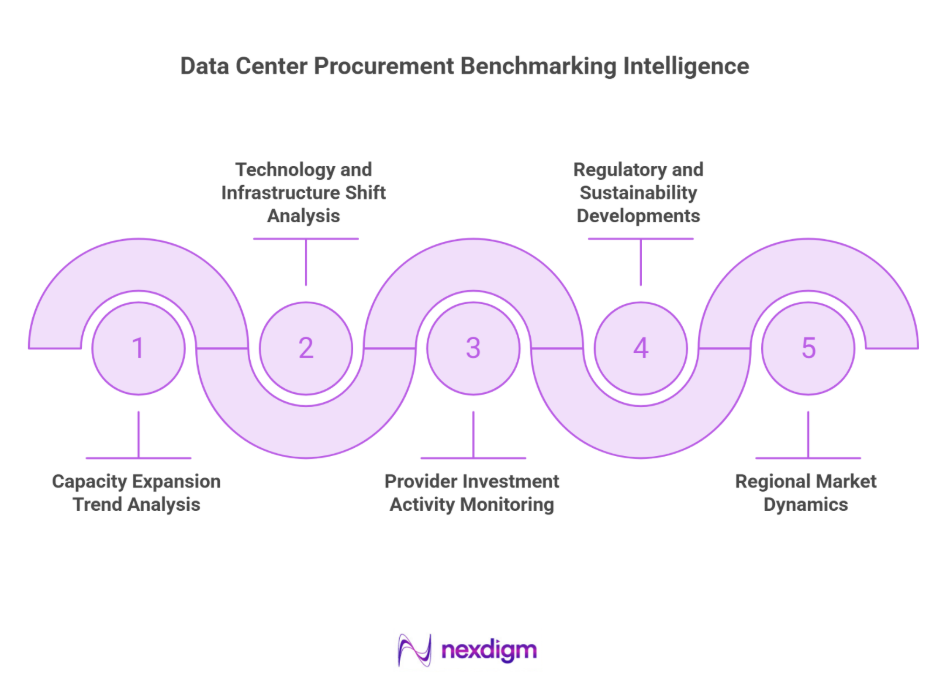
- Capacity Expansion Trends: Track planned facilities, infrastructure investments, and capacity additions to understand where future data center availability may emerge.
- Technology and Infrastructure Shifts: Examine developments in cooling systems, power efficiency, automation, and high-density computing that may influence infrastructure requirements.
- Provider Investment Activity: Monitor supplier expansion plans, strategic partnerships, and market positioning to understand changes in provider capabilities and competitive dynamics.
- Regulatory and Sustainability Developments: Examine changes in data protection requirements, energy efficiency standards, and sustainability expectations that may influence data center selection and operating costs.
- Regional Market Dynamics: Assess differences in infrastructure availability, power access, connectivity ecosystems, and local market conditions to support location-related sourcing decisions.
Through Nexdigm’s data center procurement benchmarking services BFSI organizations can also connect market developments with supplier comparisons and longer-term procurement priorities.
Nexdigm’s Support in Converting Intelligence Into Procurement Priorities
Benchmarking creates value when market insights inform practical procurement decisions. Nexdigm can help BFSI organizations and support procurement teams in prioritizing initiatives based on potential commercial benefits, such as:
- Prioritizing Cost Improvement Areas: Identify infrastructure and service components where benchmark findings indicate scope for cost review or greater pricing transparency.
- Evaluating Supplier Alternatives: Use market intelligence to assess whether existing providers remain commercially competitive or whether alternative sourcing options warrant consideration.
- Informing Procurement Planning: Translate findings into priorities for contract reviews, capacity planning, supplier diversification, and future infrastructure requirements.
- Supporting Internal Decision-Making: Present structured market and cost insights to help procurement, technology, finance, and risk teams evaluate sourcing options against organizational requirements.
By connecting benchmarking insights with procurement priorities, Nexdigm can help institutions move beyond cost comparisons toward more informed, commercially grounded infrastructure decisions.
Nexdigm’s Case
A BFSI institution engaged Nexdigm to evaluate data center costs, supplier pricing, and contractual commitments. The assessment identified 13% potential reduction in infrastructure procurement costs, 12% improvement in contract-related cost efficiency, and 15% potential savings through supplier and service optimization. These insights helped prioritize commercial negotiations, improve cost control, and strengthen procurement value.
To take the next step, simply visit our Request a Consultation page and share your requirements with us.
Harsh Mittal
+91-8422857704