

The most suitable data centre provider for a BFSI organisation is one that can support its required availability, security, regulatory obligations and recovery architecture at a commercially sustainable cost. Facility size and headline uptime commitments are insufficient measures on their own. Financial institutions need to understand how a provider manages power, cooling, connectivity, physical security, data handling and service continuity.
The choice also depends on the workload. A bank hosting critical transaction system may have different requirements from an insurer running analytics applications or a fintech company using cloud infrastructure. Provider evaluation should therefore begin with workload criticality and recovery needs before moving into facility comparisons.
Availability Depends on the Entire Infrastructure Environment
Data centre availability is shaped by several interconnected systems. Power supply, backup generation, cooling, network connectivity, physical access and facility monitoring all contribute to continuity.
A facility may have redundant power infrastructure but still experience disruption through network failures or maintenance issues. Similarly, a provider may advertise high availability while relying on external connectivity partners that introduce additional dependencies.
BFSI buyers should examine power architecture, backup arrangements, cooling redundancy, network carrier diversity and maintenance procedures. They should also understand how planned maintenance is communicated and whether service commitments apply to the entire service or only specific infrastructure components.
The location of the facility matters as well. Institutions should consider exposure to regional power constraints, flooding, seismic activity, water availability and other environmental risks. A geographically separate recovery site may provide limited protection if both facilities depend on the same regional infrastructure.
Security and Regulatory Requirements Shape Provider Suitability
Financial data centres must support strong physical and digital security. Physical controls include access management, surveillance, visitor procedures and protection of critical equipment. Digital security considerations include network segmentation, monitoring, incident response and access governance.
The institution should also understand the provider’s responsibilities for data protection, backup, retention and access by subcontractors. Where cloud or colocation services are involved, the division of responsibility between the customer and infrastructure provider must be clearly established.
Regulatory expectations vary according to the type of financial institution and the service being hosted. Providers should be able to supply relevant documentation and support the institution’s audit, reporting and oversight requirements. Buyers should not assume that a facility’s certification automatically establishes compliance with every obligation applicable to a bank, insurer or payment company.
Resilience Requires More Than a Backup Site
Disaster recovery arrangements should be evaluated against the business processes they are expected to protect. Recovery time objectives and recovery point objectives need to reflect the criticality of each workload.
For example, a transaction processing system may require a much shorter recovery window than an internal reporting application. The data centre provider should be able to explain how replication, backup, failover and recovery testing support those requirements.
Institutions should also examine whether recovery facilities have sufficient capacity to absorb workloads during a major disruption. A secondary site that is technically available but lacks the resources to support full operations may not provide meaningful resilience.
Connectivity between primary and recovery sites, data synchronisation, failover procedures and testing frequency should form part of the evaluation.
Market Growth Is Changing the Provider Landscape
India’s data centre market is expanding rapidly, increasing the range of infrastructure options available to financial institutions. According to a March 2026 government release, national data centre capacity increased from approximately 375 MW in 2020 to around 1,500 MW by 2025.
This expansion creates opportunities for BFSI organisations to compare a wider range of providers and locations. However, new capacity does not automatically mean that every facility is suitable for financial workloads. Power availability, connectivity diversity, location risk, operational maturity and the provider’s customer base remain important differentiators.
Buyers should also consider the implications of rising infrastructure demand. Large data centres require substantial electricity and cooling capacity. The provider’s access to reliable power, cooling efficiency and long-term expansion plans can influence both service continuity and future pricing.
Comparing data center supplier evaluation and research Across the Market
A market assessment should distinguish between colocation operators, wholesale data centre providers, managed hosting companies and cloud infrastructure providers. Their commercial models and levels of customer control differ considerably.
Colocation customers generally retain responsibility for their own hardware and applications, while managed hosting providers take on a broader operational role. Cloud services offer different levels of infrastructure abstraction and control. These models should not be compared solely on price per rack, server or unit of computing capacity.
Nexdigm’s supplier research can help financial institutions map provider locations, capacity, service offerings, infrastructure characteristics and commercial positioning. This provides a market-level view of available alternatives before detailed technical and regulatory validation.
Data Centre Supplier Evaluation Framework
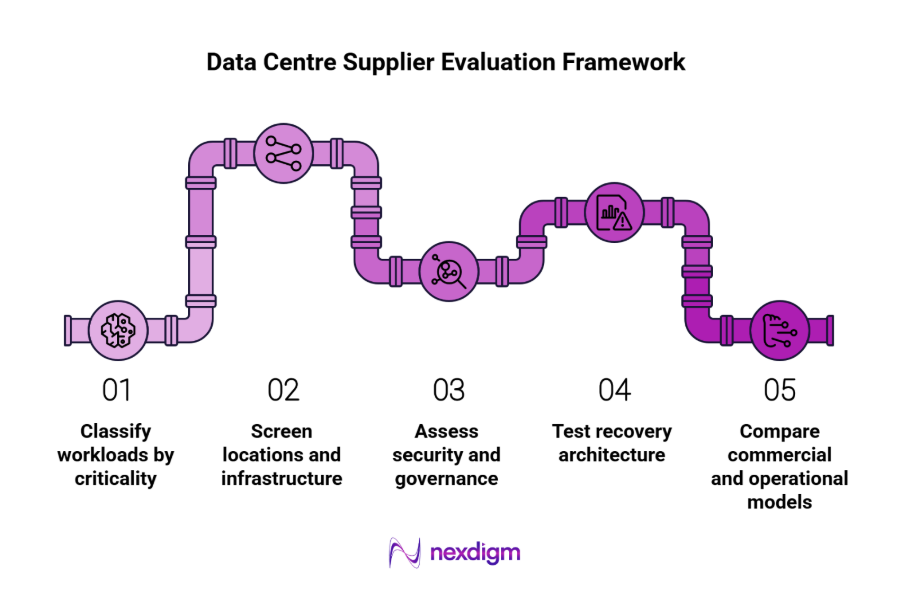
- Classify workloads by criticality: Separate transaction processing, customer applications, analytics, storage and internal systems according to availability and recovery needs.
- Screen locations and infrastructure: Compare power availability, connectivity, environmental exposure, cooling systems and expansion capacity.
- Assess security and governance: Review physical security, access controls, data handling, audit support and relevant regulatory considerations.
- Test recovery architecture: Examine replication, failover, recovery objectives, secondary-site capacity and testing arrangements.
- Compare commercial and operational models: Evaluate colocation, managed hosting and cloud options against total cost, customer control, scalability and long-term dependency.
Nexdigm’s Case: BFSI Data Centre Provider Assessment
A financial institution evaluating infrastructure options screened 14 data centre providers across Mumbai, Pune, Hyderabad and Chennai. The assessment compared capacity, connectivity, power redundancy and recovery-site availability, narrowing the market to five providers for detailed technical and commercial evaluation.
To take the next step, simply visit our Request a Consultation page and share your requirements with us.
Harsh Mittal
+91-8422857704