

As enterprise data environments expand across cloud platforms, applications, and business functions, selecting the right data management technology has become increasingly complex. Actian’s 2025 research found that 83% of organizations face data governance and compliance challenges, while 76% report concerns around data quality and trust.
The Institute for Supply Management’s 2025 survey also found that only 51% of respondents rated their organizational data quality as good or excellent. These findings underline the importance of evaluating suppliers beyond product features. A structured data management technology supplier analysis can help organizations assess master data management, metadata capabilities, data lineage, scalability, and compatibility with existing systems before making technology decisions.
When Fragmented Data Becomes an Enterprise Challenge
Dispersed data, inconsistent records, disconnected systems, and limited visibility can affect how organizations manage information. These issues may lead to duplicated records, unreliable reporting, inefficient workflows, and difficulties meeting governance requirements. As enterprises expand their technology environments, selecting suitable data management suppliers becomes important for establishing consistency, improving data accessibility, and supporting informed decisions across business functions.
Signs That Signal a Need for Better Data Management
Certain operational issues can indicate that existing data management technologies may no longer meet enterprise requirements.
- Conflicting Business Records: Different applications maintain inconsistent customer, product, or supplier information, creating duplication and reconciliation challenges.
- Limited Data Visibility: Teams struggle to identify data origins, ownership, definitions, and transformations across interconnected systems.
- Growing Infrastructure Constraints: Existing platforms face difficulties accommodating increasing data volumes, new applications, and changing deployment environments.
Recognizing these issues can help organizations define technology priorities before exploring alternative suppliers.
How Nexdigm’s Experts Identify Supplier Market Trends
Understanding supplier activity requires visibility into more than product launches. Our experts can help enterprises examine how the data management market is evolving through research into vendor strategies, technology developments, partnerships, acquisitions, and portfolio expansions. This intelligence can help organizations identify:
- Emerging Supplier Priorities: Track growing investments in AI-enabled governance, automated data discovery, and data quality management.
- Competitive Shifts: Examine changes in vendor positioning, partnerships, acquisitions, and expansion into adjacent technology segments.
- Product Portfolio Developments: Monitor new capabilities and enhancements across master data, metadata, lineage, and integration solutions.
This market perspective can help decision-makers understand which technology capabilities are gaining attention and where relevant supplier alternatives may be emerging.
Insights into Nexdigm’s Data Management Technology Supplier Analysis
Our expert-led data management technology supplier analysis services help enterprises move from understanding market developments to identifying suitable technology providers. Our research can support:
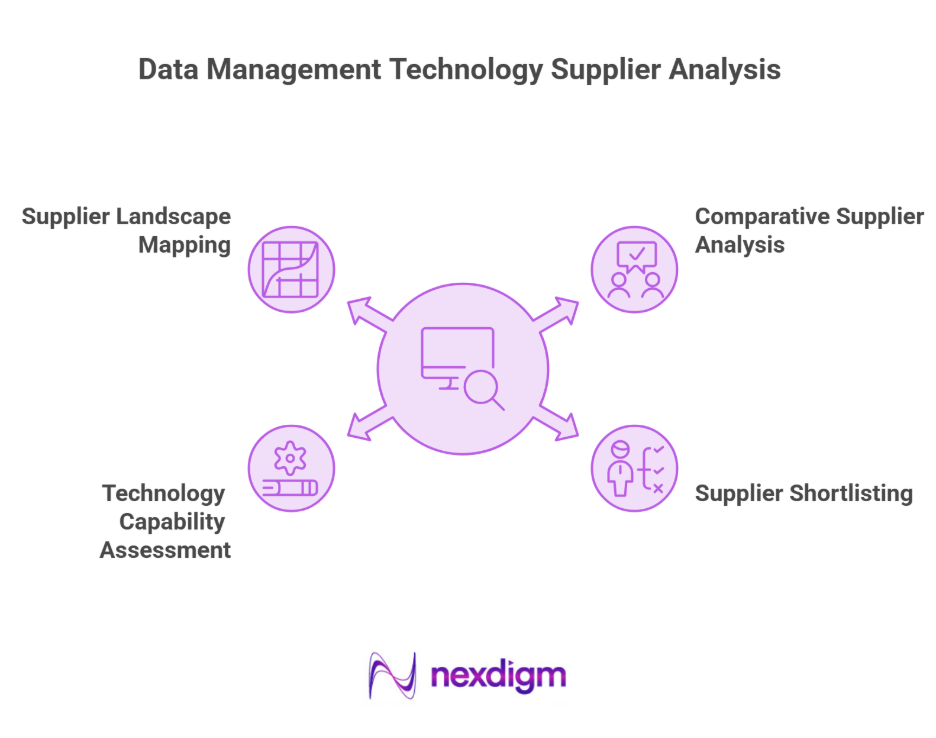
- Supplier Landscape Mapping: Identify established vendors, specialist providers, and emerging competitors across data management segments.
- Technology Capability Assessment: Examine master data management, metadata management, data lineage, integration, and scalability capabilities.
- Comparative Supplier Analysis: Evaluate provider portfolios, deployment models, product strengths, and market positioning.
- Supplier Shortlisting: Identify potential providers aligned with enterprise technology requirements and business priorities.
These insights can help organizations gain a clearer understanding of available solutions, compare relevant suppliers, and establish a focused foundation for technology selection and procurement.
Turning Nexdigm’s Supplier Analysis Insights into Better Technology Decisions
Our supplier analysis insights can help enterprises move from market understanding to informed technology decisions through three key areas:
- Identifying Suitable Providers: Use supplier landscape research to identify established vendors, specialized providers, and emerging alternatives relevant to enterprise requirements.
- Understanding Competitive Differences: Compare technology capabilities, deployment models, product strengths, and market positioning to understand supplier advantages and limitations.
- Supporting Supplier Selection: Use comparative findings and capability assessments to develop focused shortlists for technical evaluation, due diligence, and procurement planning.
These insights can help decision-makers reduce evaluation complexity, recognize suitable technology options, and align data management investments with business priorities.
Nexdigm’s Case
An enterprise sought a suitable data management platform to improve master data consistency, metadata visibility, and data lineage. Nexdigm’s expertise assessed 14 suppliers across key technology and integration parameters. The research identified capability gaps in 40% of the evaluated providers and helped shortlist 5 suppliers, representing 33% of those assessed, for detailed evaluation.
To take the next step, simply visit our Request a Consultation page and share your requirements with us.
Harsh Mittal
+91-8422857704