

Businesses collect information from sales transactions, customer interactions, supply chains, financial systems, and digital platforms. Yet large datasets do not automatically produce better decisions. The real challenge is identifying patterns that explain performance, anticipating what may happen next, and determining which findings warrant action. Data mining helps organisations move beyond reporting historical results to investigate relationships, detect anomalies, and develop predictions that support commercial and operational decisions.
Start With The Business Question
The most effective analytical projects begin with a decision rather than a dataset. A retailer may want to reduce stock shortages; a subscription business may need to understand customer churn, and a manufacturer may want to identify factors associated with equipment failure.
Each question requires a different definition of success. Reducing customer churn involves identifying customers at risk and determining which interventions could retain them. Improving inventory planning requires forecasts that are sufficiently accurate and timely to influence purchasing decisions.
For data mining for business analytics, the business objective should determine which data is collected, what analytical method is appropriate, and how the findings will be evaluated. Without this connection, organisations risk producing technically interesting patterns that have little practical value.
Choose The Right Analytical Approach
Different data mining techniques answer different questions. Classification groups observations into predefined categories, such as identifying transactions that may require fraud investigation. Clustering identifies groups with similar characteristics without requiring those groups to be defined in advance. Regression estimates relationships between variables and can support numerical forecasting, while anomaly detection identifies observations that differ from established patterns.
Association analysis can reveal relationships between products frequently purchased together, helping retailers investigate cross-selling opportunities or product placement. These techniques are not interchangeable. The method should reflect the decision, the nature of the data, and the consequences of an incorrect prediction.
Examine Data Quality Before Modelling
Analytical outputs depend on the information used to produce them. Missing values, duplicate records, inconsistent definitions, and outdated data can distort results. Combining datasets can introduce further problems when different systems define customers, products, transactions, or time periods differently.
Historical data may also contain biases that affect predictions. A model trained on past customer behaviour may perform poorly when pricing, consumer preferences or market conditions change. Organisations should document data sources, review limitations, and establish appropriate access controls, particularly when personal or commercially sensitive information is involved.
Build A Data Mining Framework
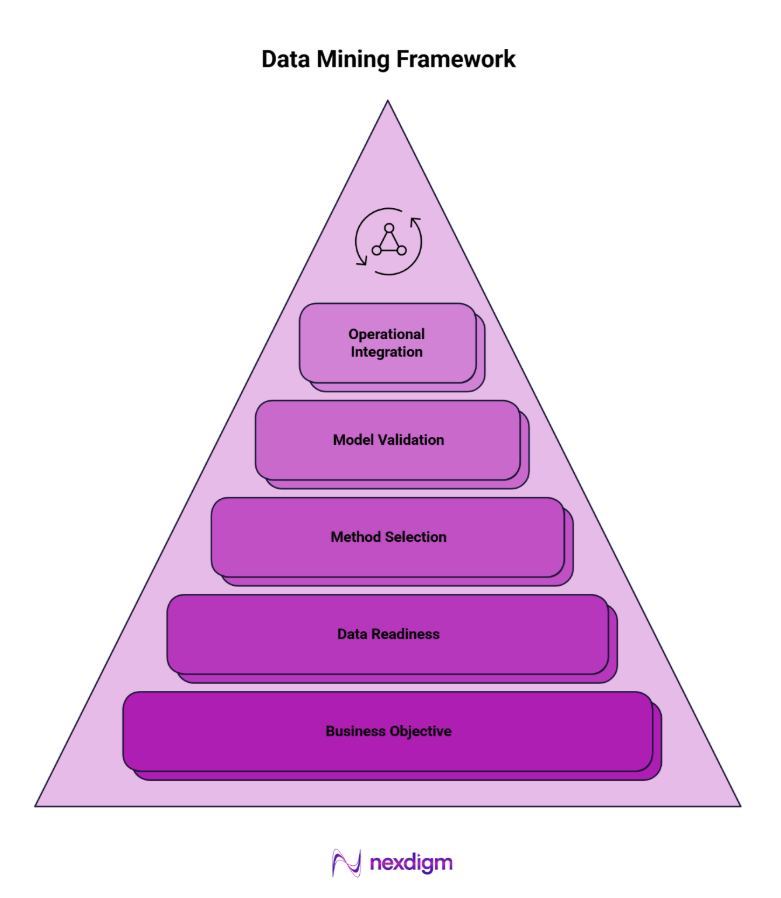
- Business Objective: Define the decision to improve, establish a measurable outcome, and identify the teams responsible for acting on the findings.
- Data Readiness: Identify relevant datasets, assess completeness and consistency, resolve quality problems, and establish appropriate permissions before beginning analysis.
- Method Selection: Choose classification, clustering, regression, association analysis, or anomaly detection according to the business question and the type of output required.
- Model Validation: Test findings against data not used during model development, compare results with a suitable baseline, and investigate errors that could affect decisions.
- Operational Integration: Translate analytical outputs into specific actions, assign ownership, and incorporate recommendations into existing business processes rather than leaving results in standalone reports.
The framework should also account for the cost of acting on a prediction. A model that flags too many legitimate transactions for review may create operational delays, while an inventory forecast that consistently overestimates demand can increase holding costs. Business value depends on the quality of decisions the analysis enables, not simply on model performance.
From Patterns To Measurable Outcomes
Data mining can improve customer segmentation, demand planning, fraud detection, and operational forecasting when analytical findings are connected to clear business objectives. Reliable data, appropriate validation, and effective implementation help organisations distinguish meaningful patterns from misleading correlations and turn analysis into measurable improvements.
Nexdigm’s Case Study
A retailer examines transaction histories, product availability, and seasonal sales to investigate recurring stock shortages. Analysis identifies product categories where demand frequently exceeds replenishment plans. The retailer tests revised inventory rules against historical performance and monitors stock availability, excess inventory, and purchasing costs to assess whether the changes improve operational efficiency.
To take the next step, simply visit our Request a Consultation page and share your requirements with us.
Harsh Mittal
+91-8422857704