

Enterprise data is expanding across more locations and formats than conventional security architectures were designed to handle. Global data volumes reached about 149 zettabytes in 2024 and are projected to approach 394 zettabytes by 2028. AI, cloud applications, connected devices, and distributed workforces are adding further layers of data creation and movement.
For enterprises, the challenge is no longer simply preventing unauthorized access to a central database. Sensitive information can reside in cloud object stores, SaaS platforms, collaboration tools, endpoints, data warehouses, backups, and AI retrieval systems. Protecting it requires visibility into where data exists, who can access it, how it is being used, and what happens when that access becomes anomalous.
Data Protection Is Becoming a Visibility Problem
Traditional DLP remains relevant for controlling data movement through endpoints, email, and other channels, but distributed environments create visibility gaps. Security teams need to discover sensitive information across structured databases and unstructured repositories before they can apply appropriate controls.
This is where Data Security Posture Management (DSPM) has gained attention. Gartner defines DSPM around discovering, classifying, and cataloguing structured and unstructured data across multiple sources while assessing exposure to privacy, security, and AI-related risks.
The market is therefore moving toward data-centric controls that connect data sensitivity with access permissions, location, usage patterns, and exposure. The objective is to identify the combinations that create material risk rather than generate another inventory of isolated alerts.
AI Is Changing What Counts as Sensitive Data
Generative AI introduces a separate layer of complexity because enterprise information can move through model-development, retrieval, and inference workflows.
A confidential document may be copied into a vector database for retrieval. A customer record may become part of an AI application’s context. An internal knowledge base may be exposed through an improperly configured agent or API. These workflows create new relationships between data, identities, applications, and models.
Gartner expects 50% of organizations to adopt a zero-trust posture for data governance by 2028 as AI-generated and unverified data proliferates. Its 2026 research also identifies data discovery and classification as central capabilities for understanding AI-related data exposure.
Security teams consequently need to evaluate AI data pipelines alongside conventional repositories. Classification alone is insufficient if an enterprise cannot determine which identity or application can retrieve the classified information.
Recovery Has Become Part of Data Protection
Protection also extends beyond preventing exfiltration. Ransomware and destructive attacks can compromise production environments and the backups intended to restore them.
Immutable or isolated backup architectures therefore form a complementary layer to DSPM and DLP. Enterprises need to understand which datasets require rapid recovery, how many copies exist, where those copies are stored, and whether attackers could alter or delete them using compromised administrative credentials.
The economic question is equally important. As data volumes approach hundreds of zettabytes globally, retaining, classifying, backing up, and continuously monitoring every dataset can create substantial infrastructure and operating costs. Data protection strategies increasingly have to distinguish critical information from redundant, obsolete, or low-value data.
What Should Enterprises Measure?
A practical data-protection assessment should examine five areas:
- Data discovery: Map structured, unstructured, semi-structured, SaaS, cloud, endpoint, backup, and AI-associated repositories.
- Classification quality: Determine whether sensitive information can be identified according to business context, regulatory category, and actual risk rather than simple pattern matching.
- Identity-to-data exposure: Compare theoretical permissions with actual access activity across human, machine, application, and AI identities.
- AI data governance: Trace how sensitive information enters vector databases, RAG pipelines, model workflows, APIs, and AI applications.
- Resilience and recovery: Evaluate encryption, immutable backups, recovery objectives, privileged access to backup systems, and the ability to restore critical datasets after an attack.
Nexdigm Data Protection Market Assessment Framework
Nexdigm can evaluate data-protection strategies through a structured framework:
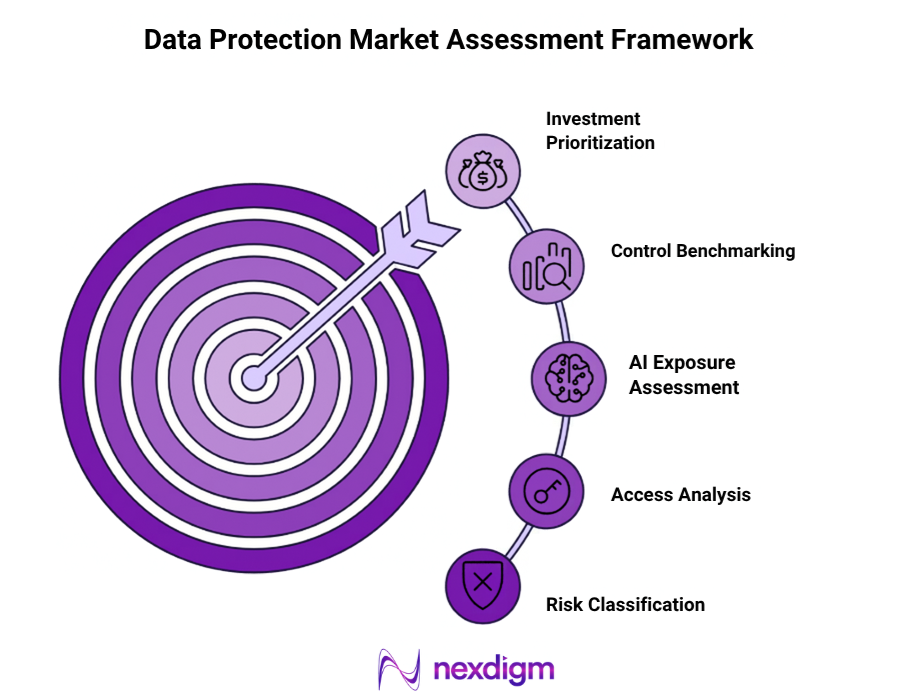
- Data estate mapping: Identify critical datasets across cloud, SaaS, on-premise systems, endpoints, and backup environments.
- Risk classification: Segment information by sensitivity, regulatory exposure, business criticality, and potential impact of unauthorized access.
- Access analysis: Map identities, permissions, active usage, and anomalous access against critical data stores.
- AI exposure assessment: Evaluate data flows into RAG architectures, vector databases, AI applications, and external services.
- Control benchmarking: Compare DSPM, DLP, encryption, masking, DDR, backup, and recovery capabilities against enterprise requirements.
- Investment prioritization: Quantify remediation priorities according to risk reduction, compliance requirements, operational effort, and total cost of ownership.
Nexdigm Digitizing Sensitive Healthcare Processes
Nexdigm supported a global eye-care company’s Indian subsidiary in digitizing cross-functional processes where sensitive product, contract, and financial data required stronger controls. The engagement delivered 100% claims-submission accuracy, 30% cost efficiency, 95% lower accrual-processing effort, and 60% less query and approval rework.
To take the next step, simply visit our Request a Consultation page and share your requirements with us.
Harsh Mittal
+91-8422857704