
Delivery demand is growing for more than one reason. E-commerce is adding orders, urbanisation is creating denser consumption clusters, and faster delivery formats are increasing the number of shipments generated by individual customers. For logistics providers, the resulting demand curve is becoming harder to forecast from historical parcel volumes alone.
India’s e-commerce market is projected to reach $250 billion by 2030, up from around $90 billion today. At the same time, Tier II and III cities already account for more than 60% of India’s e-commerce transactions, shifting incremental demand beyond the largest metropolitan markets.
E-Commerce Is Expanding the Delivery Base
The growth of online retail creates a direct increase in parcel demand, but the distribution of that demand matters just as much as its headline growth rate.
Deloitte and FICCI estimate that India’s online retail market could increase from $75 billion in 2024 to $260 billion by 2030. More recent last-mile research points to the same geographical shift: Tier II and III cities accounted for 66% of new D2C orders in FY2026.
This changes the network requirement for delivery providers. Mature metro markets can generate high order density within established routes, while emerging markets may require additional sorting capacity, delivery stations and local fleets before sufficient density develops.
Urbanisation Changes Where Deliveries Concentrate
Urbanisation creates clusters of consumers, businesses and fulfilment infrastructure that can make delivery routes more economical. But cities are not uniform delivery markets.
Dense neighbourhoods can support more stops per route, shorter average distances and greater utilisation of delivery capacity. Peripheral urban growth produces a different cost structure, particularly where housing, commercial activity and retail development spread faster than logistics infrastructure.
For forecasting purposes, population growth therefore needs to be combined with household formation, income, digital commerce penetration, retail activity and the location of fulfilment facilities.
Faster Delivery Is Creating More Demand Per Customer
The delivery market is also changing through frequency.
Quick commerce has moved from a niche grocery format into a broader retail channel. Industry estimates put India’s quick-commerce gross order value at ₹64,000 crore in FY2025, more than double the previous year, with projections of around ₹2 lakh crore by FY2028.
Rapid delivery is also expanding beyond food and groceries. BCG estimates that rapid commerce could become a $20+ billion GMV opportunity by 2030, supported by a logistics market exceeding $2 billion.
This creates a different forecasting problem. A market can generate more delivery demand even without a proportional increase in the number of online shoppers if existing customers begin ordering more frequently or shift more purchases to faster fulfilment formats.
The Service Promise Changes the Capacity Requirement
Delivery demand should be forecast alongside the service level attached to it.
Standard parcel delivery allows networks to consolidate shipments and plan routes around broader time windows. Same-day and rapid delivery require inventory and delivery capacity to be positioned closer to customers. They also make peak-hour demand, failed deliveries, route density and rider utilisation more important.
The latest market estimates reflect this shift. India’s e-commerce last-mile delivery market is projected to grow from $3.66 billion in 2026 to $7.57 billion by 2031, with same-day delivery forecast to grow faster than standard delivery.
The implication is that forecasting total shipments is only the starting point. Providers need to estimate when, where and how quickly those shipments will need to move.
The Next Demand Wave Will Be Uneven
The strongest opportunities are unlikely to emerge at the same rate across every city or customer segment.
Tier 3 and smaller cities are forecast to grow faster than Tier 1 markets in India’s e-commerce last-mile segment. Meanwhile, current industry reporting shows logistics companies preparing for greater demand dispersion across Tier II and III cities, alongside smaller and faster deliveries.
That creates a planning challenge. Expanding too early can leave delivery infrastructure underutilised. Expanding too late can produce capacity shortages, longer routes and weaker service levels just as demand reaches a commercially attractive threshold.
How Nexdigm Builds a Delivery Demand Forecast
Nexdigm combines market, customer and network indicators to determine where future delivery demand is likely to emerge:
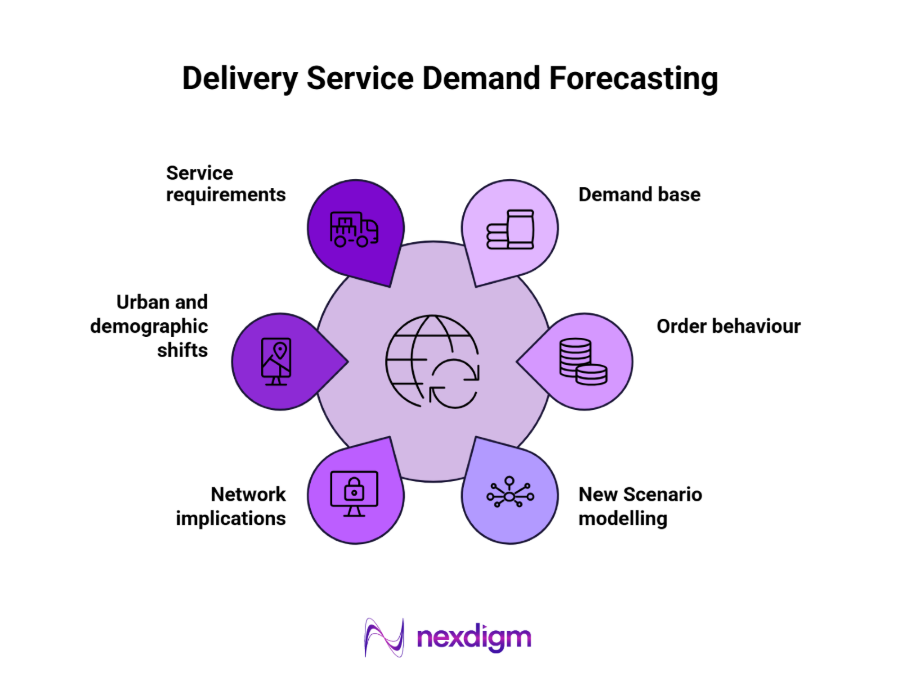
- Demand base: Forecast e-commerce, D2C, quick-commerce and other delivery-generating segments by geography and customer type.
- Urban and demographic shifts: Assess population growth, household formation, income, urban expansion and digital adoption to identify emerging consumption clusters.
- Order behaviour: Estimate order frequency, basket characteristics, delivery preferences, returns and seasonal demand patterns.
- Service requirements: Separate standard, next-day, same-day and rapid-delivery demand to determine the capacity each segment requires.
- Network implications: Translate projected shipment volumes into delivery stations, fleet requirements, warehouse capacity, rider requirements and route density.
- Scenario modelling: Test alternative growth, service-level and geographic-expansion assumptions to identify capacity requirements and potential underutilisation.
A delivery service demand forecasting exercise therefore connects market growth with the physical capacity required to serve it. The objective is to determine where demand will develop, how quickly it will develop and what network investment is justified at each stage.
Nexdigm Case: Linking Distribution Design to Service Improvement
Nexdigm worked with a major diagnostics manufacturer to redesign its distribution network using demand planning, warehouse-location analysis and transportation-lane optimisation. The engagement delivered 16% cost savings, improved service levels by 7%, and generated an additional 27% reduction in overall supply-chain costs.
To take the next step, simply visit our Request a Consultation page and share your requirements with us.
Harsh Mittal
+91-8422857704