
For department store retailers, growth is not simply about opening more locations. The real challenge lies in identifying the right market, selecting the ideal catchment area, and securing a location that can generate sustainable footfall and long-term profitability.
A store that thrives in one market may underperform in another, even with a similar product mix and brand reputation. This makes location strategy one of the most critical components of a successful expansion plan. Through specialized department store expansion entry consulting services, retailers can evaluate opportunities with greater precision and confidence.
At Nexdigm, expansion decisions are driven by data, market intelligence, and strategic planning, ensuring that every new store supports broader business objectives.
The Modern Department Store Expansion Challenge
Department stores today face a vastly different environment than they did a decade ago. Rising customer expectations, omnichannel shopping habits, evolving urban landscapes, and changing spending patterns have made expansion decisions more complex. A successful expansion strategy requires answering three fundamental questions:
- Which markets offer the highest potential?
- Which catchments within those markets can sustain profitable operations?
- Which specific locations can generate the strongest long-term returns?
Businesses that address these questions systematically are significantly more likely to achieve sustainable growth and profitability.
Where Should the Next Store Open?
The answer lies at the intersection of three critical dimensions:
High-Growth Markets
Markets experiencing strong economic growth, infrastructure development, rising disposable incomes, and population expansion often present the most attractive opportunities for department store expansion. These factors typically lead to greater consumer spending, increased demand for branded products, and higher footfall in retail destinations. By entering such markets early, retailers can establish a strong presence, build brand loyalty, and capitalize on long-term growth potential before competition intensifies.
Underserved Catchments
Even in mature retail markets, there are often specific neighborhoods, suburbs, or emerging urban clusters where consumers have limited access to quality department stores. These underserved catchments may exhibit strong purchasing power but lack adequate retail offerings, forcing shoppers to travel significant distances for their needs. Establishing stores in such locations helps retailers capture unmet demand, improve customer convenience, and gain market share with relatively lower competitive pressure.
Strategic Locations
Within attractive catchments, retailers should prioritize locations that offer:
- High visibility
- Strong footfall
- Easy accessibility
- Complementary neighboring retailers
- Long-term scalability
The next store should open not simply where retail space is available, but where these three dimensions converge.
Identifying the Optimal Store Location
After defining target catchments, retailers must evaluate specific sites. The success of a new store often depends not only on the attractiveness of the market but also on the suitability of the exact location within that market. Factors such as accessibility, visibility, customer traffic patterns, surrounding businesses, and long-term development plans can significantly influence store performance and profitability. For location selection criteria, successful sites typically deliver:
- Retail Synergies: Stores located near complementary brands often benefit from increased customer traffic and cross-shopping behavior.
- Visibility and Frontage: Prominent positioning improves brand awareness and spontaneous visits.
- Occupancy Economics: Rental costs must align with projected sales volumes and profitability targets.
Future Growth Potential
Retailers should evaluate upcoming infrastructure projects, commercial developments, and residential expansion that may increase future catchment demand. Areas undergoing rapid development often experience growth in population, employment, consumer spending, and accessibility, making them attractive locations for long-term retail investment. Considering future growth potential helps retailers move beyond current market conditions and position stores in locations that can generate sustainable revenue over time.
Nexdigm’s Future Growth Prediction Model
Nexdigm employs a multi-factor site assessment methodology that integrates multiple analytical frameworks to identify locations with the highest potential for long-term success. This approach helps retailers make data-driven expansion decisions while minimizing market and location-related risks.
- Geospatial analytics
- Competitive mapping
- Retail demand forecasting
- Commercial viability assessment
- Financial feasibility analysis
This comprehensive approach helps reduce location risk and improve the probability of successful store launches while ensuring alignment with broader retail growth strategies and investment objectives.
Building Department Store Expansion Strategy with Nexdigm
Expansion should not be viewed as a series of isolated store openings. Instead, it should function as a long-term growth program supported by repeatable frameworks and measurable criteria. Nexdigm helps retailers develop expansion strategies that include:
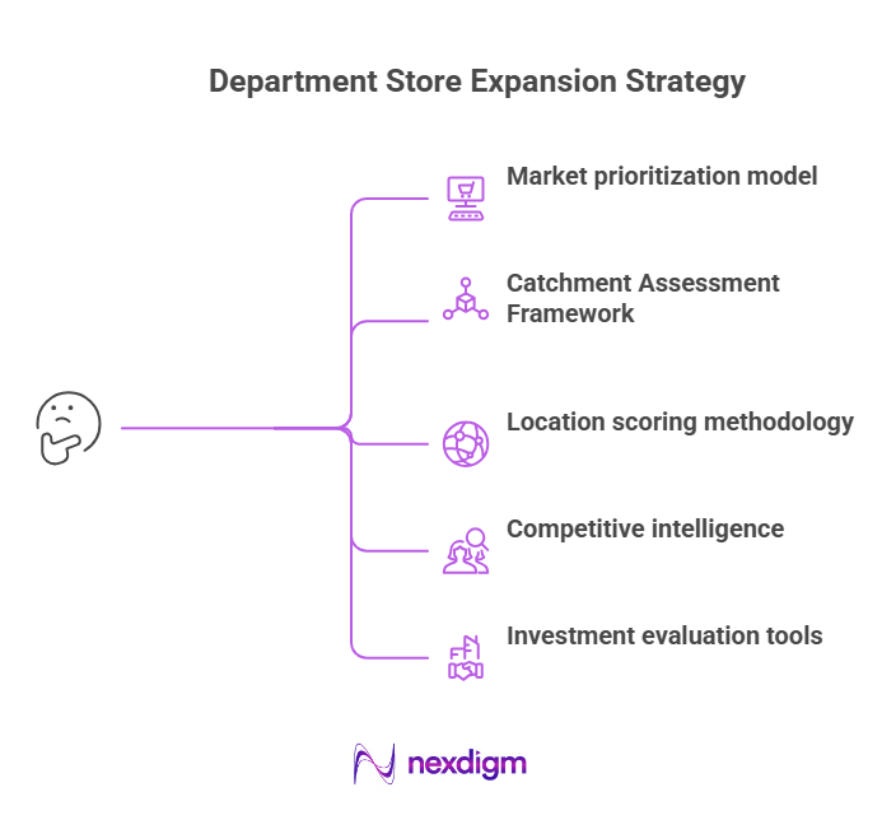
- Market prioritization models: Structured frameworks that rank target markets based on demand, competition, growth potential, demographics, and strategic business objectives.
- Catchment assessment framework: Analytical tools used to evaluate customer demographics, spending patterns, accessibility, footfall potential, and market attractiveness.
- Location scoring methodologies: Data-driven scoring systems that compare sites using criteria such as visibility, traffic, accessibility, competition, and profitability.
- Competitive intelligence programs: Research programs that monitor competitor strategies, store networks, pricing, market positioning, and expansion activities to identify opportunities.
- Investment evaluation tools: Financial assessment models that analyze costs, revenue potential, profitability, risks, and expected return on investment.
These capabilities ensure that each expansion decision contributes to broader business objectives.
Nexdigm’s Case
In a recent engagement, Nexdigm supported a department store client in prioritizing markets, catchments, and locations for expansion. Real-time analysis improved location prioritization by 34%, increased catchment potential accuracy by 29%, reduced site selection timelines by 31%, and strengthened investment confidence. This approach enabled the client to identify high-potential markets, optimize store placement, and build a focused expansion roadmap with stronger commercial returns.
To take the next step, simply visit our Request a Consultation page and share your requirements with us.
Harsh Mittal
+91-8422857704