

While software delivery is faster, managing modern environments spanning cloud, containers, security, observability, and AI coding has grown increasingly complex. Adding standalone tools only worsens fragmentation.
Consequently, DevOps is shifting toward integrated platforms that standardize the entire lifecycle. According to Gartner’s 2025 research, winning platforms prioritize developer experience and rapid delivery through platform engineering capabilities like internal developer portals, paved roads, shared services, and generative AI.
Faster Coding Is Increasing Pressure on the Delivery System
AI-assisted development is accelerating code creation, but the additional output has to move through testing, review, security and deployment processes before it creates business value.
The 2025 DORA research found that 90% of surveyed technology professionals were using AI at work and more than 80% reported productivity gains. At the same time, 30% reported little or no trust in AI-generated code. DORA also found that AI adoption can improve software delivery throughput while creating stability challenges when underlying delivery systems are weak.
This creates a different technology requirement. Development teams need platforms capable of absorbing higher change volumes without allowing deployment, testing, security and operational processes to become bottlenecks.
The Toolchain Is Becoming a Platform
Traditional DevOps environments often accumulate tools organically. One team adopts a CI system, another selects an infrastructure tool, security introduces separate scanning products, and operations adds monitoring and incident-management systems.
The resulting toolchain can be powerful but difficult to standardize.
Platform engineering addresses this fragmentation by creating a shared layer through which developers can access approved infrastructure, deployment pipelines, security controls and operational capabilities.
Google Cloud’s 2025 research across 500 IT professionals and application developers found that organisations with platform engineering teams were using platforms to reduce developer cognitive load and improve software delivery capabilities.
The opportunity therefore extends beyond automating individual DevOps activities. It increasingly involves making the entire delivery environment easier to consume.
Internal Developer Portals Change the User Interface
One of the clearest manifestations of this shift is the internal developer portal.
Rather than asking developers to understand every underlying infrastructure component, portals provide a standard interface for accessing services, environments, documentation, deployment workflows and software components.
Gartner’s 2026 Market Guide for Internal Developer Portals describes their role in improving developer and AI-agent experience while providing consistent governance and access to software development and delivery capabilities.
For platform vendors, this creates a new competitive layer. The product is no longer judged only by the sophistication of its underlying automation. Developer experience, self-service capability, integration breadth and governance increasingly influence adoption.
Enterprise Buyers Are Evaluating Control Alongside Speed
Speed remains important, but enterprises cannot optimise deployment frequency independently of reliability and security.
A platform that enables developers to deploy rapidly but provides weak access controls, inconsistent environments or limited observability can increase operational risk.
DORA’s research reinforces this relationship. Its 2025 findings indicate that platform quality is strongly connected with the ability to realise value from AI-assisted development. The research reports that 90% of organisations had adopted at least one internal platform and 76% had dedicated platform teams.
This creates demand for platforms that combine developer autonomy with centrally managed guardrails.
Where the Platform Opportunity Is Expanding
The opportunity is consequently broadening across several connected capabilities:
- Continuous Integration and Delivery: Automating build, test and deployment processes while improving release consistency.
- Infrastructure and Environment Management: Providing reusable infrastructure components and standardised deployment environments.
- Security and Compliance: Embedding security checks, policy controls and auditability into delivery workflows.
- Observability: Connecting application performance, infrastructure telemetry and operational feedback to the development lifecycle.
- Internal Developer Portals: Giving developers self-service access to approved tools, environments and workflows.
- AI-Assisted Development: Integrating coding agents and AI capabilities into governed engineering environments.
- Platform Operations: Managing the underlying platform as an internal product, with adoption, usability and reliability measured continuously.
The market opportunity therefore depends increasingly on how much of the software delivery lifecycle a platform can simplify without creating another layer of complexity.
How Nexdigm Assesses the DevOps Platform Opportunity
A DevOps platform market assessment can evaluate the opportunity through seven connected dimensions:
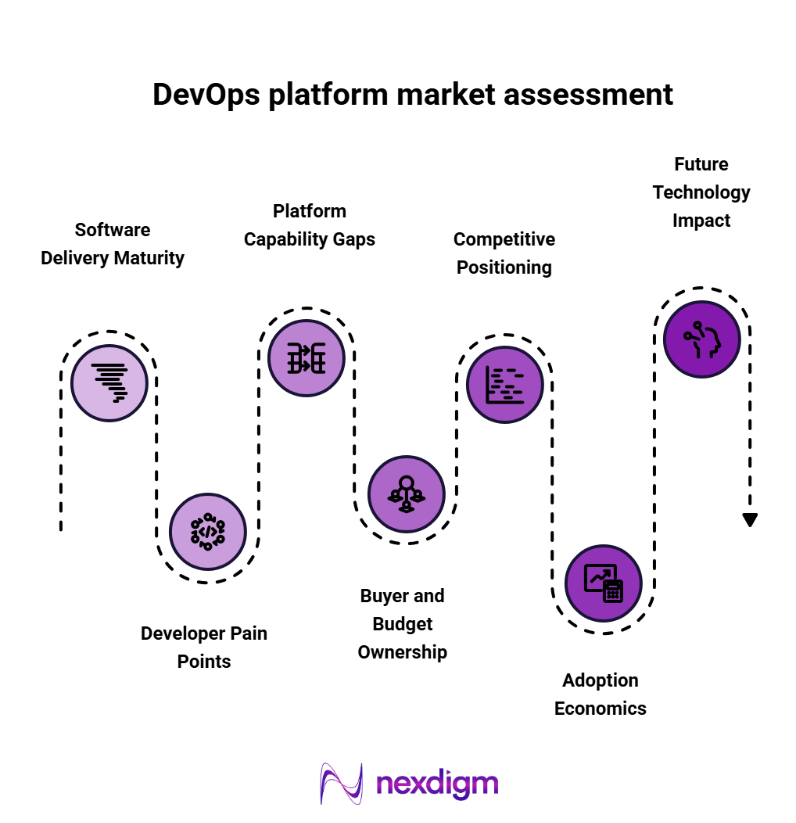
- Software Delivery Maturity: Maps target organisations by their existing CI/CD, cloud, automation, security and observability capabilities to identify where platform adoption is commercially realistic.
- Developer Pain Points: Identifies the parts of the development lifecycle creating the greatest cognitive load, manual effort or delivery delays.
- Platform Capability Gaps: Compares existing DevOps tools with the capabilities required for integrated platform engineering, including portals, automation, governance and self-service.
- Buyer and Budget Ownership: Maps CIO, CTO, engineering, DevOps, platform and security stakeholders to determine who influences platform purchases and controls budgets.
- Competitive Positioning: Evaluates established DevOps platforms, cloud-native alternatives, specialist tools and open-source technologies to identify whitespace.
- Adoption Economics: Models implementation costs, migration requirements, platform-team investment, licensing and expected productivity gains.
- Future Technology Impact: Assesses how AI coding agents, autonomous workflows, cloud-native development and increasingly standardised internal platforms could reshape demand.
The analysis can then identify priority customer segments, high-value platform capabilities, competitive gaps and the most commercially attractive areas of the DevOps ecosystem.
Nexdigm in Action
Nexdigm supported an ERP transition and transformation engagement by assessing technology and process requirements, supporting solution selection, and managing implementation and hypercare. The client integrated financial, manufacturing, and other business functions within six months, improving management visibility across operations.
To take the next step, simply visit our Request a Consultation page and share your requirements with us.
Harsh Mittal
+91-8422857704