

Benchmarking DevOps platforms accelerating software development and deployment cycles enables organizations to evaluate tools that streamline CI/CD pipelines, automation, and collaboration. Through DevOps tool benchmarking, enterprises can compare platform capabilities, integration flexibility, scalability, and deployment efficiency against industry peers.
Competitive intelligence allows businesses to understand how competitors leverage DevOps tools, identify gaps in their own processes, and adopt best practices. By systematically analyzing performance metrics and operational outcomes, organizations can optimize development velocity, reduce deployment risks, enhance software quality, and maintain a competitive advantage in fast-paced digital markets.
DevOps adoption continues to rise, with around 80 % of organizations practicing DevOps and 77 % using or planning DevOps for software deployments to accelerate delivery cycles. Continuous Integration/Continuous Delivery (CI/CD) tool usage correlates with 2.5× faster software delivery and improved performance outcomes.
Additionally, over 83 % of developers report involvement in DevOps‑related activities, highlighting widespread adoption of DevOps practices and tools in modern development environments.
Using DevOps Competitive Intelligence to Enhance Software Quality and Delivery Speed
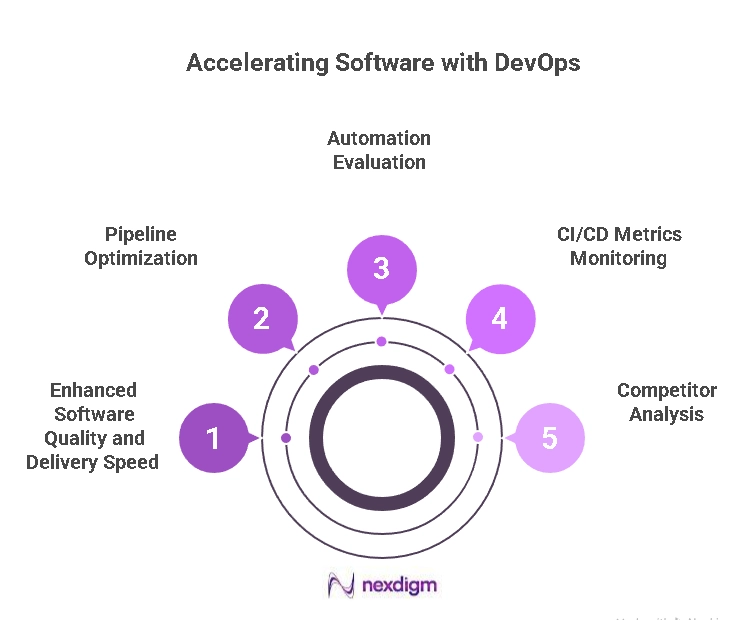
Using DevOps Competitive Intelligence to Enhance Software Quality and Delivery Speed involves analyzing competitor tool usage, CI/CD performance, and automation practices to optimize pipelines, reduce errors, and accelerate software releases effectively:
-
Analyzing Competitor DevOps Tool Usage
Reviews tools, CI/CD pipelines, and automation strategies employed by competitors to identify best practices and improvement opportunities.
-
Benchmarking Deployment Frequency and Cycle Time
Compares release speed and development cycle efficiency across industry peers to optimize delivery processes.
-
Evaluating Automation Coverage and Effectiveness
Assesses automation in testing, deployment, and monitoring to reduce errors and accelerate software delivery.
-
Monitoring Continuous Integration/Continuous Delivery (CI/CD) Metrics
Tracks build success rates, pipeline efficiency, and integration performance to enhance software quality.
-
Translating Competitive Insights into Pipeline Optimization Strategies
Converts benchmarking data into actionable recommendations for faster releases, higher quality, and improved operational efficiency.
Nexdigm Strategic Roadmaps for DevOps Implementation
Nexdigm Strategic Roadmaps for DevOps Implementation provide organizations with structured guidance to deploy DevOps platforms efficiently. By analyzing CI/CD pipelines, automation, and integration capabilities, Nexdigm identifies gaps and improvement opportunities.
These roadmaps align DevOps initiatives with business objectives, optimize development velocity, reduce deployment risks, enhance software quality, and leverage competitive intelligence to accelerate digital transformation and maintain a strategic advantage.
Nexdigm Evaluation of CI/CD Performance, Automation, and Integration Capabilities
Nexdigm Evaluation of CI/CD Performance, Automation, and Integration Capabilities assesses pipeline efficiency, automated processes, and system interoperability to optimize software delivery, reduce errors, accelerate deployment, and enhance overall DevOps effectiveness.
-
Assessing Deployment Frequency and Lead Time
Measures how often and how quickly code moves from development to production, identifying delays in the CI/CD pipeline.
-
Reviewing Automated Testing Effectiveness
Evaluates the coverage, reliability, and efficiency of automated tests to minimize errors and accelerate release cycles.
-
Monitoring Continuous Integration Health
Tracks build stability, failure rates, and integration consistency to maintain high-quality software delivery standards.
-
Evaluating Toolchain Interoperability
Analyzes how development, deployment, and monitoring tools work together, ensuring seamless workflow and system integration.
-
Optimizing Pipeline Performance Through Analytics
Leverages performance metrics to recommend improvements in automation, integration, and overall CI/CD efficiency for faster delivery.
Nexdigm’s case:
In a recent engagement with a software services company, Nexdigm’s DevOps benchmarking and CI/CD optimization increased deployment frequency by 45 % and reduced average lead time for changes by 38 % within six months. Automated testing coverage improved from 52 % to 78 %, while integration failures dropped by 30 %. These improvements accelerated delivery cycles, enhanced software quality, and positioned the client more competitively in its market.
To take the next step, simply visit our Request a Consultation page and share your requirements with us.
Harsh Mittal
+91-8422857704