

Diagnostics are becoming increasingly central to healthcare delivery, spanning imaging, laboratory testing, and decentralized point-of-care systems. The global in vitro diagnostics market was valued at approximately $107.4 billion in 2025 and is projected to reach $160.7 billion by 2033, while the global medical imaging market was valued at $43.5 billion in 2025.
Point-of-care diagnostics are also expanding. The global point-of-care diagnostics market was estimated at $21.7 billion in 2025, with demand supported by the ability to provide rapid results closer to patients. WHO notes that approximately 70% of healthcare decisions depend on diagnostic test results, while only 3–5% of healthcare budgets are directed toward diagnostic services.
With suppliers spanning multiple technologies, applications, and care settings, diagnostic equipment supplier mapping can help organizations understand the vendor universe, identify relevant manufacturers, and assess where capabilities and market coverage differ.
Diagnostics Are Becoming More Distributed Across Care Settings
Diagnostic technologies are no longer concentrated within large hospital laboratories. Imaging systems support hospitals and specialist centers, laboratory equipment serves centralized and decentralized testing, while point-of-care systems increasingly bring testing closer to patients. WHO’s diagnostic framework includes both in vitro laboratory tests and in vivo technologies such as imaging. This diversification makes it important to understand suppliers by technology, application, care setting, geography, and service capability rather than treating diagnostics as one market.
Areas that Shape the Diagnostic Supplier Landscape
A useful supplier map should distinguish vendors across three broad areas:
- Imaging Suppliers: Map vendors across MRI, CT, X-ray, ultrasound, nuclear imaging, and related diagnostic technologies.
- Laboratory Suppliers: Identify manufacturers of analyzers, reagents, molecular systems, immunoassay platforms, and other laboratory technologies.
- Point-of-Care Suppliers: Assess providers of portable, rapid, decentralized, and near-patient diagnostic systems across relevant applications.
These categories create a foundation for understanding where suppliers compete, where portfolios overlap, and where specialized capabilities exist.
Nexdigm’s Expertise in Shaping Diagnostic Supplier Landscape
The diagnostic equipment market includes suppliers with very different product portfolios, manufacturing footprints, technology capabilities, and geographic coverage. Nexdigm can combine market research, supplier intelligence, competitive analysis, and healthcare industry expertise to develop a structured view of this landscape.
Through diagnostic equipment supplier mapping, Nexdigm can help organizations identify and profile vendors across imaging, laboratory diagnostics, and point-of-care systems, while assessing their product coverage, market presence, manufacturing capabilities, service infrastructure, and strategic relevance.
This enables procurement and healthcare organizations to move beyond a basic supplier list toward a more differentiated view of who operates in each diagnostic segment and where their capabilities are strongest.
Nexdigm’s Diagnostic Supplier Intelligence Approach
A supplier map becomes more useful when it helps organizations understand not only who participates in the market, but where each supplier fits within the diagnostic ecosystem. Nexdigm can add this perspective by:
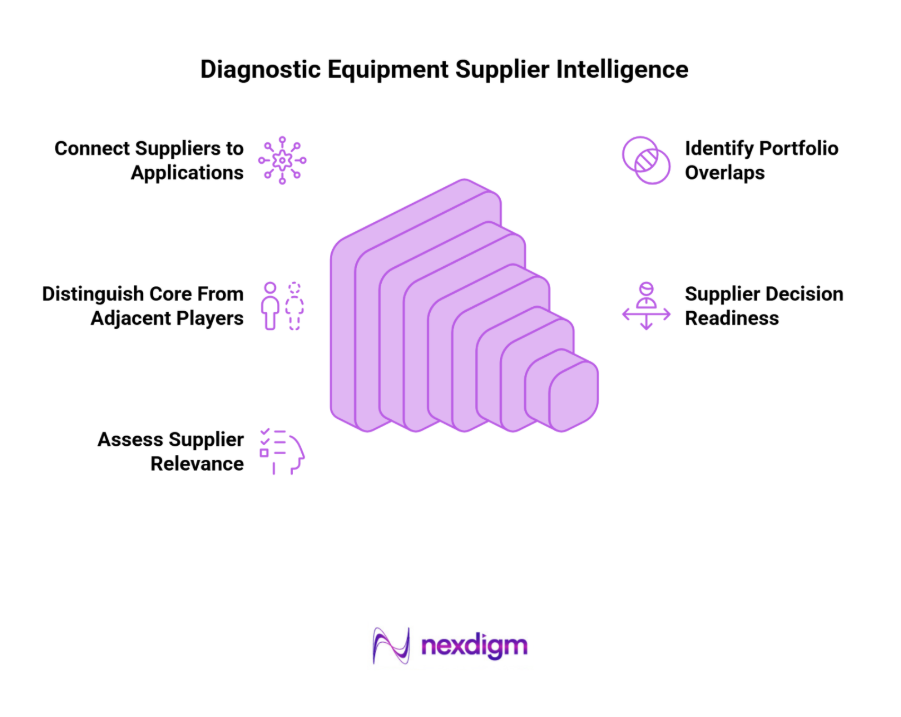
- Connect Suppliers to Applications: Link vendors with specific imaging, laboratory, and point-of-care applications to identify the most relevant suppliers for each requirement.
- Distinguish Core From Adjacent Players: Separate established diagnostic equipment manufacturers from specialized technology providers, regional suppliers, and emerging participants.
- Assess Supplier Relevance: Consider product capabilities, geographic presence, service infrastructure, and market experience to determine which vendors warrant closer evaluation.
- Identify Portfolio Overlaps: Highlight suppliers competing across similar technologies or offering complementary products that could influence sourcing choices.
- Create a Decision-Ready Supplier Universe: Convert broad market intelligence into a focused set of suppliers for procurement, partnerships, qualification, or further due diligence.
Through diagnostic equipment supplier mapping, Nexdigm can help organizations move from market visibility to a more actionable understanding of supplier relevance and strategic fit.
How Nexdigm’s Approach Differs in Diagnostic Supplier Mapping
Nexdigm’s approach can go beyond compiling supplier names or comparing basic product information. The differentiation can be positioned around the depth and integration of the intelligence used to interpret the diagnostic supplier landscape:
- Beyond Supplier Lists: Move from identifying vendors to understanding their product strengths, technology focus, geographic presence, and market relevance.
- Connected Intelligence: Bring together market, supplier, technology, and competitive information rather than evaluating each data point in isolation.
- Segment-Specific Perspective: Examine imaging, laboratory, and point-of-care suppliers according to the characteristics and requirements of each segment.
- Decision-Oriented Insights: Translate supplier information into practical implications for sourcing, partnerships, market expansion, and supplier diversification.
- Forward-Looking View: Consider emerging technologies, evolving supplier capabilities, and market developments to understand how the supplier landscape may change.
This approach allows diagnostic equipment supplier mapping to move beyond a static vendor directory toward a decision-oriented intelligence view that helps organizations understand supplier relevance today and potential opportunities ahead.
Nexdigm’s Case
A healthcare organization evaluated 40 diagnostic equipment suppliers across three markets using Nexdigm’s diagnostic equipment supplier mapping approach. The analysis identified 28% of suppliers with broad multi-category capabilities, while 20% demonstrated stronger regional service coverage. The mapping also highlighted 15% of suppliers with emerging technology capabilities, helping the organization prioritize vendors across imaging, laboratory, and point-of-care requirements.
To take the next step, simply visit our Request a Consultation page and share your requirements with us.
Harsh Mittal
+91-8422857704