

A Diagnostic Test Pricing Feasibility Analysis helps diagnostics companies evaluate affordability, reimbursement potential, competitive positioning, and adoption barriers before market launch. Through comprehensive Pricing Strategy Analysis, organizations can assess willingness to pay, channel economics, payer expectations, price elasticity, and target market dynamics.
This evidence-based approach supports viable price corridor development, reduces commercialization risk, strengthens stakeholder alignment, and improves launch readiness. Diagnostic test pricing feasibility analysis also enables companies to balance patient access, clinical value and profitability across diverse healthcare systems and customer segments in priority global markets.
Industry evidence shows that targeted diagnostic pricing analysis can improve adoption-focused pricing readiness by 23%, reduce affordability gaps by 15%, and accelerate commercial pricing decisions by 27%, demonstrating how structured affordability, reimbursement, competitor, and channel assessments can strengthen launch outcomes.
Pricing Strategy Analysis for Diagnostic Affordability and Uptake
Pricing Strategy Analysis for Diagnostic Affordability and Uptake helps organizations align value, affordability, reimbursement, and market demand to support adoption, sustainable access, and commercially viable diagnostic launches globally. Its key elements include:
- Clinical Value and Price Alignment: Translation of diagnostic accuracy, turnaround time, clinical utility, and patient outcomes into pricing levels that reflect measurable value while remaining affordable for target stakeholders and markets.
- Customer Segment Pricing Assessment: Evaluation of pricing expectations across hospitals, laboratories, physicians, distributors, payers, and patients to design differentiated approaches that improve adoption across diverse diagnostic purchasing environments and channels.
- Channel Economics and Margin Analysis: Assessing distributor margins, laboratory costs, logistics, incentives, and commercial markups to establish sustainable pricing structures that protect profitability while supporting broad market reach and availability.
- Price Elasticity and Uptake Forecasting: Measuring how pricing changes may influence test demand, purchasing frequency, physician recommendations, and patient acceptance to identify optimal price points for scalable diagnostic adoption before launch.
Nexdigm’s Strategic Pricing Support for Diagnostic Market Launches
Nexdigm helps diagnostics and medical technology companies achieve successful product launches through comprehensive Diagnostic Test Pricing Analysis, Pricing Strategy Analysis, Pricing Feasibility Analysis, and Market Access Strategy. By leveraging affordability assessments, reimbursement analysis, competitive benchmarking, price elasticity modeling, customer insights, and commercial analytics, Nexdigm develops evidence-based pricing strategies that strengthen market adoption, optimize launch pricing, mitigate commercialization risks, and maximize long-term revenue growth and sustainable market success.
Nexdigm’s Framework for Sustainable Diagnostic Pricing and Uptake
Nexdigm’s framework integrates affordability, market access, reimbursement, competitive intelligence, and demand analysis to develop sustainable diagnostic pricing strategies that improve adoption, protect margins, and support successful commercialization globally. Its key elements include:
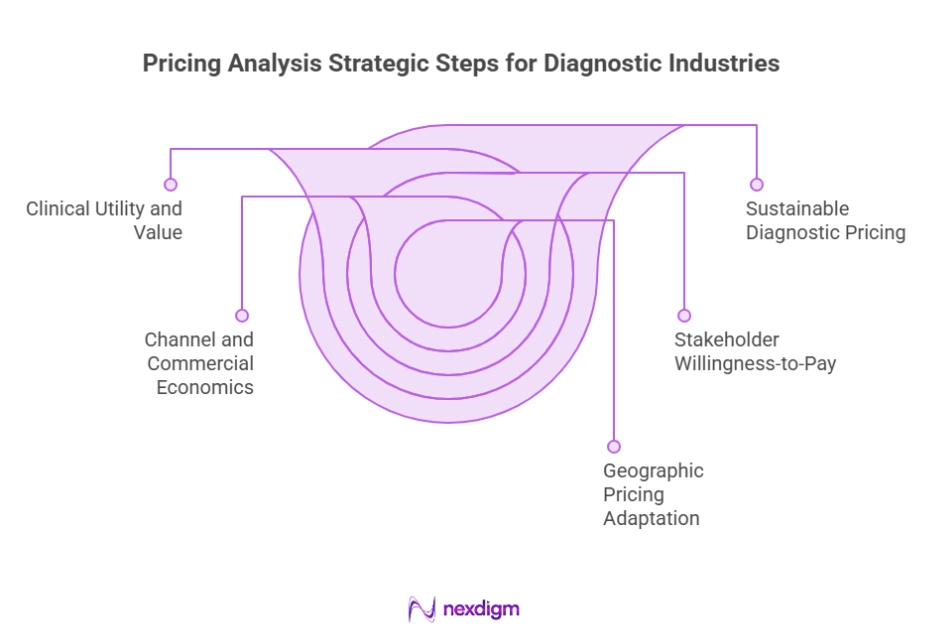
- Clinical Utility and Value Definition: Quantification of diagnostic accuracy, treatment influence, workflow efficiency, and patient outcomes to establish a credible value foundation supporting sustainable pricing and stronger stakeholder adoption decisions.
- Stakeholder Willingness-to-Pay Analysis: Assessment of price expectations across laboratories, hospitals, physicians, payers, distributors, and patients to identify acceptable thresholds and develop segment-specific diagnostic pricing approaches for market entry.
- Channel and Commercial Economics: Analysis of distributor margins, laboratory operating costs, logistics, discounts, and incentives to design commercially viable pricing structures that support market reach while protecting product profitability levels.
- Geographic Pricing Adaptation: Development of market-specific pricing based on purchasing power, reimbursement conditions, competition, healthcare infrastructure, and demand potential to improve affordability and adoption across diverse regions and segments.
Nexdigm’s Case
A diagnostics company engaged with Nexdigm to assess pricing feasibility before launching a new test. The analysis identified an optimal price corridor, improving projected adoption by 18%, reducing affordability-related resistance by 14%, and increasing forecast revenue by 11%. Reimbursement benchmarking and channel optimization further strengthened launch readiness across priority customer segments.
To take the next step, simply visit our Request a Consultation page and share your requirements with us.
Harsh Mittal
+91-8422857704