

Digital banking has become a core part of everyday financial activity. The World Bank’s Global Findex 2025 found that 79% of adults globally owned a financial account in 2024, while 86% owned a mobile phone.
However, access does not automatically mean active usage or customer loyalty. Customers increasingly compare banks with fintech platforms and other digital services when evaluating speed, pricing, convenience, security, and support.
For banks, fintech companies, and investors, understanding these expectations is becoming commercially important. A Digital banking market demand assessment helps identify which expectations influence adoption, where customer experience gaps exist, and which improvements can create stronger engagement.
Nexdigm connects customer behavior, digital usage, pricing, market intelligence, and competitive analysis to identify changing demand and potential growth opportunities.
Nexdigm’s Support towards Digital Banking Adoption
Speed is becoming a basic expectation across digital financial services. Customers expect routine activities to happen with minimal delays. Nexdigm supports digital banknig adoption by customers by evaluation of:
- Account Openings: Measure registration, verification, and activation time.
- Payments: Examine how efficiently customers can send and receive money.
- Credit: Assess the speed of digital applications and lending decisions.
- Service: Measure how quickly customer issues are addressed.
- Processing: Identify unnecessary steps and delays within digital journeys.
Nexdigm uses these indicators to identify where faster processes could improve adoption and reduce customer abandonment.
How Nexdigm Assesses Digital Banking Demand
Nexdigm begins by identifying the expectations that shape digital banking decisions. The assessment covers speed, pricing, convenience, service, security, digital features, personalization and product availability.
Rather than treating every feature equally, Nexdigm evaluates which factors influence customer acquisition, engagement, retention, and product adoption.
This provides institutions with a clearer understanding of what customers actually value.
Nexdigm in Enhancing Digital Banking Experience
Convenience is more than having a mobile application. Customers expect to complete financial activities without unnecessary steps or channel switching.
Nexdigm assesses the following signals to identify practical sources of digital banking and enhance the customer experience:
- Navigation: Evaluate the ease with which customers can locate services, complete tasks, and access information across digital channels.
- Onboarding: Assess the efficiency and simplicity of account opening, identity verification, and customer registration processes.
- Self-service: Review the availability and effectiveness of features that enable customers to independently manage routine banking activities.
- Account visibility: Evaluate how clearly customers can view account balances, transaction histories, product holdings, and financial insights.
- Payment simplicity: Assess the ease, speed, and convenience of making transfers, bill payments, and other digital transactions.
Nexdigm helps financial institutions enhance digital banking experiences by identifying these friction points across the customer journey. Through a structured assessment framework, Nexdigm enables organizations to deliver seamless, customer-centric digital experiences that drive engagement, satisfaction, and long-term loyalty.
Nexdigm’s Digital Banking Demand Assessment Framework
Nexdigm’s framework conducts Digital banking market demand assessment which brings customer expectations together through four simple dimensions:
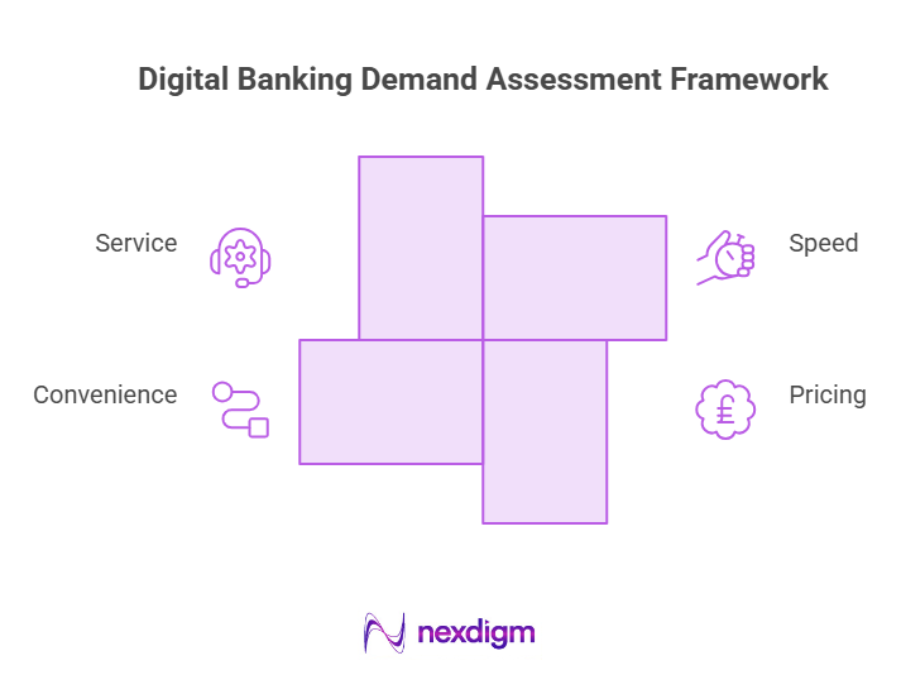
- Speed: Measures onboarding, transactions, applications, and service response to identify opportunities for faster digital journeys.
- Pricing: Evaluates fees, rates, rewards, and price sensitivity to understand how cost influences customer choice.
- Convenience: Assesses navigation, accessibility, self-service, and channel integration to identify barriers to digital adoption.
- Service: Examines support, resolution, human assistance, and customer experience to identify opportunities for stronger relationships.
Together, these dimensions show what customers expect, where digital experiences fall short, and which improvements can create stronger demand.
Business Impact of Nexdigm’s Demand Assessment Framework
Customer expectations matter because they can influence acquisition, engagement, retention, and revenue. Nexdigm connects customer expectations with commercial measures such as:
- Active users: Evaluate the number of customers regularly engaging with digital banking platforms to measure adoption and customer engagement.
- Transaction frequency: Assess how often customers use digital channels for payments, transfers, and other banking activities to understand platform utilization.
- Product adoption: Analyze uptake of banking products and services, such as savings accounts, loans, investments, and digital payment solutions.
- Customer acquisition: Evaluate the effectiveness of digital channels in attracting new customers and expanding market reach.
By combining such market trends with customer behavior, Nexdigm helps organizations to identify where digital banking demand can translate into commercial opportunities.
Nexdigm’s Investment Decision Support
For investors, digital banking opportunity should extend beyond registered-user numbers. Nexdigm evaluates whether customer adoption is creating measurable commercial value. The assessment considers:
- Market Demand: Size and growth of digitally engaged customer segments.
- Customer Value: Product adoption, retention, and revenue potential.
- Competitive Position: Strength of the digital proposition compared with alternatives.
- Scalability: Ability to expand digital products across markets and customer groups.
This helps investors distinguish between digital access and sustainable digital banking growth.
Nexdigm’s Case
A digital bank used Nexdigm’s Digital banking market demand assessment to identify customer expectations across speed, pricing, convenience, and service. Within 11 months, digital engagement increased 36%, onboarding completion improved 29%, active-user retention rose 24%, and customer-service resolution time decreased 21%, strengthening overall digital adoption.
To take the next step, simply visit our Request a Consultation page and share your requirements with us.
Harsh Mittal
+91-8422857704