

A smartphone in a student’s hand does not automatically make that student an online learner.
Digital education markets often begin with impressive connectivity statistics, but the commercial opportunity sits further down the funnel. A learner may own a device, watch educational videos occasionally, use a free platform during examinations, and still never become a paying subscriber.
The real market therefore must be measured through behaviour, not access alone.
From Connectivity to Commitment
ASER 2024 provides a useful illustration. Among rural adolescents aged 14 to 16, 82.2% knew how to use a smartphone, but only 57% had used one for an educational activity during the preceding week. Social media usage was considerably higher at 76%.
Device access establishes possibility.
Educational usage establishes intent.
Paid conversion and sustained engagement establish commercial demand.
Public platforms show how strongly this behaviour can change when digital content is connected to an immediate academic requirement. DIKSHA has recorded more than 556 crore learning sessions and over 6,455 crore learning minutes, with QR-linked textbooks directing students towards digital learning content.
For private platforms, however, the harder question begins after the free interaction.
Where Learners Drop Out
The digital education journey can be viewed as six behavioural stages:
Access → Consumption → Exploration → Structured Usage → Paid Conversion → Retention
- Access (Establishing Possibility): A device and connectivity provide the infrastructure, but ownership does not guarantee learning, entertainment and social media often dominate initial usage.
- Consumption (Establishing Intent): The user engages with free, episodic content (e.g., brief tutorials or QR-linked textbook videos) driven by immediate academic need or curiosity.
- Exploration (Evaluating Fit): The user browses course catalogues, samples quizzes, or downloads an app, actively assessing whether the platform matches their syllabus, medium, and pace.
- Structured Usage (Building Habit): The tipping point where episodic visits become regular study routines, marked by practice-question attempts, assignment submissions, and repeat sessions.
- Paid Conversion (Investing in Outcomes): Learners or parents pay for what free repositories lack: live doubt resolution, structured exam preparation, personalized assessment, and mentor accountability.
- Retention (Commercial Validation): The true test of product-market fit, sustained session frequency, course completion, and subscription renewal that validate measurable academic progress.
Each stage represents a different commercial problem.
A learner who watches a five-minute tutorial has demonstrated curiosity. A learner who completes assignments, repeatedly returns to the platform, and pays for structured support has demonstrated substantially stronger demand.
This distinction becomes particularly important in markets where free educational content is abundant. A platform cannot assume that a large registered-user base represents an equivalent pool of potential subscribers.
What Makes Someone Pay?
Paid conversion usually requires a stronger proposition than access to information.
Live doubt resolution, personalised assessment, mentor accountability, structured examination preparation, progress tracking, and outcome-linked learning can create value that free content does not easily replicate.
Pricing therefore needs to be assessed alongside engagement. A low-cost subscription with weak retention may be less attractive than a higher-priced service that solves a specific academic problem and keeps learners engaged.
Engagement Is the Commercial Signal
For digital education providers, useful metrics extend beyond downloads and registrations.
Track:
- onboarding completion
- first-week activity
- lesson completion
- average learning-session duration
- practice-question attempts
- assignment submissions
- free-to-paid conversion
- subscription renewal
- inactivity and churn
Together, these metrics reveal where the learner journey breaks down and which behaviours are associated with revenue.
Nexdigm’s Digital Education Demand Conversion Framework
A digital education demand analysis research approach can evaluate the market through six connected stages:
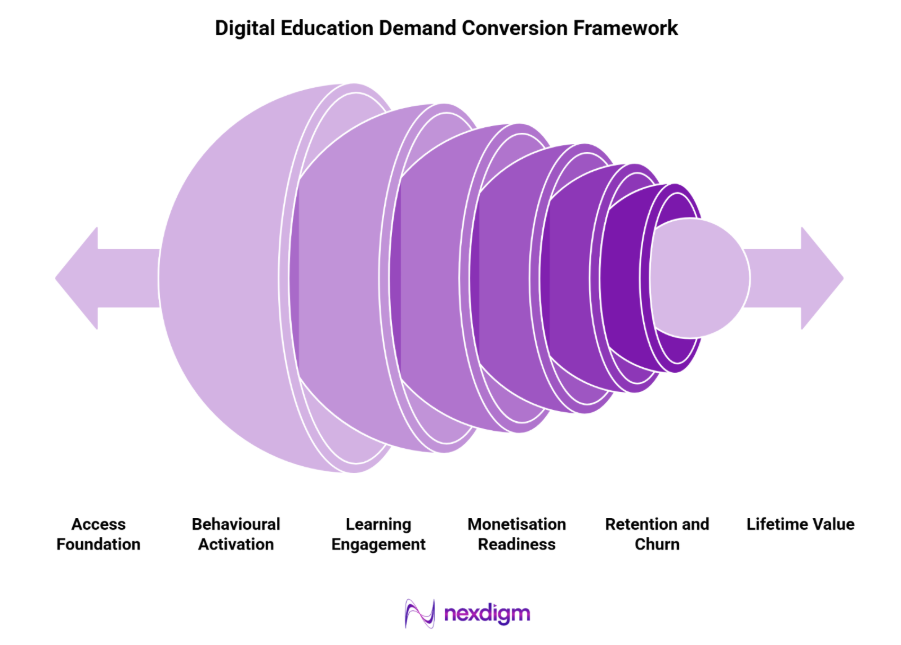
- Access Foundation
Measure smartphone availability, device ownership and sharing, connectivity quality, and bandwidth reliability across target learner segments. - Behavioural Activation
Track registrations, installations, onboarding completion, first-week activity, and frequency of initial platform use. - Learning Engagement
Measure meaningful educational behaviour through lesson completion, video consumption, assessments, practice activity, and assignment participation. - Monetisation Readines
Identify the behavioural and demographic characteristics associated with willingness to pay and movement from free to paid offerings. - Retention and Churn
Analyse declining activity, subscription cancellations, course completion, renewal rates, and the factors associated with sustained engagement. - Lifetime Value
Model retention, referrals, upgrades, cross-selling, and multi-year revenue to determine the commercial value of different learner cohorts.
Case Study: From Daily Usage to Higher Retention
A digital learning platform analysed 10,000 smartphone learners and found 78% daily video usage but 65% testing-stage drop-off. Interactive micro-assessments and regional-language audio increased course completion from 14% to 46% and annual renewals by 24%.
Digital education demand is therefore better understood as a progression from access to sustained learning behaviour. For platforms, publishers, and investors, identifying where users fall out of that progression can reveal which product features, pricing models, and learner segments have genuine commercial potential.
To take the next step, simply visit our Request a Consultation page and share your requirements with us.
Harsh Mittal
+91-8422857704