

Digital education has already moved beyond the question of whether learners will use online tools. The harder commercial question is whether a digital model can convert adoption into recurring engagement, paid usage and sustainable economics.
India’s digital learning infrastructure demonstrates the scale of adoption possible. DIKSHA has recorded 556.24 crore learning sessions and more than 6,455 crore learning minutes, while hosting 7,116 QR-code-enabled textbooks, including 389 NCERT textbooks.
ASER 2024 provides another view from rural households. Among 14–16-year-olds, 82.2% reported knowing how to use a smartphone, while 57% had used a smartphone for an educational activity during the reference week.
Access is therefore no longer the only market question.
Adoption and Monetisation Are Different Problems
A learner may use a digital platform frequently without paying for it. A school may adopt a platform but fail to renew the contract. A university may offer online courses while struggling to achieve sufficient enrolment.
The commercial model needs to account for this gap.
Different digital education models generate value in different ways:
- B2C subscriptions depend on learner acquisition, retention and willingness to pay.
- Institutional platforms depend on school or university contracts, implementation and renewal.
- B2B learning depends on employer demand, completion and workforce outcomes.
- Assessment and credentialing models depend on perceived value and recognition.
- Hybrid models combine physical instruction with digital content and can broaden reach without eliminating delivery costs.
The relevant market assessment therefore needs to examine the business model alongside learner adoption.
Engagement Is the Metric Between Adoption and Revenue
Digital education platforms can accumulate large user numbers without creating equivalent economic value.
The critical indicators include active-user rates, course completion, repeat usage, conversion to paid products, customer acquisition cost and lifetime value.
These measures can reveal whether growth is producing a stronger business or simply a larger user base.
This distinction has become increasingly relevant as the sector moves away from pandemic-era assumptions about unlimited online learning growth. Nexdigm’s current India EdTech market research also identifies monetisation, customer acquisition costs and learner retention as important market challenges.
The Delivery Model Has to Match the Learner
Digital education is not a single format.
A learner preparing for a competitive examination may value live instruction and frequent assessments. A working professional may prioritise flexible, asynchronous learning. A school student may require teacher-supported digital content. An institution may need an integrated learning-management system rather than a consumer-facing course library.
The same technology can therefore produce very different adoption and retention outcomes depending on the segment.
Localisation matters as well. Language, pricing, bandwidth requirements, device access and curriculum alignment can affect adoption, particularly outside major urban markets.
Scale Requires More Than More Users
A sustainable digital education model needs economics that improve as the platform grows.
Content-production costs, instructor costs, technology infrastructure, learner acquisition and support should be assessed against revenue per learner and retention.
A platform with strong engagement but high acquisition costs may struggle to scale profitably. A low-cost product with weak retention may face the opposite problem.
Market assessment should therefore test the relationship between user growth and unit economics rather than treating scale as an outcome in itself.
Nexdigm’s Digital Education Assessment Framework
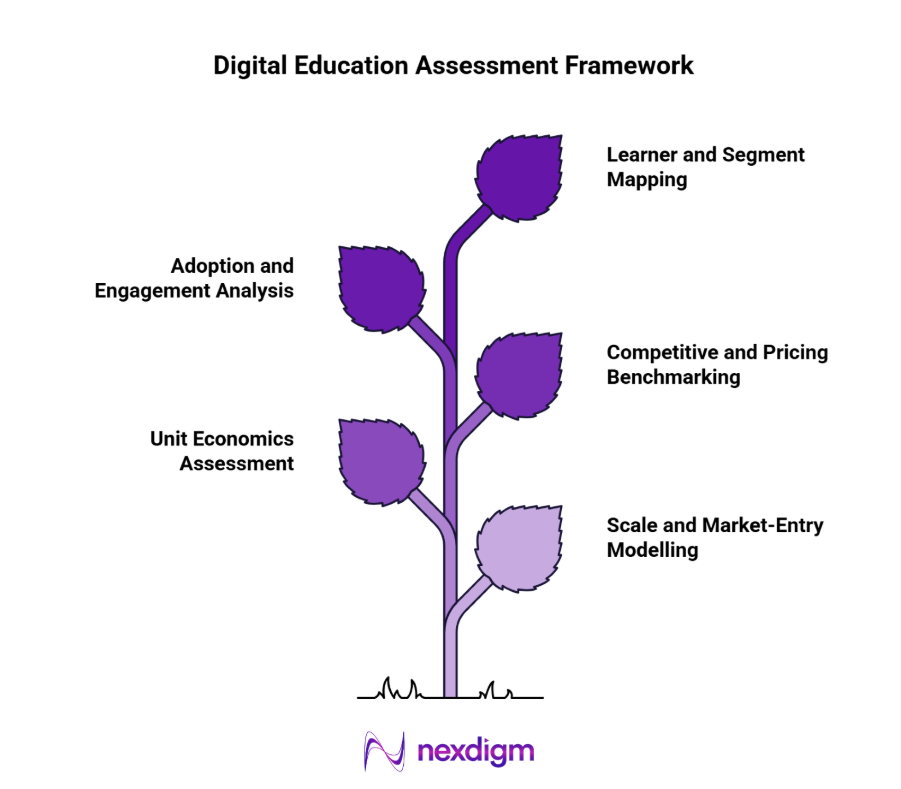
- Learner and Segment Mapping
Identify target learners by age, academic stage, occupation, geography, affordability and learning need. - Adoption and Engagement Analysis
Assess usage, active learners, completion, retention and preferred delivery formats. - Competitive and Pricing Benchmarking
Compare competitors on content, pricing, features, positioning, acquisition channels and monetisation models. - Unit Economics Assessment
Evaluate acquisition cost, revenue per learner, retention, delivery costs and lifetime value. - Scale and Market-Entry Modelling
Test growth scenarios across B2C, institutional, B2B and hybrid models to determine where sustainable expansion is feasible.
Nexdigm’s Case Study: Improving Digital Learning Conversion
A leading digital skilling platform operating across Asia faced low completion rates and unclear learner engagement patterns. Nexdigm benchmarked 14 global competitors, mapped engagement triggers and redesigned the retention model. Course completion increased by 34%, while paid conversions rose by 19% within five months. Digital education can achieve substantial reach but reach alone does not establish a sustainable business. The stronger opportunity lies where learner demand, engagement, monetisation and delivery economics reinforce one another.
Nexdigm can support digital education providers and investors through learner research, competitive benchmarking, pricing analysis, market sizing and commercial feasibility assessment.
To take the next step, simply visit our Request a Consultation page and share your requirements with us.
Harsh Mittal
+91-8422857704