

Two education platforms can offer similar courses and still deliver very different results. One becomes part of a learner’s routine. The other is opened a few times and forgotten. The difference may have little to do with the size of the content library. Navigation, teaching quality, assessment, personalisation and access to credible credentials can matter just as much.
For platform providers, the challenge is deciding which capabilities actually influence adoption, retention and willingness to pay.
Digital Education Platform Features That Matter to Buyers
Content remains essential, but quantity is a weak differentiator when learners can access free videos, open educational resources and competing course libraries. A platform needs a clear reason for users to choose its material over alternatives.
That reason varies by segment. School leaders may value curriculum alignment and teacher controls. Universities may prioritise integration with existing systems, assessment tools and reporting. Individual learners may care more about instructor credibility, flexibility and whether a credential is recognised by employers.
The strongest product proposition usually combines relevant content with a useful learning experience. That includes clear course structure, accessible interfaces, appropriate difficulty, timely feedback and support when learners get stuck.
Accessibility also affects the addressable market. The World Wide Web Consortium’s Web Content Accessibility Guidelines provide a recognised basis for making digital content more usable for people with disabilities. Captioning, keyboard navigation, readable layouts and compatibility with assistive technologies are not merely design details. They can determine whether some learners can use a platform at all.
Why User Experience and Learning Outcomes Affect Retention
A platform may attract users through marketing, partnerships or a large course catalogue. Retention depends on what happens after registration.
Learners need to understand what to do next, see progress and receive feedback that helps them improve. Educators need tools that fit their workflows rather than create additional administrative work. Institutional administrators need reliable reporting and control over access, permissions and data.
UNESCO’s 2023 Global Education Monitoring Report cautions that evidence of education technology’s impact is uneven. The report emphasises that technology should support learning outcomes rather than serve as a substitute for effective teaching. For platform operators, this creates a practical distinction between activity metrics and meaningful value.
Time spent in the application does not necessarily mean learning has improved. Better indicators might include assessment performance, successful completion of a learning objective, skill demonstration or reduced time required to perform a task.
Digital Education Platform Market Assessment: Where Is the Advantage?
A Digital education platform market assessment should compare competitors across the factors that influence the buying decision, not simply count features.
The analysis needs to establish whether a platform has an advantage in one or more areas:
- Content differentiation: Specialist subject coverage, credible instructors, curriculum alignment or recognised credentials.
- Learning experience: Clear navigation, mobile usability, personalisation, feedback and accessible design.
- Demonstrable outcomes: Evidence of skill development, learning progress or improvements in teaching and administration.
- Ecosystem reach: Relationships with institutions, employers, publishers, content creators and credentialing partners.
- Commercial sustainability: Pricing, support costs, retention, acquisition efficiency and the ability to serve larger customer groups.
Ecosystem reach can be particularly difficult for competitors to replicate. A platform connected to universities, employers or professional bodies may offer credentials and opportunities that an isolated content provider cannot. But partnerships create value only when they improve the learner’s experience or the buyer’s results.
Nexdigm’s Digital Education Platform Competitive Strategy Framework
The Digital Learning Platform Competitive Advantage Framework helps providers decide where to invest.
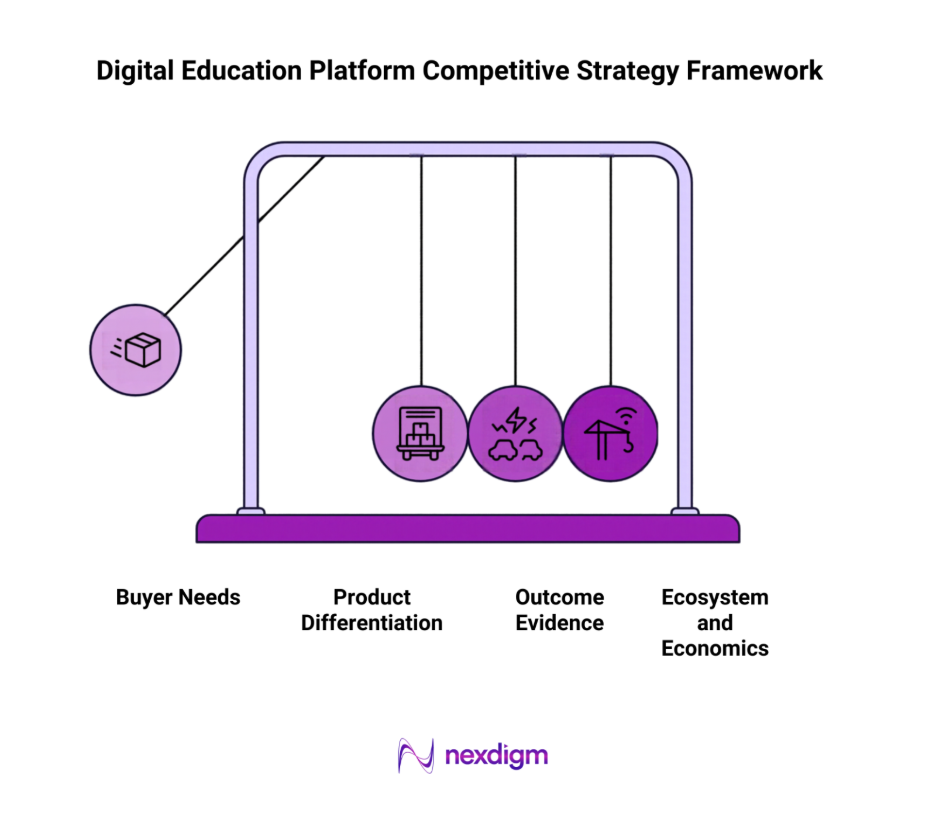
- Buyer Needs: Identify the user, budget owner and job the platform must perform.
- Product Differentiation: Compare content quality, user experience, accessibility and integration against alternatives.
- Outcome Evidence: Establish which learning or operational results the platform can credibly demonstrate.
- Ecosystem and Economics: Assess partnership value, retention, support requirements and the cost of scaling delivery.
A platform does not need to lead on every dimension. It does need a defensible advantage that matters to its target customers and can be maintained as competitors respond.
Nexdigm Case Study: Assessing Platform Differentiation
Nexdigm compared 12 digital education platforms across content depth, usability, assessment, integrations, pricing and institutional partnerships. The assessment found that feature breadth alone did not explain the strongest competitive positions. Four platforms stood out for a clearer combination of specialised content, measurable outcomes, and distribution partnerships. The client used these findings to prioritise product improvements and focus its positioning on a defined buyer segment.
To take the next step, simply visit our Request a Consultation page and share your requirements with us.
Harsh Mittal
+91-8422857704