

Customer experiences increasingly span websites, mobile applications, online stores, customer portals and digital service channels. Organisations need these touchpoints to feel consistent, even when different teams manage the underlying content, customer data and technology. A digital experience platform (DXP) can bring several of these capabilities together, but the market includes products with very different strengths. Some are built around content management, while others offer broader capabilities for commerce, personalisation, analytics and customer engagement.
A digital experience platform vendor analysis helps organisations identify suppliers that can support their digital strategy without creating unnecessary technology complexity. The evaluation should consider the platform’s functional capabilities, integration architecture, deployment model, scalability and total cost of ownership.
Understanding What the Organisation Actually Needs
The term DXP is used broadly across the technology market. Some platforms provide an integrated suite covering content management, digital asset management, customer data, personalisation and commerce. Others operate as composable platforms, allowing organisations to assemble capabilities from specialist products through APIs and integrations.
Neither approach is automatically superior. An integrated suite may simplify administration and provide a more consistent user experience for marketing teams. A composable architecture can offer greater flexibility, particularly when organisations already operate established commerce, analytics or content systems. However, it also increases the importance of integration planning, technical ownership and ongoing vendor coordination.
Procurement teams should begin by identifying the digital experiences the platform must support. A business managing multiple regional websites may prioritise multilingual content, workflow approvals and localisation. A retailer may place greater emphasis on product catalogues, transactions and customer personalisation. A financial services organisation may require stronger identity controls, consent management and auditability.
Five Areas That Should Shape Vendor Evaluation
Content management and experience delivery
Content capabilities determine how easily teams can create, approve, publish and update digital experiences. Vendors should be assessed on content modelling, version control, workflow management, multilingual support, digital asset management and omnichannel publishing.
The evaluation should also examine how content is delivered across websites, mobile applications and other interfaces. Headless content management can provide greater flexibility by separating content storage from presentation, but it may require more development resources than a traditional integrated content system.
Personalisation and customer data
Personalisation capabilities vary from basic audience segmentation to more advanced behavioural targeting and recommendation engines. Organisations should examine how platforms collect customer signals, create audience profiles and use data to adapt digital experiences.
Data governance is central to this assessment. Suppliers should explain how consent preferences, customer identities, data retention and access permissions are managed. Organisations operating across jurisdictions must also consider applicable privacy requirements.
Digital commerce
Commerce capabilities matter when the platform supports product discovery, catalogues, promotions, pricing, checkout or customer account management. Some DXPs include native commerce functionality, while others integrate with specialist commerce engines.
Procurement teams should establish whether the platform can support the organisation’s product structure, payment requirements, regional pricing and order management processes. They should also assess how easily commerce data can be exchanged with ERP, CRM and inventory systems.
Analytics and performance measurement
A DXP should help organisations understand how visitors interact with digital channels. Evaluation criteria may include journey analytics, content performance, conversion tracking, experimentation and integration with business intelligence tools.
The presence of an analytics module does not necessarily mean it will replace existing enterprise reporting systems. Organisations should assess data export, reporting flexibility and compatibility with their wider analytics architecture.
Integration and technical flexibility
DXPs often need to connect with CRM, marketing automation, identity management, payment, search, product information and enterprise resource planning systems. Vendor assessment should examine API availability, connectors, event handling, integration tooling and support for existing infrastructure.
The ability to integrate with third-party products can be more important than the number of features included in a vendor’s own suite. Procurement teams should identify dependencies that could increase implementation costs or restrict future platform changes.
Commercial Considerations and Long-Term Platform Risk
DXP pricing may depend on traffic volumes, content usage, user numbers, environments, API consumption, storage or selected modules. Organisations should model costs against expected digital growth rather than compare introductory subscription prices.
Implementation and migration costs can also be substantial, particularly when an organisation operates multiple websites, legacy content repositories or complex customer journeys. Other considerations include developer availability, partner ecosystem maturity, upgrade requirements and the effort needed to maintain integrations.
A vendor’s roadmap should be reviewed alongside its current capabilities. Organisations need confidence that the supplier will continue investing in relevant technologies without forcing disruptive changes to the existing architecture.
How Nexdigm Supports DXP Supplier Research
Nexdigm supports technology procurement through market research, supplier intelligence, competitive benchmarking and commercial analysis. Its research can help organisations map DXP providers, compare functional capabilities, assess market positioning and evaluate pricing and implementation considerations against their digital priorities.
Digital Experience Platform Vendor Evaluation Framework
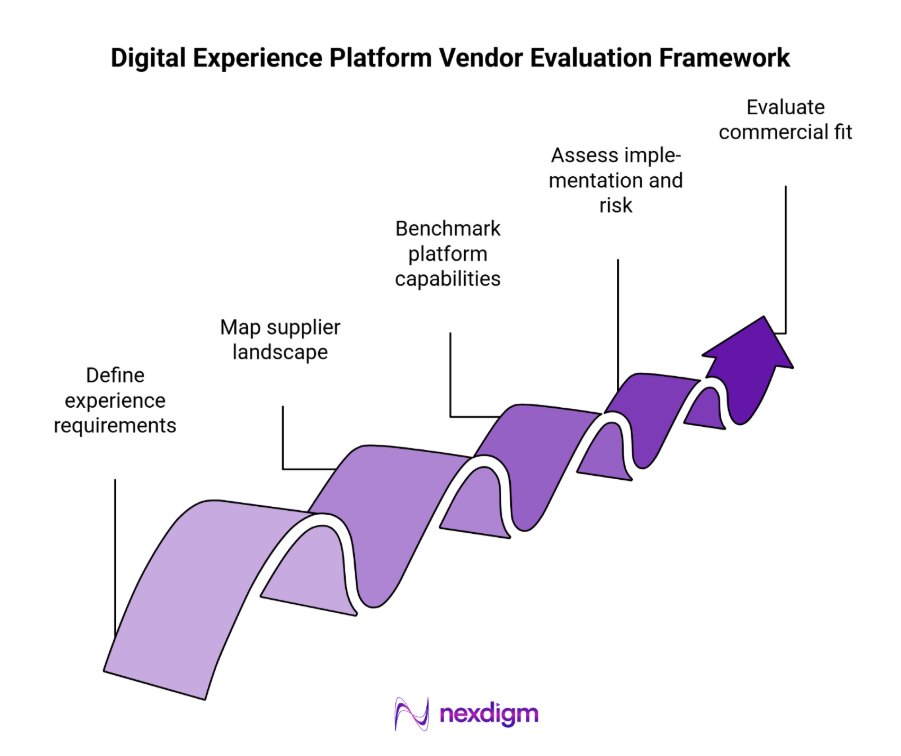
- Define experience requirements: Identify customer journeys, digital channels, content needs, commerce requirements and regional considerations.
- Map the supplier landscape: Classify vendors by platform architecture, core specialisation, industry focus and deployment model.
- Benchmark platform capabilities: Compare content, personalisation, commerce, analytics, integration and governance.
- Assess implementation and risk: Review migration complexity, technical dependencies, data controls, partner availability and vendor roadmap.
- Evaluate commercial fit: Model licensing, implementation, support, maintenance and scaling costs.
Nexdigm’s Case Study: Comparing Digital Experience Platform Providers
Nexdigm assessed 12 DXP providers across five functional categories, reviewed integration requirements for eight enterprise systems and compared commercial models across three deployment scenarios. The research shortlisted four suppliers for detailed evaluation.
To take the next step, simply visit our Request a Consultation page and share your requirements with us.
Harsh Mittal
+91-8422857704