

Digital health platforms are expanding rapidly as virtual care adoption accelerates across global markets, driven by rising patient demand for convenience, remote access, and continuous care. A well-defined Digital health platform market entry strategy helps healthcare companies assess regulatory requirements, technology readiness, data privacy norms, payer models, and patient adoption potential before entering new markets. It also supports decisions around teleconsultation, remote monitoring, digital diagnostics, e-pharmacy, and integrated care platforms.
As healthcare systems shift toward hybrid delivery models, digital platforms are becoming central to improving access, reducing system pressure, and scaling care delivery efficiently across diverse regions.
Digital health adoption is expanding as healthcare systems invest in virtual care, remote monitoring, and technology-enabled access. The global digital health market was valued at about USD 288.55 billion in 2024 and is projected to reach USD 946.04 billion by 2030, growing at nearly 22% CAGR. The telehealth market alone is expected to reach USD 455.27 billion by 2030, highlighting strong momentum for digital health platform market entry strategy.
Managing Market Entry Risks in Digital Health and Virtual Care Delivery
Managing market entry risks in digital health and virtual care delivery involves assessing data privacy, cybersecurity, regulatory compliance, reimbursement uncertainty, technology readiness, patient adoption, and provider integration before launching in new markets.
- Data Privacy and Consent Risks: Assess patient data collection, consent, storage, and sharing requirements to avoid privacy breaches and regulatory non-compliance.
- Cybersecurity and Platform Protection: Review system vulnerabilities, access controls, encryption, and incident response readiness to protect digital health platforms from cyber threats.
- Technology Readiness and Integration: Review platform scalability, interoperability, electronic health record integration, and connectivity requirements for smooth service delivery.
- Patient Adoption and Trust Barriers: Analyze digital literacy, user experience, language needs, and trust levels to improve patient engagement and adoption.
Nexdigm’s Market Assessment for Digital Health Adoption
Nexdigm’s market assessment for digital health adoption helps healthcare and technology companies evaluate demand, readiness, and growth potential across target markets. This includes analyzing patient behavior, digital literacy, telehealth usage, provider readiness, payer acceptance, regulatory conditions, and competitive activity. The assessment supports informed market entry, platform localization, adoption planning, and scalable virtual care expansion.
How Can Nexdigm Assist with Business Setup and Entity Structuring for Digital Health Companies?
Nexdigm can assist digital health companies with entity formation, ownership structuring, tax alignment, regulatory registration, compliance setup, and operating model design to support smooth market entry and scalable virtual care operations:
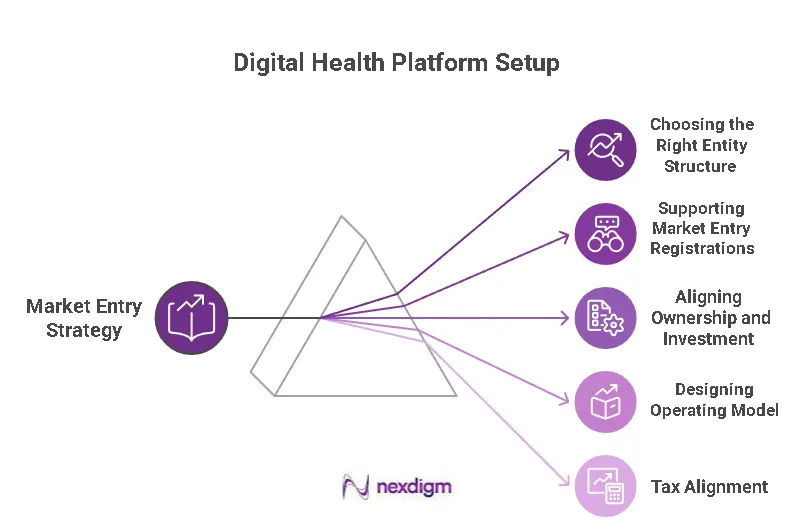
- Choosing the Right Entity Structure: Assess subsidiary, branch, joint venture, or partnership models based on ownership, liability, tax, and expansion needs.
- Supporting Market Entry Registrations: Assist with business incorporation, regulatory filings, tax registrations, healthcare approvals, and other setup requirements in target markets.
- Aligning Ownership and Investment Models: Structure ownership, funding flows, investor participation, and governance arrangements to support compliant digital health expansion.
- Designing a Scalable Operating Model: Define local roles, cross-border functions, reporting lines, technology ownership, and service delivery responsibilities.
- Planning Tax and Transfer Pricing Alignment: Evaluate tax exposure, intercompany charges, digital service revenues, and transfer pricing requirements for virtual care operations.
Nexdigm’s case:
Nexdigm helped a digital health company set up operations across three new markets for virtual care delivery. Nexdigm supported entity structuring, tax registration, regulatory setup, and operating model design for a platform targeting 500,000 users. The engagement helped reduce market entry preparation time by 25%, align compliance requirements across jurisdictions, and create a scalable structure to support teleconsultation, remote monitoring, and digital care expansion.
To take the next step, simply visit our Request a Consultation page and share your requirements with us.
Harsh Mittal
+91-8422857704