

Digital health is expanding from individual applications into broader technology ecosystems spanning telehealth, patient engagement, remote monitoring, analytics, digital therapeutics, connected devices, and health information exchange. The global digital health market was valued at approximately $347.4 billion in 2025 and is projected to reach $1.83 trillion by 2033, representing a 23.4% CAGR from 2026 to 2033. Software accounted for 45.7% of market revenue in 2025, highlighting the growing importance of technology platforms.
Adoption is also broadening across healthcare organizations. In 2024, 99% of U.S. hospitals enabled patients to electronically view health information, while 92% supported secure messaging with providers. About 81% enabled patient access through apps configured to meet API specifications, and 70% supported FHIR-enabled apps.
The market is not uniform, however. The WHO’s 2024 Global Digital Health Monitor recorded an average global digital health maturity of Phase 3, with high-income countries averaging Phase 4 and lower-middle-income countries averaging Phase 3.
As organizations adopt digital solutions at different levels of maturity, digital health solution supplier research can help map relevant providers, understand their capabilities and deployment models, and determine which suppliers are best aligned with specific healthcare environments.
Digital Health Is Becoming a Multi-Solution Ecosystem
Digital health now spans multiple technology categories rather than a single software market. Organizations may evaluate telehealth platforms, patient engagement tools, remote monitoring solutions, analytics platforms, digital therapeutics, interoperability technologies, and connected-care applications simultaneously. This creates a supplier environment where platform breadth, specialization, integration, deployment flexibility, and market presence can vary substantially between vendors.
Three Questions Help Define the Supplier Landscape
Before comparing individual providers, organizations can establish the broader market context:
- What Solutions Are Available? Map platform categories, applications, capabilities, and use cases across the digital health ecosystem.
- How Can They Be Deployed? Compare cloud, SaaS, on-premises, hybrid, mobile, and other deployment approaches against organizational technology requirements.
- Which Suppliers Fit the Market? Evaluate capabilities, healthcare experience, integration, scalability, geographic reach, commercial positioning, and implementation readiness.
A structured view of these dimensions helps organizations move from a broad supplier universe toward more relevant digital health options.
Nexdigm’s Approach to Digital Health Solution Supplier Research
Nexdigm can combine healthcare market intelligence, technology research, supplier mapping, competitive analysis, and sector expertise to evaluate the increasingly diverse digital health ecosystem. Through digital health solution supplier research, Nexdigm can examine solution portfolios, platform capabilities, deployment models, interoperability, healthcare presence, scalability, implementation capabilities, market positioning, and commercial structures.
Nexdigm’s Healthcare Expertise in Interpreting Supplier Markets
Nexdigm’s subject-matter expertise can add context to supplier research by interpreting technology capabilities through the lens of healthcare delivery, market dynamics, digital adoption, and business requirements. Rather than treating supplier information as standalone data points, experts can connect:
- Healthcare Domain Expertise: Interpret supplier capabilities in the context of clinical workflows, patient needs, provider adoption, and evolving healthcare delivery models.
- Market Intelligence Expertise: Assess supplier positioning, competitive dynamics, emerging technologies, partnerships, and market developments to identify meaningful shifts in the digital health landscape.
- Technology & Commercial Expertise: Connect platform capabilities with integration requirements, deployment considerations, scalability, pricing structures, and broader investment implications.
- Decision-Making Perspective: Translate complex supplier information into insights that can support technology strategy, procurement, partnerships, and digital transformation decisions.
This expert-led perspective helps turn digital health solution supplier research into contextual intelligence, giving organizations a clearer understanding of not only what suppliers offer, but what those capabilities mean for their strategic priorities.
How Nexdigm’s Expertise Strengthens Supplier Intelligence
Nexdigm’s expert-led interpretation can help organizations turn fragmented supplier information into actionable market intelligence. By connecting supplier capabilities, healthcare needs, technology developments, competitive positioning, and commercial considerations, the analysis can reveal opportunities and gaps that may not be apparent from basic vendor mapping. This can support more informed supplier evaluation, technology planning, partnership decisions, and procurement priorities.
Impact of Nexdigm’s Expert-Led Digital Healthcare Supplier Intelligence
Nexdigm’s expert interpretation can turn supplier research into practical intelligence with three key outcomes:
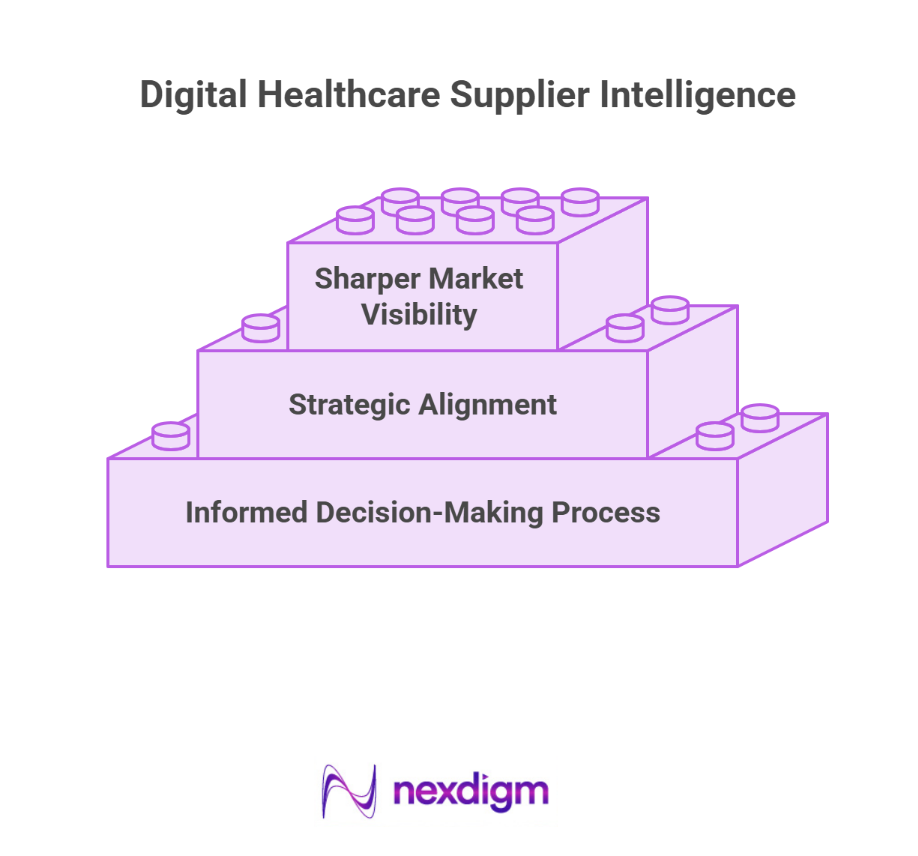
- Sharper Market Visibility: Bring supplier capabilities, emerging technologies, competitive positioning, and market developments into a consolidated view for clearer decision-making.
- Better Strategic Alignment: Connect supplier strengths and gaps with healthcare priorities, technology requirements, deployment considerations, and evolving digital health needs.
- More Informed Decisions: Provide contextual insights that can support supplier evaluation, procurement, partnerships, technology planning, and broader digital transformation initiatives.
This enables organizations to move from simply understanding the supplier landscape to using market intelligence as an input for strategic digital health decisions.
Nexdigm’s Case
Nexdigm supported a healthcare organization in mapping 38 digital health suppliers across solution capabilities. The analysis identified 25% with broader solution portfolios, 24% with stronger integration capabilities, and 18% with greater deployment flexibility, helping the organization prioritize relevant suppliers for deeper evaluation and strategic discussions.
To take the next step, simply visit our Request a Consultation page and share your requirements with us.
Harsh Mittal
+91-8422857704