

The retail investment experience has changed from broker-assisted transactions to digital, self-directed investing. Investors can now open accounts, complete KYC, transfer funds, research securities, and manage portfolios through a single platform. As a result, the platform itself has become an important part of the investment proposition.
Access, pricing, product availability, interface quality, and technology reliability increasingly influence where investors hold their assets. This is particularly important as digital platforms expand beyond trading into broader wealth-management ecosystems.
Access Changed First. Pricing Is Changing Next
Digital infrastructure such as Aadhaar e-KYC, DigiLocker, and UPI has reduced the friction associated with opening and funding investment accounts. What previously required physical documentation and intermediary assistance can now be completed through a smartphone.
Discount brokerages subsequently changed the economics of retail investing through flat-fee and zero-brokerage models for selected transactions. Lower transaction costs helped broaden participation and increased competitive pressure across the brokerage industry.
Pricing, however, is becoming less distinctive as low-cost execution becomes increasingly common. Platforms now need to compete through product breadth, usability, analytics, and the overall investment experience.
Product Breadth Is Becoming a Differentiator
Platforms that began with a single product are increasingly developing multi-asset propositions. Investors can access equities and derivatives alongside mutual funds, SIPs, bonds, gold, REITs, and other investment products through a single interface.
This expansion serves several purposes:
- Equities and derivatives drive active engagement and transaction activity.
- Mutual funds and SIPs support recurring investments and longer-term AUM accumulation.
- Bonds and fixed-income products attract more conservative capital and can improve portfolio retention during equity-market downturns.
- Alternative products such as digital gold, REITs, InvITs, and thematic baskets provide additional options for mass-affluent investors.
A digital investment platform market analysis can help management teams assess whether broader product coverage is generating stronger engagement, cross-selling, and customer lifetime value rather than simply increasing the number of products available.
Investor Experience Is Becoming a Competitive Advantage
Once access and pricing become broadly comparable, the quality of the digital experience becomes more important. Investors increasingly expect fast onboarding, reliable execution, intuitive portfolio reporting, and convenient access to tax and transaction information.
Platforms are also incorporating portfolio-risk diagnostics, investor education, concentration alerts, dividend tracking, and capital-gains reporting. These features can extend the role of an investment application from transaction execution toward ongoing portfolio management.
Technology resilience is equally important. Market volatility can generate sharp increases in platform traffic, making uptime, execution reliability, exchange connectivity, and customer support critical components of the proposition.
Nexdigm’s Digital Investment Platform Market Analysis Framework
Nexdigm evaluates digital investment platforms across the full customer and commercial lifecycle, linking acquisition performance with product depth, technology, engagement, and monetization.
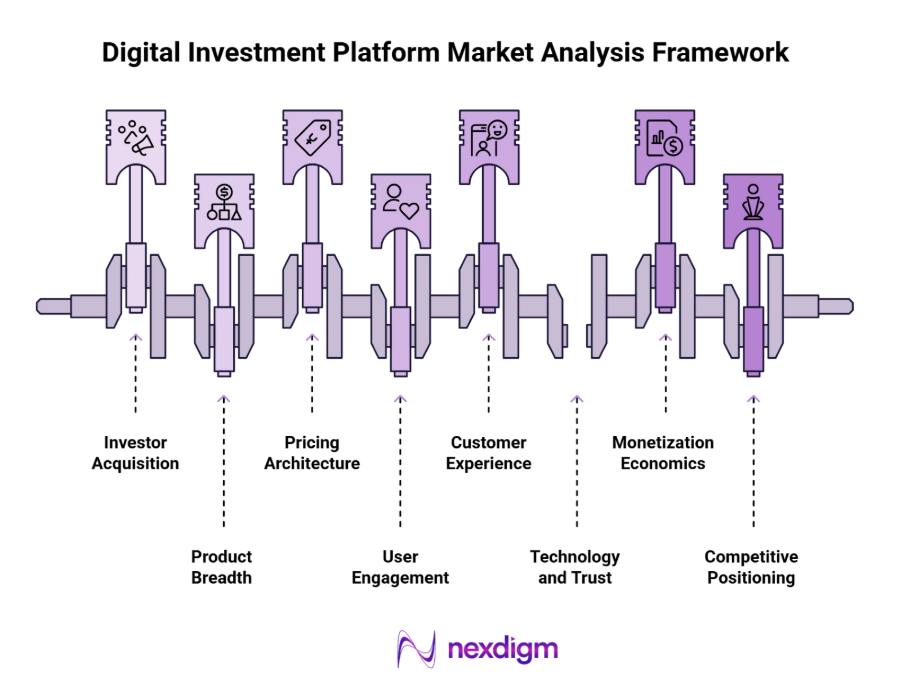
- Investor Acquisition: Assess onboarding time, KYC completion, funnel drop-offs, customer acquisition costs, and referral contribution.
- Product Breadth: Benchmark availability across equities, derivatives, mutual funds, fixed income, gold, REITs, and other investment products.
- Pricing Architecture: Compare brokerage structures, subscriptions, margin funding costs, and other customer charges.
- User Engagement: Measure active-user ratios, session behaviour, portfolio reviews, and trading or investment frequency.
- Customer Experience: Evaluate interface responsiveness, research tools, portfolio reporting, tax functionality, and customer sentiment.
- Technology and Trust: Assess uptime, peak-load resilience, execution performance, security controls, and exchange and depository connectivity.
- Monetization Economics: Analyse ARPU, cross-selling, margin-funding income, recurring revenue, and customer lifetime value.
- Competitive Positioning: Benchmark market share, trading activity, customer demographics, regional penetration, and account attrition.
The resulting assessment identifies where a platform is losing customers, where product expansion can improve wallet share, and which technology or experience improvements are most likely to affect commercial performance.
How Nexdigm Benchmarks Digital Investment Platforms
A traditional financial services conglomerate seeking to defend its retail brokerage position benchmarked 14 digital investment platforms across 35 user journeys.
Digital-native leaders completed KYC and first-trade funding in 4.2 minutes with an 84% completion rate, compared with 28 minutes and a 42% drop-off on the client’s legacy platform.
Multi-asset platforms recorded 3.1x higher monthly engagement and 48% higher customer lifetime value. The client subsequently redesigned onboarding and introduced a unified multi-asset portfolio dashboard, improving mobile onboarding conversion by 38% and multi-product adoption by 26% over 12 months.
To take the next step, simply visit our Request a Consultation page and share your requirements with us.
Harsh Mittal
+91-8422857704
[email protected]