

Digital learning demand will not grow at the same rate across schools, universities, and workforce training. A school may adopt software to support classroom instruction; a university may digitise assessment and course administration, and an employer may purchase training to close a specific skills gap. Each market has different budgets, procurement cycles, and reasons to invest.
For providers planning capacity or entering new segments, a single growth rate can obscure more than it reveals. A useful forecast needs to explain where demand is likely to emerge, what could accelerate adoption, and which barriers may slow it down.
Digital Learning Demand Forecast: What the Current Indicators Show
India’s education system offers a substantial potential user base. The Economic Survey 2024–25 reported that schools served approximately 24.8 crore students across 14.72 lakh schools. Higher education also represents a significant market: the Ministry of Education’s AISHE 2021–22 survey recorded nearly 4.33 crore students enrolled in higher education, up from 3.42 crore in 2014–15.
Infrastructure is gradually widening the scope for digital delivery. Government data show that 67.4% of schools reported internet access in 2025–26, compared with 53.9% in 2023–24. This creates more opportunities for digital content, assessment and school-management tools, although connectivity alone does not guarantee that schools have the devices, budgets or staff training needed to adopt them.
The workforce market has a different demand driver. The World Economic Forum’s Future of Jobs Report 2025 found that two-thirds of companies operating in India saw a need to access more diverse talent pools to fill emerging roles. Employers’ efforts to develop skills internally create potential demand for digital training, but providers must show that their programmes address specific business requirements.
These indicators point to expanding opportunities. They do not, by themselves, establish a reliable annual growth rate for the entire digital learning market.
Which Education Segments Are Likely to Grow Faster?
- Schools: Adoption will depend on implementation capacity. Demand may develop around assessment, teacher support, curriculum-aligned content and administrative tools. Public procurement, uneven infrastructure, and educator training can influence how quickly products reach classrooms. Vendors that reduce teacher workload and work reliably on available devices may have an advantage.
- Universities: Integration and flexible delivery will matter. Higher education institutions can use digital tools for course management, assessment, hybrid instruction, and specialised learning resources. Growth will depend partly on whether platforms integrate with existing systems and provide useful reporting. Procurement and faculty adoption may make institutional sales slower than consumer subscriptions.
- Workforce training: Skills requirements will shape spending. Employers need to update employee capabilities as roles and technologies change. Digital training can help distribute programmes across locations and measure participation, but purchasing decisions increasingly need to connect learning with demonstrable competence, compliance or job performance.
Consumer learning may also grow where learners have a clear reason to pay, such as professional certification or examination preparation. However, competition, price sensitivity and customer acquisition costs can limit profitability even when enrolments increase.
Forecasting Digital Learning Demand Under Different Scenarios
A practical Digital learning demand forecast should model adoption by segment rather than apply one growth assumption to all buyers.
- High-growth scenario: Infrastructure improves, institutional budgets expand, educators receive effective support, and employers increase spending on skills development. Adoption accelerates where products demonstrate measurable value.
- Base-case scenario: Connectivity and digital use continue to improve, but purchasing remains uneven. Schools and universities adopt selectively, while workforce training grows where employers can identify clear business needs.
- Low-growth scenario: Budget pressure, weak implementation capacity, limited evidence of outcomes or disappointing renewal rates delay adoption. Interest remains visible, but conversion into paid and sustained usage is slower.
Each scenario should be translated into measurable assumptions: the number of institutions targeted, the proportion likely to adopt, average contract value, sales-cycle length, learner conversion, and renewal rates. These inputs make the forecast useful for revenue planning rather than simply describing a growing sector.
Digital Learning Market Forecast Framework
The Digital Learning Demand Forecasting Framework combines four sources of evidence:
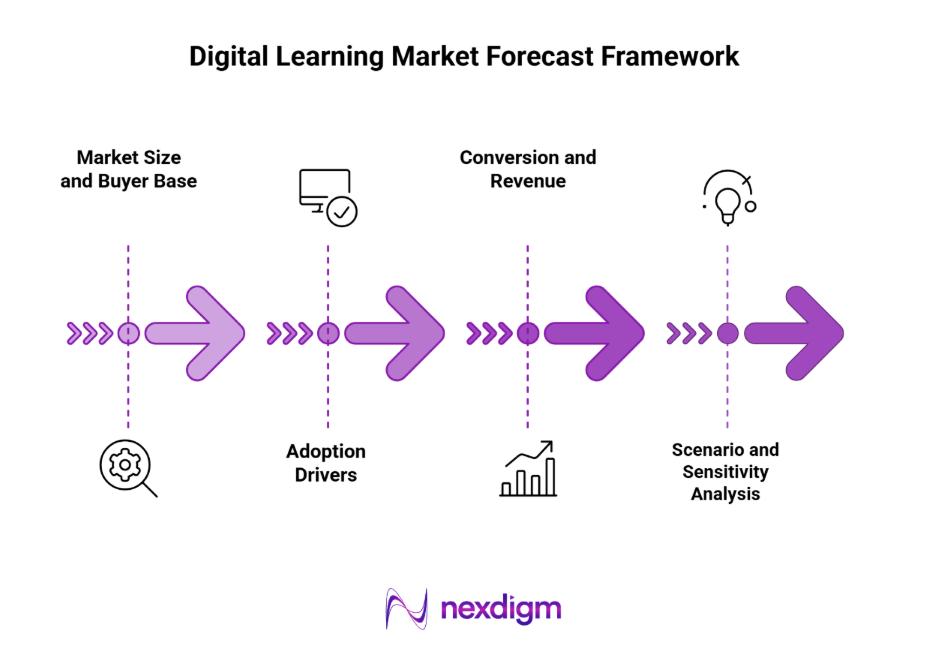
- Market Size and Buyer Base: Estimate addressable schools, universities, employers and individual learners by segment.
- Adoption Drivers: Track infrastructure, digital readiness, skills requirements, policy priorities and procurement activity.
- Conversion and Revenue: Model purchase rates, pricing, implementation time, retention and repeat spending.
- Scenario and Sensitivity Analysis: Test how budget changes, adoption delays and weaker renewals affect expected demand.
Forecasts should be refreshed as new adoption and purchasing data become available. Registrations, pilot projects and expressions of interest are useful leading indicators, but paid deployments and renewals provide stronger evidence of sustained demand.
Nexdigm Case Study: Forecasting Demand Across Education Segments
Nexdigm assessed digital learning demand across schools, higher education and corporate training. The analysis compared addressable buyers, procurement timelines, infrastructure readiness, pricing, and likely adoption rates. Schools showed broad potential but varied implementation readiness, while corporate training opportunities were more concentrated around defined skills requirements. The resulting forecast used separate adoption assumptions for each segment rather than a single growth rate for the overall market.
To take the next step, simply visit our Request a Consultation page and share your requirements with us.
Harsh Mittal
+91-8422857704