

Digital Lending Strategies Improve Credit Access Across Underserved Consumer Segments highlights how technology-led lending models are helping expand financial inclusion. Many consumers and small businesses remain underserved due to limited credit histories, branch access, or traditional underwriting barriers.
Digital lending platforms use alternative data, automated risk assessment, digital KYC, and faster disbursement processes to improve access to credit. A strong Digital lending market entry strategy helps firms assess borrower demand, regulatory requirements, credit risk, partnerships, data infrastructure, and repayment behavior. When linked with a broader market entry strategy, it enables lenders to scale responsibly across new markets.
Digital lending market entry strategy is important for expanding credit access. The global digital lending platform market was valued at USD 10.55 billion in 2024 and is projected to reach USD 44.49 billion by 2030, growing at a 27.7% CAGR. At the same time, 1.4 billion adults remain unbanked globally, creating opportunities for digital lenders to serve underserved consumers responsibly.
Evaluating Credit Access Gaps Before Market Entry in Digital Lending
Evaluating Credit Access Gaps Before Market Entry in Digital Lending involves assessing underserved borrowers, credit history limitations, loan demand, affordability, rejection rates, financial inclusion needs, and alternative data opportunities:
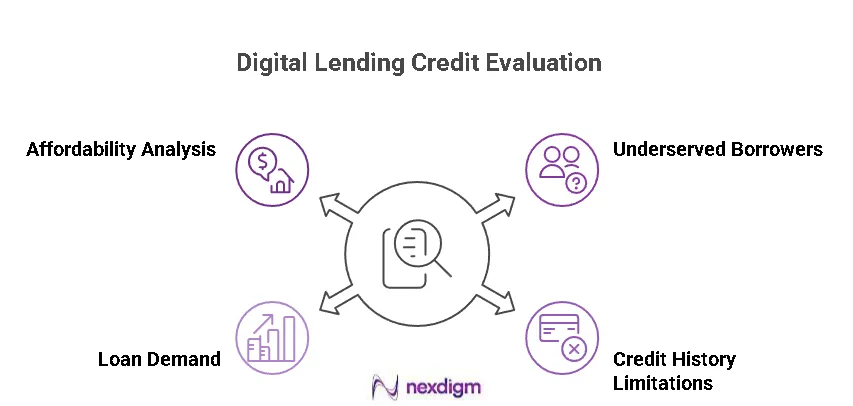
- Underserved Borrower Identification: Assess consumers, SMEs, gig workers, rural users, and thin-file borrowers with limited access to formal credit.
- Credit History Limitations: Review lack of bureau data, informal income patterns, limited documentation, and past rejection reasons affecting borrower eligibility.
- Loan Demand Assessment: Evaluate demand for personal loans, SME credit, emergency loans, education finance, and working capital across target segments.
- Affordability Analysis: Assess income stability, repayment capacity, debt burden, interest sensitivity, and suitable loan ticket sizes for underserved borrowers.
Nexdigm’s Advisory for Digital Lending Market Entry Strategy
Nexdigm’s Advisory for Digital Lending Market Entry Strategy helps lenders assess underserved borrower segments, credit demand, regulatory requirements, licensing needs, risk controls, partnerships, and operating models. This support enables responsible lending, smoother market entry, stronger compliance readiness, and scalable digital credit expansion across consumer and SME segments.
How Does Nexdigm Help Assess Credit Access Gaps in Underserved Segments?
Nexdigm evaluates borrower profiles, credit demand, income patterns, rejection reasons, financial inclusion barriers, alternative data sources, and lending opportunities.
- Borrower Profile Assessment: Nexdigm identifies underserved consumers, SMEs, gig workers, rural borrowers, and thin-file customers lacking formal credit access.
- Credit Demand Analysis: Nexdigm studies demand for personal loans, SME finance, emergency credit, education loans, and working capital products.
- Income Pattern Review: Nexdigm assesses formal, informal, seasonal, and gig-based income patterns to understand borrower repayment capacity.
- Loan Rejection Analysis: Nexdigm reviews rejection reasons such as limited credit history, documentation gaps, low scores, and income verification challenges.
Nexdigm’s case:
Nexdigm helped a digital lending company assess credit access gaps across underserved consumer segments before market entry. Nexdigm analyzed 7 borrower groups, reviewed 5 loan rejection factors, assessed 4 alternative data sources, and mapped 3 high-potential lending segments. This helped the company reduce borrower assessment timelines by 30%, improve projected credit approval efficiency by 22%, and build a responsible digital lending expansion strategy.
To take the next step, simply visit our Request a Consultation page and share your requirements with us.
Harsh Mittal
+91-8422857704