

Digital lending adoption tends to follow existing digital financial behavior. Consumers and businesses that already use smartphones, digital payments, electronic identity systems, and online financial services leave behind transaction histories that can support faster credit decisions.
India’s digital public infrastructure has accelerated this progression through Aadhaar-based e-KYC, UPI, Account Aggregator networks, and the Unified Lending Interface. These systems are expanding the pool of borrowers whose financial activity can be assessed without relying entirely on traditional branch-based documentation.
The Next Borrowers Are Not Necessarily Traditional Credit Customers
Urban professionals were among the earliest users of digital financial products, but many established borrowers in this segment already have access to cards, personal loans, and conventional banking relationships. Further acquisition can therefore become increasingly expensive.
Three borrower groups present a different opportunity:
- Digitized MSME owners using QR payments, merchant gateways, and digital commerce platforms. Their transaction histories can provide evidence of business activity and cash flow.
- Gig workers and freelancers receiving regular payments through delivery, mobility, or digital-service platforms. Platform earnings can provide an alternative to conventional salary documentation.
- Tier-2 and Tier-3 consumers who increasingly shop and transact online but may have limited bureau histories. Consumer durable financing can provide both immediate purchasing capacity and an entry point into formal credit.
The common characteristic is measurable digital activity rather than conventional credit depth.
Distribution Is Changing the Economics of Lending
Traditional lending depends heavily on physical branches, loan officers, documentation, and manual verification. Digital channels can reduce the time and expense associated with these processes by using electronic KYC, automated data retrieval, and digital underwriting.
The difference becomes particularly relevant in underserved markets. A borrower who may be uneconomical to acquire through a branch can become commercially viable when acquisition, verification, and servicing take place through an existing digital platform.
Embedded distribution can strengthen the proposition further. A lender reaching a merchant through its payment provider, or a worker through a payroll or gig platform, already has a relationship through which financial activity can be observed and credit products introduced.
Digital Access Still Requires Stronger Risk Controls
Lower acquisition costs do not eliminate credit risk. Digital lending can increase exposure to identity fraud, adverse selection, over-indebtedness, and inaccurate underwriting when borrowers have limited established credit histories.
Multiple digital loans are particularly important. A borrower may appear acceptable when assessed against one lending relationship while carrying significant obligations elsewhere. Changes in employment, income, or access to additional credit can then expose weaknesses in the portfolio.
Regulation is also shaping how digital lenders operate. Requirements around direct loan disbursal, consent-based data use, and loss-sharing arrangements place greater responsibility on regulated lenders. Data frameworks such as India’s Digital Personal Data Protection regime further reinforce the need for transparent, consent-driven financial-data access.
Digital Behaviour Can Identify Underserved Markets
The strongest digital lending opportunities are likely to emerge where digital activity is high enough to support underwriting but conventional credit access remains limited.
Merchant transaction histories can reveal sales patterns and working-capital requirements. Platform earnings can provide evidence of income for workers without traditional payslips. Banking data can help lenders understand cash-flow consistency among young salaried borrowers with limited bureau histories.
Loan purpose also matters. Productive working capital, education, mobility, and asset upgrades can create stronger lending propositions than very short-tenor discretionary borrowing among financially stretched customers.
This makes the market more granular than simply dividing borrowers into “digital” and “non-digital” populations.
Nexdigm’s Digital Lending Opportunity Map
Nexdigm’s Digital Lending Market Analysis evaluates digital borrower segments across data availability, underwriting potential, acquisition economics, product suitability, and regulatory conditions. The assessment considers:
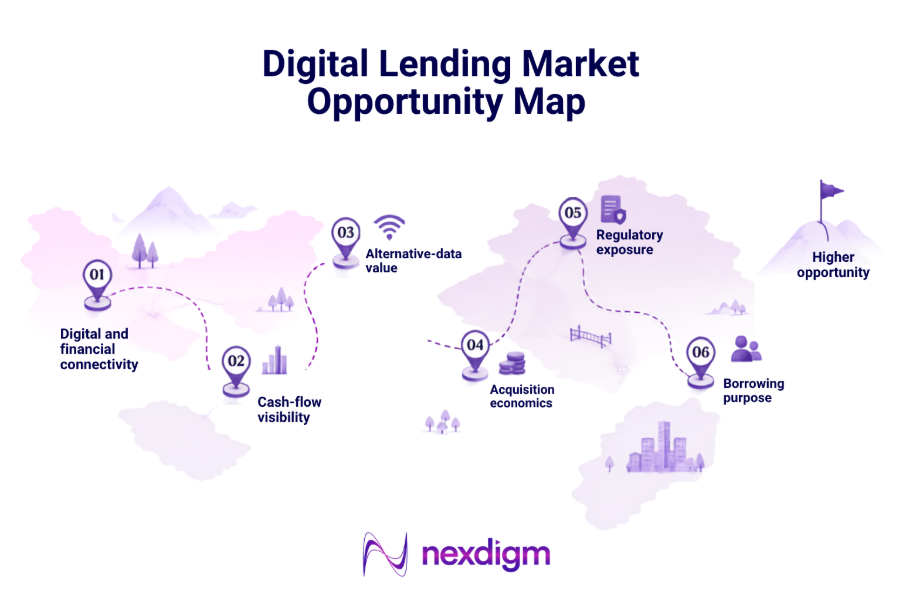
- Digital and financial connectivity: penetration of e-KYC, digital payments, banking-data access, and credit reporting.
- Cash-flow visibility: availability and consistency of transaction or banking data that can support affordability assessment.
- Alternative-data value: whether digital activity provides meaningful signals for assessing thin-file borrowers.
- Acquisition economics: customer acquisition costs, repeat borrowing potential, and the cost of servicing each segment.
- Regulatory exposure: data-consent requirements, lending structures, capital implications, and applicable loss-sharing rules.
- Borrowing purpose: whether credit supports consumption, working capital, education, mobility, or asset acquisition.
The objective is to identify borrower pools where digital distribution improves access without simply transferring conventional credit risk into a faster channel.
How Nexdigm Finds the Borrowers Most Ready to Move Online
Nexdigm screens borrower cohorts according to the quality of their digital footprint, income visibility, borrowing purpose, acquisition economics, and credit risk.
For example, a merchant with six months of verified payment flows presents a fundamentally different underwriting opportunity from an applicant providing only self-reported income. Similarly, a salaried thin-file borrower with consistent banking inflows may be more attractive than an applicant with several recent unsecured loans but limited repayment capacity.
Nexdigm’s Case
A digital lender screened 15 borrower cohorts across urban, Tier-2, and rural markets. Three segments, including digitized merchants and salaried thin-file borrowers, generated 58% of modeled acquisition potential while requiring substantially stronger data verification than conventional digital campaigns.
Nexdigm prioritized the segments with clearer cash-flow visibility and sustainable acquisition economics.
This helps lenders determine which borrower populations are genuinely ready for digital acquisition, which require additional data infrastructure, and which should remain outside the target portfolio.
To take the next step, simply visit our Request a Consultation page and share your requirements with us.
Harsh Mittal
+91-8422857704
[email protected]