

Logistics digitalization creates value when it improves a measurable business outcome: fewer manual handovers, more reliable shipment visibility, faster clearance, better asset utilisation or lower processing costs. Simply introducing a tracking platform or warehouse automation does not guarantee these gains. The commercial result depends on whether technology addresses a real operational constraint and whether the data can move across the organisations involved.
Where Digital Tools Are Making A Difference
Logistics technology spans shipment visibility platforms, transport management systems, warehouse automation, electronic documentation, customs systems and data-sharing standards. Each addresses a different part of the operating chain.
- Shipment Visibility: Combines milestone data from carriers, ports and warehouses to identify delays before they disrupt delivery.
- Warehouse Automation: Supports repetitive picking, sorting, storage and movement tasks where throughput and labour requirements justify investment.
- Digital Documentation: Reduces repeated data entry and inconsistencies across shipping instructions, customs declarations and transport documents.
- Route And Capacity Planning: Uses demand, vehicle, delivery and traffic data to improve scheduling and asset utilisation.
- Data Exchange Platforms: Allow carriers, freight forwarders, shippers and customers to share shipment information through standardised interfaces.
The International Air Transport Association’s ONE Record initiative provides an industry example. It defines a common data-sharing model for air cargo, allowing participants to exchange information through a standardised and secured interface rather than relying on fragmented document and messaging exchanges.
Identify The Commercial Opportunity
A digital investment should begin with a specific problem. A shipper dealing with frequent late deliveries may need reliable milestone visibility before it needs predictive analytics. A warehouse struggling with congestion may need better slotting and order sequencing before buying automated equipment.
Effective digital logistics market intelligence helps businesses identify which technologies are gaining adoption, what operational problems they address and where implementation could create commercial value. It also helps technology providers understand customer segments, buying requirements and the gaps between available solutions and actual logistics needs.
Market opportunity should be assessed through several questions:
- Which logistics activities still depend on manual entry or disconnected systems?
- Where do delays, errors or idle assets create measurable costs?
- Can the technology integrate with existing systems and partner data?
- Who owns the budget, and which operating metric will justify the investment?
- What training, maintenance, cybersecurity and change-management costs will arise?
The 2025 World Bank Logistics Performance Indicators 2.0 demonstrate the growing importance of operational data. Their use of shipment-level information across maritime, aviation and postal networks shows how observed movement data can support more precise analysis of connectivity, speed and reliability.
Measure Value Before Scaling
Technology investments should be tested against a baseline. Depending on the application, useful measures include processing time per shipment, manual interventions, order accuracy, warehouse throughput, vehicle utilisation, on-time delivery and total cost per order.
The comparison must include implementation costs and any new operational dependencies. Automation may improve throughput but require costly maintenance. A visibility platform may reveal delays without being able to resolve them. Digital systems can also introduce cybersecurity and data-sharing risks if access controls and responsibilities are poorly defined.
Nexdigm’s Logistics Digitalisation Investment Framework
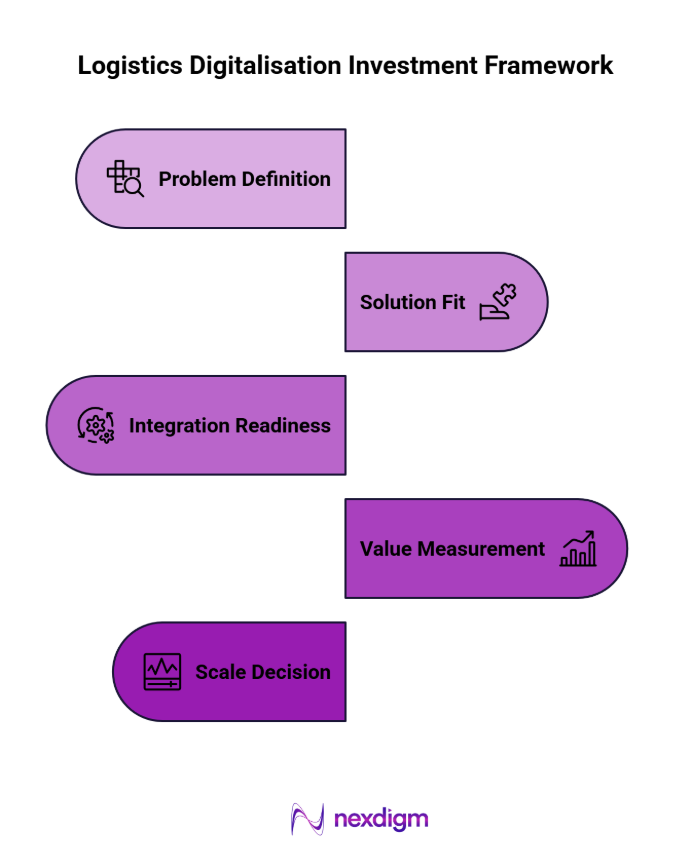
- Problem Definition: Identify the process failure, delay or cost the technology should address.
- Solution Fit: Compare platforms, automation and data tools against the specific operating requirement.
- Integration Readiness: Assess data quality, system compatibility, partner participation and security.
- Value Measurement: Establish baseline costs and service measures, then quantify expected benefits.
- Scale Decision: Expand only when a controlled implementation demonstrates sustainable operational value.
Nexdigm’s Case Study: Improving Shipment Visibility
A freight forwarder reviewed 1,200 monthly shipments and found that milestone updates were arriving inconsistently from several carriers. It introduced a shared tracking workflow for selected routes, monitored manual follow-ups and late-delivery alerts, and used the results to determine whether to extend the platform across its wider network.
To take the next step, simply visit our Request a Consultation page and share your requirements with us.
Harsh Mittal
+91-8422857704