

Digital logistics platforms are transforming freight and supply chain operations by providing real-time visibility across shipments, inventory, routes, carriers, and delivery performance. As part of a market entry strategy, these platforms help businesses monitor logistics movements, improve decision-making, and respond quickly to delays or demand shifts in new markets.
Digital logistics platform market entry approach enables companies to reduce operational uncertainty, improve coordination with partners, and enhance customer service. By using data-driven tracking, automation, and performance insights, businesses can build more transparent, responsive, and scalable supply chain networks across domestic and cross-border operations.
The Digital logistics platform market entry opportunity is supported by rapid technology adoption in supply chains. The global digital logistics market was valued at USD 37.64 billion in 2025 and is projected to reach USD 155.29 billion by 2034, growing at a CAGR of 17.10%. The supply chain visibility software market is also expected to grow from USD 3.5 billion in 2026 to USD 10.9 billion by 2034, reinforcing demand for real-time visibility.
Enhancing Distribution Control with Real-Time Logistics Visibility
Real-time logistics visibility improves distribution control by tracking shipments, inventory, delays, and delivery performance, helping businesses make faster decisions and strengthen market entry execution:
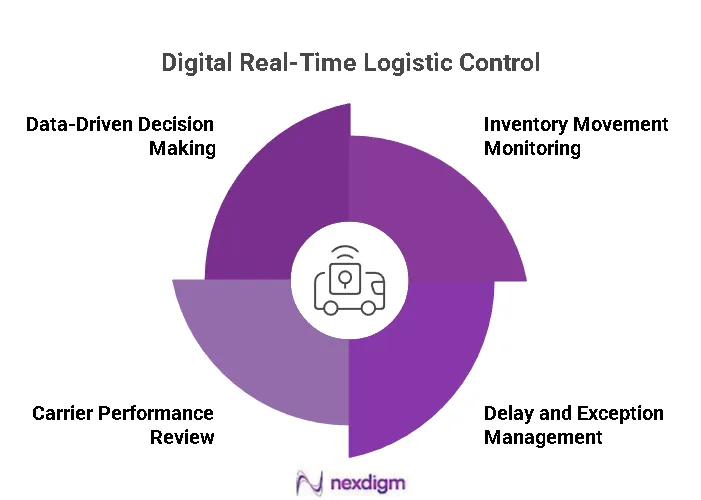
-
Inventory Movement Monitoring
Tracks inventory across warehouses, hubs, and delivery routes to ensure better stock availability and fulfilment planning.
-
Delay and Exception Management
Identifies route disruptions, missed milestones, and delivery exceptions early, enabling faster corrective action during market entry.
-
Carrier Performance Review
Measures carrier reliability, delivery timelines, and service quality to improve logistics partner management and accountability.
-
Data-Driven Decision Making
Uses real-time logistics data to optimise routes, reduce costs, improve service levels, and support scalable distribution growth.
Nexdigm Data and Reporting Framework for Freight Visibility
Nexdigm can help design data and reporting frameworks that track shipment status, transit delays, carrier performance, inventory movement, and delivery milestones. This supports real-time freight visibility, improves decision-making, strengthens logistics control, and enables businesses to manage market entry operations with greater transparency and accountability.
Nexdigm Digital Readiness Assessment for Logistics Transformation
Nexdigm can assess current logistics systems, data maturity, process gaps, integration needs, and technology adoption readiness to support effective digital transformation and real-time supply chain visibility.
-
Process Gap Assessment
Reviews shipment tracking, inventory updates, carrier coordination, and reporting workflows to identify areas needing automation or improvement.
-
Data Maturity Evaluation
Examines data accuracy, availability, integration, and reporting consistency to support reliable real-time supply chain visibility.
-
Technology Integration Readiness
Assesses ERP, warehouse, transport, and partner system compatibility for smoother digital logistics platform implementation.
-
Transformation Roadmap Planning
Defines priority actions, implementation phases, investment needs, and governance controls for scalable logistics transformation.
Nexdigm’s case:
Nexdigm helped a distribution company assess its digital readiness for logistics transformation across four operating regions. By reviewing system capability, data maturity, process gaps, integration needs, and reporting workflows, Nexdigm helped the company identify 18 improvement areas, reduce manual reporting dependency by 35%, improve shipment visibility by 40%, and build a phased roadmap for real-time logistics control.
To take the next step, simply visit our Request a Consultation page and share your requirements with us.
Harsh Mittal
+91-8422857704