

Digital logistics platforms are changing how shippers, carriers, freight forwarders, and logistics providers discover, book, manage, and track transportation services. For startups, however, building technology is only one part of the challenge. Sustainable growth depends on solving a meaningful customer problem, achieving repeat usage, creating network effects, and developing an economically viable monetization model.
The market opportunity is expanding rapidly. The global digital logistics market was valued at approximately $37.64 billion in 2025 and is projected to reach $155.29 billion by 2034, representing a CAGR of 17.1%, according to Fortune Business Insights.
These trends create an attractive environment for logistics technology startups, but adoption alone does not guarantee commercial success. For logistics technology startups, freight platforms, SaaS providers, corporate innovators, and strategic logistics companies, a digital logistics startup entry strategy services approach helps evaluate product-market fit, customer demand, monetization and market-entry priorities to determine where a digital logistics proposition can gain traction.
Customer Pain Points Drive Platform Adoption
Successful digital logistics platforms address specific operational challenges such as limited visibility, fragmented workflows, manual processes, capacity constraints, or inefficient coordination. Solving a clearly defined customer pain point is often a stronger driver of adoption and long-term engagement than digitizing existing processes alone.
Digital Transformation Is Reshaping Logistics Demand
Shippers and logistics stakeholders increasingly expect real-time visibility, automated booking, analytics, seamless integrations, and improved access to transportation capacity. As digital adoption expands across transportation and warehousing, customer willingness to adopt technology-enabled logistics solutions is creating new opportunities for scalable business models.
Customer Segmentation Determines Market Opportunity
The digital logistics market comprises diverse customer groups with varying requirements based on industry, company size, shipment characteristics, geographic reach, and supply-chain complexity. Understanding these differences is critical for identifying target customers, refining value propositions, and prioritizing the most commercially attractive market segments.
Role of Nexdigm in Helping Digital Logistics Startups Scale
Building a digital logistics platform requires more than technology. Nexdigm helps startups evaluate product-market fit, understand customer needs, assess monetization potential, and prioritize growth opportunities to support sustainable expansion.
Through its digital logistics startup entry strategy services, Nexdigm combines market intelligence, customer insights, and commercial analysis to help businesses validate opportunities, refine go-to-market strategies, and build scalable growth plans in an increasingly competitive digital logistics ecosystem.
Nexdigm’s Value to Digital Logistics Innovators
From market validation to commercialization planning, Nexdigm helps digital logistics startups evaluate opportunities, identify growth drivers, and build strategies for sustainable market success.
- Opportunity Validation: Assess customer demand, market attractiveness, and adoption potential to validate opportunities before significant investments are made.
- Commercial Strategy Development: Evaluate pricing, monetization models, and revenue opportunities to strengthen business viability and support long-term growth objectives.
- Competitive Positioning: Analyze market competitors, alternative solutions, and differentiation opportunities to help startups establish a stronger market presence.
- Growth Readiness Assessment: Identify operational, technology, and resource requirements needed to scale efficiently and support future expansion plans.
By focusing on the following areas, Nexdigm helps organizations validate market opportunities, refine go-to-market strategies, and build scalable growth plans that support long-term success in the digital logistics ecosystem.
How Nexdigm Turns Market Insights Into Go-to-Market Action
Through its digital logistics startup entry strategy services, Nexdigm helps startups convert market insights into actionable growth strategies by focusing on the following steps:
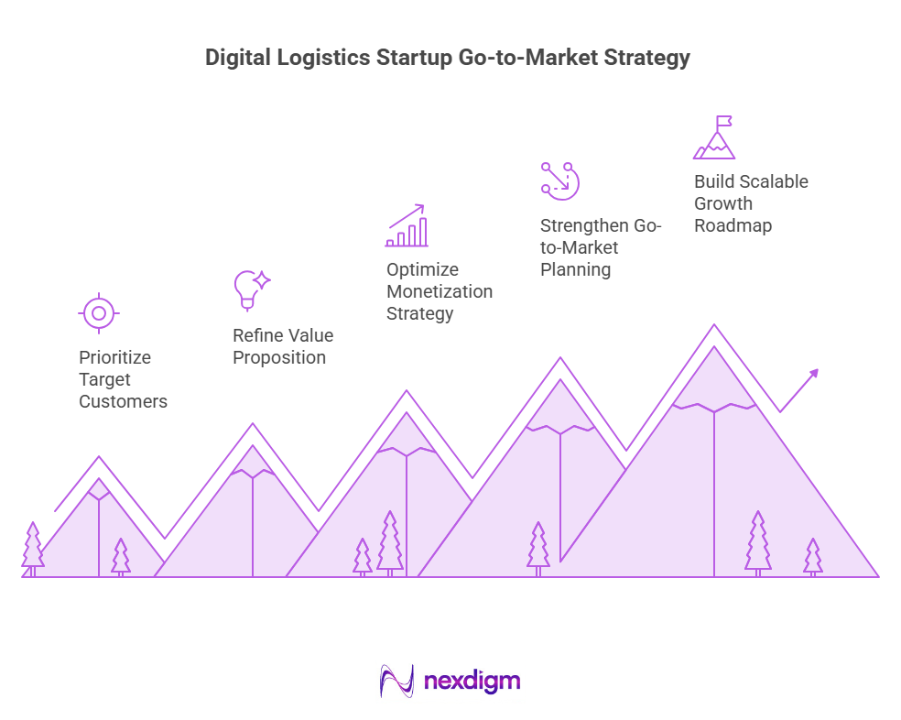
- Prioritize Target Customers: Identify customer segments with the strongest demand potential, highest adoption likelihood, and best revenue opportunities to focus resources and accelerate market traction.
- Refine the Value Proposition: Align product capabilities with customer pain points and expectations to strengthen differentiation, improve adoption, and increase overall market relevance.
- Optimize Monetization Strategy: Evaluate pricing structures, revenue models, and willingness to pay to support commercial viability, profitability, and long-term business sustainability.
- Strengthen Go-to-Market Planning: Define customer acquisition priorities, partnership opportunities, and market-entry strategies that improve visibility, adoption, and growth execution effectiveness.
- Build a Scalable Growth Roadmap: Identify the operational, commercial, and technology capabilities required to support expansion, manage growth, and sustain competitive advantage.
Success in digital logistics depends on more than technology innovation. Through its digital logistics startup entry strategy services, Nexdigm helps organizations validate market opportunities, refine commercialization strategies, and build scalable growth plans that support long-term success in an evolving logistics ecosystem.
Nexdigm’s Case
A logistics technology startup engaged with Nexdigm to assess product-market fit, customer segments, monetization, and network potential. The assessment identified priority segments with 18% higher adoption potential, 15% stronger revenue opportunity, and 13% lower projected customer acquisition costs, helping sharpen market-entry priorities and improve the startup’s commercial growth outlook.
To take the next step, simply visit our Request a Consultation page and share your requirements with us.
Harsh Mittal
+91-8422857704