
Digital media consumption is becoming less predictable because the screen is no longer the scarce resource. Consumers can divide attention across streaming platforms, social video, connected television, gaming, creator content, short-form formats and increasingly fragmented digital experiences.
Forecasting the next phase of media consumption therefore requires more than projecting today’s viewing hours forward.
India provides a particularly strong example. Ormax estimates that India’s OTT audience reached 664.9 million in 2026, up 11% from 2025. The connected-TV audience increased 60% in one year to 206.9 million, while active paid OTT subscriptions reached 172.6 million. Average OTT audience time spent across online video, social video, microdramas and FAST channels reached 14.9 hours per week, equivalent to 517 billion annual hours of video consumption.
Screen time is fragmenting across formats
Traditional television, streaming and social video increasingly compete for the same finite attention.
Deloitte’s 2026 Digital Media Trends research found that 55% of Gen Z respondents consider social media content more relevant to them than traditional content, while 52% report a stronger personal connection to social media creators than to television actors or personalities.
This does not mean traditional video disappears. It means the definition of video consumption is expanding.
Short-form video can capture frequent daily sessions. Streaming can capture longer-form viewing. CTV can bring digital content into the television environment. Creator content can deepen engagement around personalities and communities.
Forecasting demand therefore requires measuring both total time and the distribution of that time.
CTV is changing the shape of the market
India’s connected-TV audience grew from 129.2 million in 2025 to 206.9 million in 2026, according to Ormax. That 60% increase represents a significant shift in where digital video is being consumed.
CTV also changes the commercial relationship between television and digital media.
Larger screens can support longer-form viewing and premium advertising environments, while digital distribution provides audience targeting and measurement. This creates potential overlap between television economics and digital advertising models.
The growth of FAST channels adds another layer. Ormax estimates India’s FAST audience at 35.2 million in 2026, indicating that ad-supported free streaming is becoming part of the country’s digital-video ecosystem.
Future screen time will be shaped by content behaviour
Consumption forecasting needs to separate three variables: how much people watch, what they watch and where they watch it.
Ormax reports that microdramas, K-dramas and anime were among India’s fastest-growing content formats in 2026, with audience growth of 50%, 48% and 32% respectively.
That matters because format growth can alter total consumption even when overall screen time remains relatively stable.
A 90-second video can generate a very different consumption pattern from a two-hour film. Short-form content can increase session frequency, while long-form programming can concentrate hours into fewer sessions.
Forecast models therefore need to account for content duration, frequency, platform switching and audience overlap.
The next phase is likely to be more fragmented
Nexdigm expects global entertainment and media revenues to reach $4.2 trillion by 2030, with advertising revenues projected to reach $1.4 trillion. Its 2026 outlook also identifies AI-powered advertising, streaming consolidation and bundling as important forces shaping the industry.
The implication for demand forecasting is that audience growth and revenue growth should be modelled separately.
A platform can gain viewing time without generating proportional revenue. Another may have a smaller audience but stronger monetization because its users are more engaged, its advertising inventory is more valuable, or its subscription base has greater willingness to pay.
That is why future screen-time forecasting should combine behavioural data with commercial assumptions.
From audience measurement to strategic planning
For media companies, broadcasters, streaming platforms, advertisers and investors, the useful output is not simply a five-year estimate of total viewing hours.
It is an understanding of where those hours will migrate, which audiences will drive the change, which formats will gain frequency, how devices will influence consumption and where monetization can follow.
India’s current trajectory illustrates the scale of the transition: 664.9 million OTT users, 206.9 million CTV viewers, 172.6 million active paid OTT subscriptions and 517 billion annual hours of online video consumption.
The next opportunity lies in understanding how that enormous attention pool will be redistributed.
Nexdigm’s screen-time forecasting framework
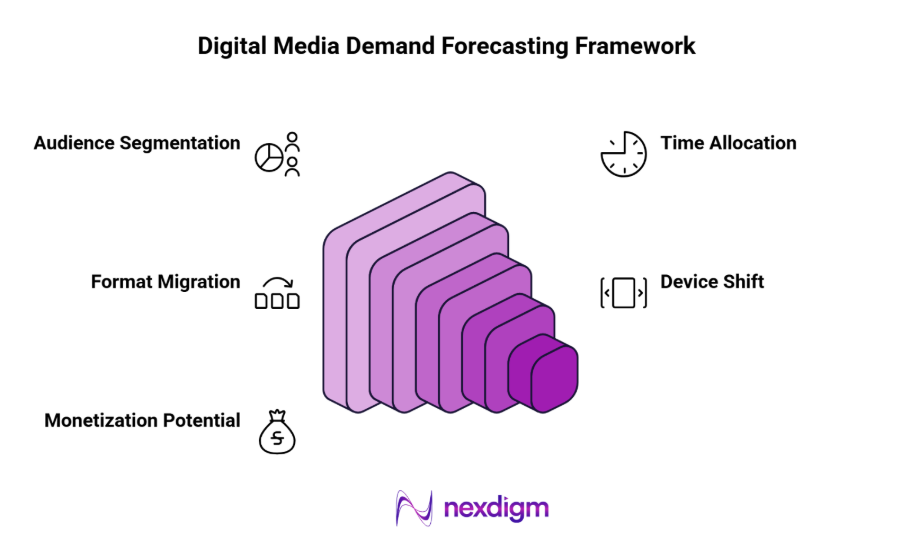
Nexdigm’s structured digital media demand forecasting services approach can build the forecast across five layers.
- Audience base
Estimate the number of active users across OTT, CTV, social video, gaming, audio and other digital formats. Segment by age, geography, income and digital maturity. - Time allocation
Measure current weekly time spent across platforms and formats. This establishes the actual attention pool rather than relying on subscriber numbers alone. - Format migration
Track movement between long-form, short-form, creator, gaming, FAST and interactive formats. This is where emerging behaviour can materially change the forecast. - Device and distribution shift
Model smartphone, connected-TV, tablet, desktop and other screen usage. India’s 60% annual increase in CTV audience demonstrates why device migration can alter both viewing behaviour and monetization. - Monetization potential
Connect projected attention with advertising inventory, subscription conversion, commerce and other revenue models.
Nexdigm Case: Digital Media Demand Forecast
A streaming platform with 8.4M monthly active users wanted to forecast 2029 viewing demand. Nexdigm modelled 5 content formats across 12 cohorts, projecting 31% higher short-form consumption and a 22% CTV share increase over three years.
To take the next step, simply visit our Request a Consultation page and share your requirements with us.
Harsh Mittal
+91-8422857704