

Digital media markets have become large enough that audience scale alone is no longer a sufficient measure of commercial attractiveness. Platforms now compete across subscriptions, advertising, Connected TV, retail media, creator ecosystems and commerce, with each model generating different economics.
India illustrates the scale of this transition. PwC estimates that India’s entertainment and media market will grow from $25.7 billion in 2025 to $36.7 billion by 2030, while internet advertising revenue is projected to reach $14.3 billion. India had 216.5 million OTT subscriptions in 2025, making it the world’s third-largest base.
The TMT research adds another layer. India’s screen economy is estimated at $12.5 billion in 2026, including $6 billion in online video revenue, while Connected TV reaches approximately 65 million households and retail media has reached $3.1 billion.
Audience Scale and Revenue Scale Are Different Things
A large audience can be commercially weak if engagement is low, advertising inventory is poorly targeted or subscription conversion is limited.
The reverse can also be true. A smaller audience with high purchasing intent can become valuable through premium subscriptions, targeted advertising or commerce.
This is why digital media markets need to be assessed across the complete revenue chain. Audience acquisition creates potential reach. Engagement creates inventory and retention. Monetisation converts that engagement into revenue.
The economics differ substantially by model.
Subscription businesses depend on conversion, retention and average revenue per subscriber. Advertising businesses depend on inventory, targeting, engagement and advertiser demand. Retail media adds transaction data and closed-loop measurement to the equation.
Streaming Is Moving Toward Hybrid Monetisation
Streaming has already demonstrated the limits of a pure subscription model. Deloitte’s 2026 data cited in the TMT research puts average US subscribing-household expenditure at $69 per month, while 61% of consumers indicate that an additional $5 price increase could trigger cancellation of their favourite service.
As subscription prices encounter resistance, advertising becomes increasingly important. The same research reports that 68% of streaming subscribers maintain at least one ad-supported streaming service.
India’s market is developing within this broader pattern. Online video advertising has already surpassed linear television advertising, while Connected TV and retail media are creating additional inventory and targeting opportunities.
For media companies, this means monetisation strategy needs to be designed alongside audience strategy.
Advertising Is Becoming More Measurable
Digital media’s commercial advantage is increasingly tied to measurement. Traditional television can provide large-scale reach, but digital platforms can connect exposure with engagement, clicks, transactions and customer behaviour.
This is one reason retail media has expanded. India’s retail media market has grown to approximately $3.1 billion, allowing platforms to combine advertising with first-party purchase information.
Connected TV occupies an interesting position between the two systems. It offers large-screen viewing while retaining digital targeting and measurement capabilities.
The result is a market in which the commercial value of an audience increasingly depends on what can be measured after the impression.
Building a Digital Media Commercial Assessment
A digital media market assessment services approach should connect audience behaviour to revenue mechanics.
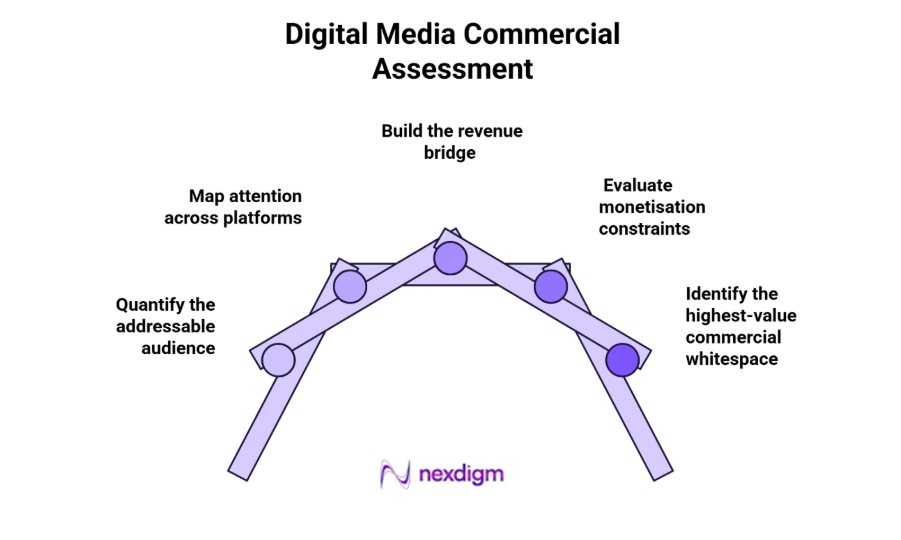
- Quantify the addressable audience.
Assess audience size, demographics, geography, device usage and viewing frequency. This establishes the pool of potential users, but it should not be treated as the final market opportunity. - Map attention across platforms.
Determine where audiences spend time, how frequently they switch platforms and which formats generate the strongest engagement. This helps identify platform substitution and emerging consumption behaviour.
India’s OTT audience reached 664.9 million users in 2026, according to Ormax, up 11% from 2025. Its Connected TV audience reached 206.9 million, growing 60% in a single year. - Build the revenue bridge.
Translate audience behaviour into subscriptions, advertising impressions, average revenue per user, commerce transactions or combinations of these streams.
This is where apparently similar media businesses can produce very different valuations and economics. - Evaluate monetisation constraints.
Assess subscription fatigue, advertising demand, content costs, customer acquisition, churn and platform fees. Revenue growth that requires proportionally greater content or acquisition spending may not translate into stronger margins. - Identify the highest-value commercial whitespace.
The final assessment should determine whether the opportunity lies in a new audience segment, content format, advertising model, Connected TV proposition, creator ecosystem or commerce integration.
The TMT research points toward this convergence, noting that short-form formats and shoppable media increasingly connect audience attention directly to transactions.
Nexdigm Case: Converting Audience Data Into a Media Revenue Strategy
A digital media platform analysed 6 audience segments across 9 markets, using 3,600 consumer interviews and 24 months of engagement data. Nexdigm identified two high-value segments and a hybrid revenue model projected to increase ARPU by 18% and advertising yield by 21%.
Nexdigm’s digital media market assessment services help businesses evaluate audiences, platform dynamics, monetisation models, competitive positioning, advertising economics and emerging digital-media opportunities.
To take the next step, simply visit our Request a Consultation page and share your requirements with us.
Harsh Mittal
+91-8422857704