

Digital media has accumulated more ways to monetize an audience than almost any previous media model. Advertising, subscriptions, creator partnerships, commerce, gaming, memberships and branded experiences now overlap across the same consumer relationship.
The commercial challenge is therefore less about finding another digital audience and more about determining which audience relationships can support sustainable revenue.
Global advertising spending can grow 5.0% in 2026, with digital representing 69% of total spend. Retail media connected TV and video, social and digital out-of-home are among the faster-growing areas. This creates a broad market opportunity, but broad growth can conceal significant differences in monetization quality.
Four revenue systems are converging
Digital media opportunity can be viewed through four interconnected layers.
Content creates attention. Advertising monetizes that attention. Subscriptions monetize recurring access. Commerce converts attention into transactions.
The boundaries between them are increasingly fluid.
2026 Digital Media Trends research found that 68% of SVOD subscribers have at least one ad-supported service, while average monthly household streaming expenditure remains around $69. More than 60% say they would cancel a favorite service if its monthly price increased by $5.
That combination points toward a market where subscription pricing alone has limited room to expand, increasing the importance of advertising, bundling, fandom and other monetization layers.
Creator media adds another pool. EMARKETER expects creators to generate more than $21 billion in revenue in 2026, with micro- and nano-influencers accounting for 45.5% of influencer-marketing spending.
The opportunity is expanding, but so is competition for attention.
Where white spaces can emerge
A digital media opportunity assessment needs to examine the relationship between audience behaviour and monetization rather than treating content categories as isolated markets.
- Under-monetized audiences
Identify audiences with high engagement but limited commercial conversion. A niche community may have lower reach than a mass platform but significantly stronger willingness to pay, purchase or participate. - Advertising formats
CTV, retail media, social commerce and creator advertising are expanding the advertising surface. Retail media growth of 12.3% in 2026 and CTV growth of 11.5% is being forecasted, illustrating how advertiser budgets are moving toward environments where audience data and measurable outcomes are stronger. - Subscription architecture
Assess whether the opportunity lies in premium tiers, advertising-supported plans, bundles, fan memberships or specialized communities. The objective is to identify the revenue structure that matches audience willingness to pay. - Commerce integration
Evaluate whether content can influence a transaction directly. Shoppable media, creator commerce and media-owned marketplaces can potentially capture value beyond advertising impressions. - Data and measurement
Determine whether the platform can demonstrate incremental value to advertisers and partners. Measurement becomes especially important in creator and commerce media, where marketers increasingly expect attribution rather than reach alone.
The commercial assessment sits between audience and economics
A structured digital media opportunity assessment consulting approach can map six variables simultaneously:
Audience scale determines potential reach, but engagement indicates the depth of the relationship. Monetization determines whether that relationship can generate revenue. Distribution determines the cost of reaching the audience. Data determines targeting and measurement capability. Competition determines how much of the value pool is already captured.
The sixth variable is economics.
A media opportunity with strong engagement may still be unattractive if customer acquisition costs are excessive, content production is expensive or revenue per user remains too low.
This is why content-market assessment should connect consumer behaviour with unit economics.
From attention to transaction
The more interesting digital media models increasingly combine several revenue mechanisms.
A streaming platform may combine subscriptions, advertising and commerce. A creator business may combine brand partnerships, memberships and product sales. A publisher may combine advertising, events, premium research and commerce.
The opportunity assessment should therefore test combinations rather than evaluate each model independently.
Around 80% of surveyed consumers identify as fans of at least some entertainment properties, and fan households report higher monthly streaming expenditure than non-fans.
That makes intensity of engagement commercially relevant. A smaller but highly engaged audience can create a different opportunity profile from a large passive audience.
Nexdigm’s Digital Media Opportunity Framework
A five-step assessment can connect audience behaviour to the revenue pools that are realistically accessible.
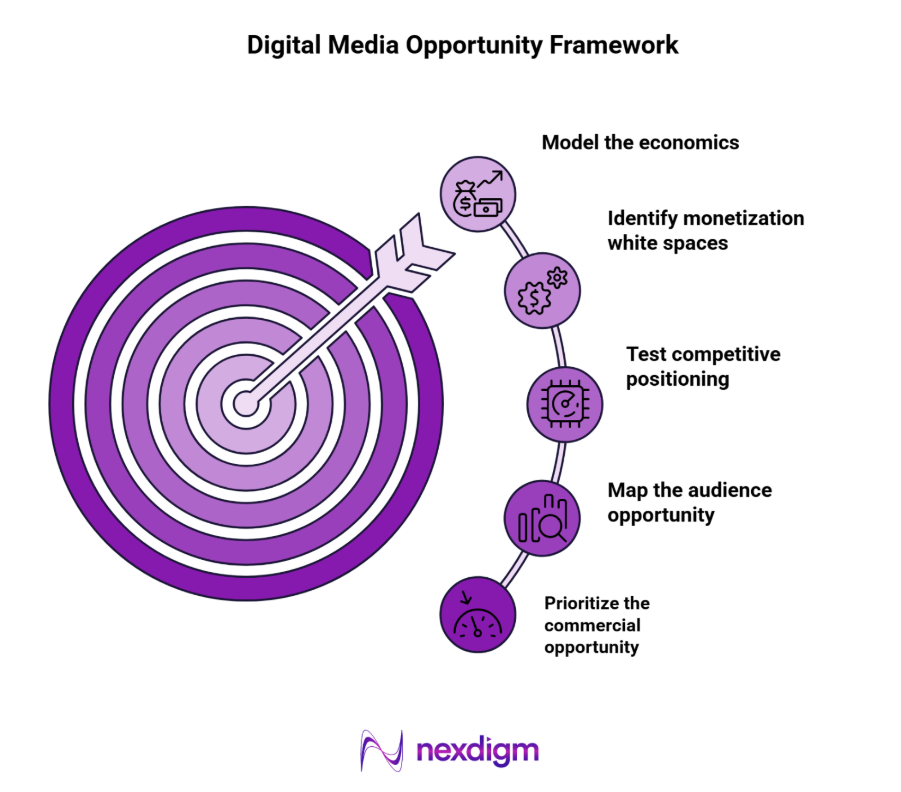
- Map the audience opportunity
Segment audiences by size, engagement, demographics, content consumption and willingness to pay. The objective is to identify high-value audience groups rather than simply the largest ones. - Identify monetization white spaces
Assess advertising, subscriptions, memberships, creator partnerships and commerce to determine where existing audience demand is under-monetized and which revenue models have room to expand. - Test competitive positioning
Map competitors, platforms, content propositions, pricing, advertiser relationships and distribution channels. This establishes whether the opportunity represents genuine white space or an already crowded revenue pool. - Model the economics
Evaluate revenue per user, customer acquisition cost, content and technology costs, advertising yields, subscription conversion and commerce margins. Different monetization combinations can then be tested against realistic operating assumptions. - Prioritize the commercial opportunity
Rank opportunities by market size, monetization potential, competitive intensity, investment requirements and scalability. The final output identifies which audience segments and revenue models warrant investment, partnership or further validation.
Nexdigm Case: Media Monetization White Space
A regional digital publisher with 18M monthly users generated $6.2M annual revenue, 78% from advertising. Nexdigm mapped 5 audience cohorts and 4 monetization models, identifying commerce and premium memberships as a $19M three-year revenue opportunity.
To take the next step, simply visit our Request a Consultation page and share your requirements with us.
Harsh Mittal
+91-8422857704