

Supply chain digitisation is increasingly being built as a technology stack rather than purchased as a single system. Cloud infrastructure provides the base, visibility platforms connect physical activity, analytics interprets the data, and automation acts on recurring decisions. Control towers sit above these layers, bringing information from multiple systems into a common operating view.
The commercial question is therefore becoming more specific: which layers are attracting investment, where do they create measurable value, and where does adding another technology layer simply increase complexity?
Digital Supply Chain Is Becoming a Stack, Not a Single Platform
A modern digital supply chain can involve ERP and planning systems, cloud infrastructure, warehouse and transport platforms, IoT feeds, analytics applications, automation tools and control towers. Emerging capabilities such as agentic AI are beginning to sit on top of this architecture, using information from several systems to support or execute decisions.
This creates a different market structure from the earlier generation of standalone supply-chain software. Buyers increasingly assess how well technologies exchange data and fit into existing workflows. Integration capability can therefore influence adoption as much as the functionality of an individual product.
Cloud Provides the Infrastructure
Cloud adoption has made it easier to connect applications across functions and locations without building separate infrastructure for every operation. It also gives companies the computing and storage capacity required for increasingly data-intensive supply-chain applications.
PwC’s 2025 Digital Trends in Operations survey found that 56% of operations and supply-chain leaders cited cloud among the technologies being used. Yet technology investment does not automatically translate into business value. The same survey found that 92% of respondents said their technology investments had not fully delivered their expected results.
The market opportunity therefore extends beyond cloud migration. Integration, data architecture and the ability to connect applications to operational processes remain significant areas of demand.
Visibility Is the Layer That Connects the Network
A supply chain can contain information from suppliers, factories, warehouses, carriers, ports and customers. Each participant may operate on a different system. Visibility platforms attempt to bring these fragmented signals together so that companies can identify delays, inventory movements, capacity constraints and exceptions across the network.
The value increases when visibility moves beyond tracking. A shipment status becomes more useful when it can trigger a replenishment decision, flag a customer-service risk or change a transport plan.
That is where visibility starts creating demand for the layers that sit above it.
Analytics Turns Visibility into Decisions
Data becomes commercially useful when it changes what an organisation does. Analytics can identify recurring delays, compare supplier performance, detect cost leakage, forecast demand or model the effect of a network disruption.
This is also where digital supply chains begin to diverge by maturity. Companies with inconsistent master data or fragmented processes may still be working toward reliable reporting, while more mature organisations can use the same data for predictive planning and optimisation.
The distinction matters for market assessment because the addressable opportunity for advanced analytics depends partly on the maturity of the underlying supply chain.
Automation Changes Execution
Automation has a different role. Instead of helping managers interpret information, it reduces manual intervention in repeatable activities.
Purchase-order processing, inventory reconciliation, shipment documentation, warehouse workflows, invoice validation and transport calculations are examples where automation can remove repetitive work. The strongest commercial cases tend to emerge where transaction volumes are high and the existing process is sufficiently standardised.
This also explains why automation demand does not develop evenly across the supply chain. A process with inconsistent inputs may require process redesign before automation can deliver its expected return.
Control Towers Pull the Pieces Together
Control towers occupy a different position in the stack. They combine data from multiple systems and provide a consolidated view of supply-chain performance, exceptions and decisions.
Their value depends heavily on what sits underneath them. A control tower connected to fragmented, delayed or unreliable data can create a sophisticated interface without producing better decisions. A mature architecture can use the same layer to coordinate inventory, transport, supplier performance and disruption response across functions.
For technology providers, this makes control towers a potential aggregation point for several markets: cloud, visibility, analytics, integration and automation.
How Nexdigm Maps Digital Supply Chain Investment
A digital supply chain market study by Nexdigm can examine the technology stack from both the market and buyer perspective, including:
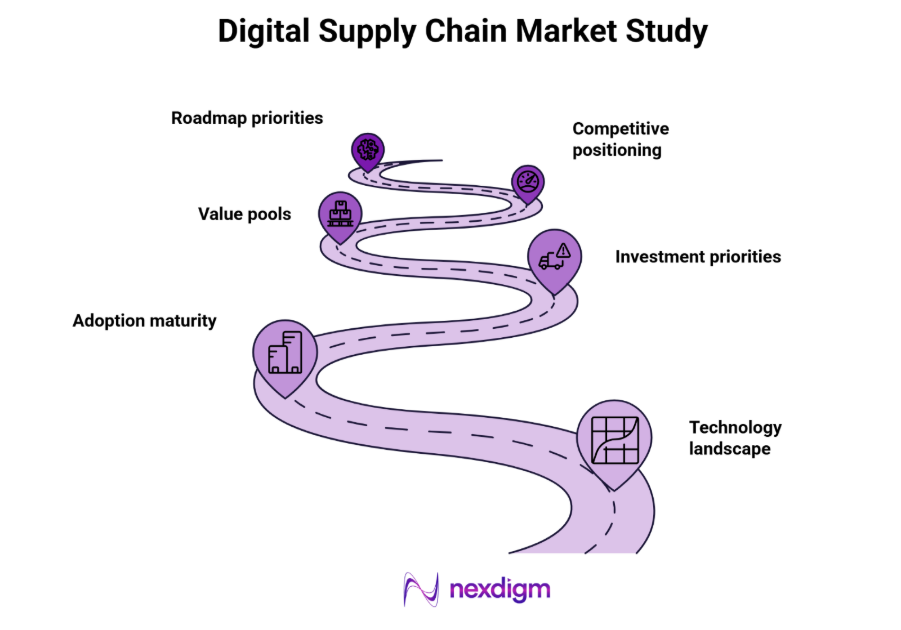
- Technology landscape: Map cloud, visibility, analytics, automation, control towers and emerging AI capabilities.
- Adoption maturity: Segment buyers by current technology deployment, process maturity and integration capability.
- Investment priorities: Identify where organisations are increasing technology spending and which capabilities remain underpenetrated.
- Value pools: Assess the operational problems each technology addresses and the potential economic impact.
- Competitive positioning: Compare vendors by functionality, industry focus, integration capabilities and market presence.
- Roadmap priorities: Identify which technology layers have the strongest commercial opportunity and where adoption is likely to accelerate.
This allows technology providers, investors and supply-chain organisations to distinguish between a large technology category and a genuinely addressable market opportunity.
A Digital Intervention With a Measurable Outcome
Nexdigm worked with a global healthcare company operating across 165+ countries to improve cost-data visibility. By standardising workflows, automating data cleansing and analysis, and introducing a Power BI dashboard, the engagement reduced overall turnaround time from 14.83 days to 8.9 days, a 40% reduction, while achieving 95%+ data accuracy and reducing the requirement by one FTE.
To take the next step, simply visit our Request a Consultation page and share your requirements with us.
Harsh Mittal
+91-8422857704