

Digital transformation programmes often begin with a clear ambition: modernise operations, improve customer experiences, automate processes or build stronger data capabilities. The difficulty emerges when organisations move from strategy to implementation. Legacy systems, fragmented data, inconsistent processes and limited internal expertise can make transformation considerably more complicated than the original business case suggests.
Choosing the right implementation partner is therefore a strategic procurement decision. A digital transformation vendor analysis helps organisations assess which suppliers have the delivery capabilities, sector knowledge and technical resources required to translate transformation objectives into operational improvements.
Why Supplier Selection Influences Transformation Outcomes
Digital transformation rarely involves a single technology deployment. A programme may combine cloud migration, enterprise software implementation, data modernisation, cybersecurity, process redesign and workforce adoption. Each workstream introduces dependencies that need to be managed across business functions.
A supplier with strong technical capabilities may still struggle if it lacks experience in the client’s industry or cannot coordinate complex implementation activities. Similarly, a large consulting or technology provider may offer extensive resources but rely on delivery teams whose experience does not match the project’s requirements.
The market itself reflects uneven levels of digital maturity. Eurostat’s 2026 digitalisation publication reported that 72% of EU businesses had reached at least a basic level of digital intensity in 2025. However, the figure was 96% for large businesses and 71% for SMEs. These differences indicate that transformation requirements vary significantly by organisational size and capability. Supplier selection must account for the starting point of the organisation rather than assume every client needs the same implementation model.
Assessing the Supplier Landscape
Digital transformation providers operate across several overlapping categories. Global technology integrators typically support large-scale enterprise programmes, including cloud migration, application modernisation and systems integration. Specialist consultancies may focus on particular industries, technologies or business functions. Software vendors offer implementation ecosystems around their own platforms, while managed service providers support ongoing operations after deployment.
These categories are not interchangeable. A supplier specialising in cloud infrastructure may be well suited to migration and platform management but may not provide the process redesign or change management capabilities required for a broader transformation.
A meaningful supplier assessment begins by defining the services required. Organisations should distinguish between strategy development, technology implementation, systems integration, data engineering, cybersecurity, organisational change and post-implementation support. This prevents procurement teams from comparing suppliers whose proposals address fundamentally different scopes.
The Four Dimensions of Supplier Evaluation
- Delivery capability and implementation discipline
A supplier’s delivery record should be assessed through comparable projects, implementation timelines, project governance and the ability to manage dependencies. Procurement teams should examine whether proposed delivery teams have experience with programmes of similar complexity and scale.
Reference checks can reveal how suppliers manage delays, scope changes, integration problems and stakeholder disagreements. Organisations should also establish whether senior experts remain involved throughout delivery or are primarily present during the sales process. - Industry expertise and business understanding
Industry knowledge matters because transformation programmes are shaped by regulatory requirements, operating models and sector-specific processes. A financial services transformation, for example, may involve extensive compliance and data governance requirements, while a manufacturing programme may prioritise production systems, supply chain visibility and operational technology integration.
Suppliers should demonstrate familiarity with the client’s business environment, not simply provide a list of technology certifications. Relevant experience should be supported by project references, domain specialists and an understanding of sector-specific constraints. - Scale, geographic coverage and resource availability
Large programmes require access to multidisciplinary teams across locations and functions. Organisations should evaluate workforce capacity, regional delivery centres, subcontractor dependencies and the supplier’s ability to maintain service quality during periods of rapid expansion.
Global reach can be valuable, but the actual delivery model matters more than the number of offices a supplier operates. Procurement teams should understand where project work will be performed, how resources will be allocated and which activities may be outsourced. - Strategic fit and long-term value
Transformation partners may influence architecture decisions, technology choices and operating models for years. Their recommendations can affect future flexibility, licensing costs and supplier dependency.
The assessment should therefore consider whether a provider supports open standards, knowledge transfer, internal capability development and integration with the organisation’s wider technology strategy. A supplier that delivers quickly but leaves the client dependent on proprietary expertise may create long-term constraints.
Looking Beyond the Initial Proposal
Commercial evaluation should include more than implementation fees. Organisations need to examine change-request mechanisms, resource pricing, licensing assumptions, support arrangements and the cost of maintaining the solution after go-live.
Risk assessment should also cover data security, subcontractor management, intellectual property, business continuity and contractual accountability. Transformation programmes frequently involve access to sensitive business information, making supplier governance a core procurement requirement.
A structured scoring model can help decision-makers compare suppliers consistently. However, weighted scores should not replace due diligence. A high overall score may conceal a critical weakness in regulatory experience, delivery capacity or cybersecurity.
Nexdigm’s Role in Digital Transformation Supplier Research
Nexdigm supports organisations through market intelligence, supplier benchmarking, competitive analysis and commercial research. Its work can help procurement and transformation teams map relevant providers, assess service capabilities, understand industry positioning and compare supplier propositions against programme requirements. This creates a stronger evidence base before organisations commit to long-term implementation partnerships.
Digital Transformation Vendor Assessment Framework
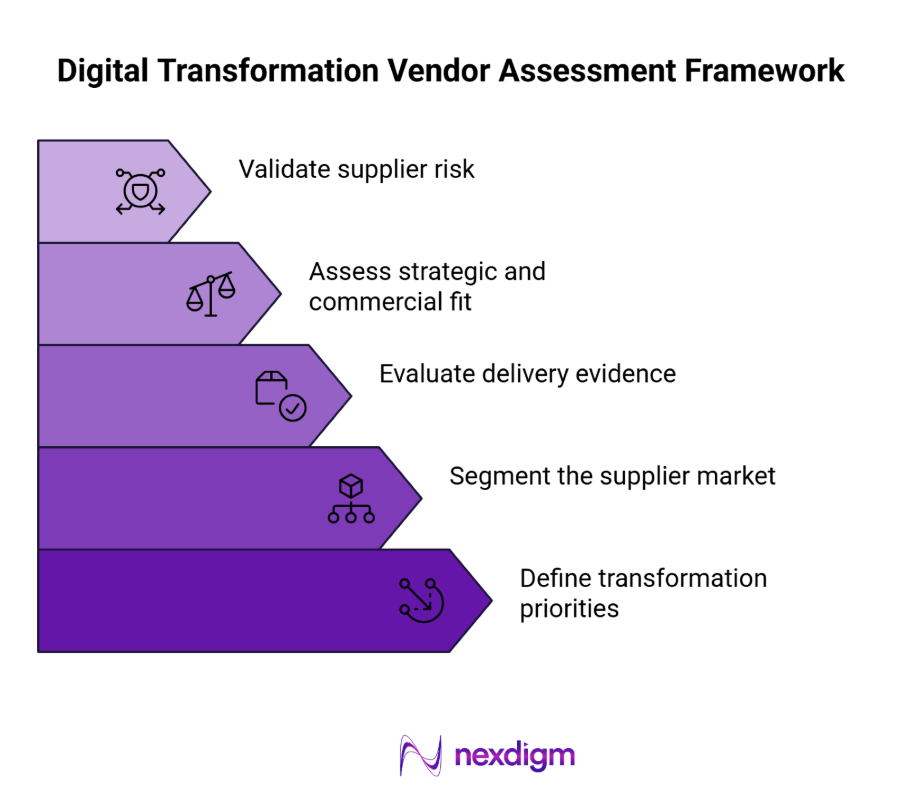
- Define transformation priorities: Identify business objectives, technology requirements, implementation scope and expected outcomes.
- Segment the supplier market: Classify providers by service specialisation, industry focus, geographic coverage and delivery model.
- Evaluate delivery evidence: Review comparable engagements, team expertise, project governance and implementation capabilities.
- Assess strategic and commercial fit: Compare pricing models, technology flexibility, knowledge transfer and long-term support.
- Validate supplier risk: Examine data security, subcontracting, regulatory exposure, financial stability and contractual accountability.
Nexdigm’s Case Study: Identifying Digital Transformation Partners
Nexdigm evaluated 15 transformation providers across six capability areas, reviewed 20 comparable engagements and assessed delivery coverage in eight markets. The research shortlisted four suppliers aligned with the client’s implementation scope and long-term operating requirements.
To take the next step, simply visit our Request a Consultation page and share your requirements with us.
Harsh Mittal
+91-8422857704