

Digital twins are becoming an important layer of industrial and infrastructure decision-making, but their value depends heavily on the asset being modelled. A complex physical system can generate enormous quantities of operational data without necessarily producing an attractive business case for a digital twin. The strongest candidates combine high asset value, operational complexity, continuous data availability, and a measurable financial consequence when performance deteriorates.
The global digital twin market was valued at approximately $21.14 billion in 2025 and is projected to reach $149.81 billion by 2030, representing a 47.9% CAGR. Such growth expands the technology opportunity, but it also makes asset selection more important. Enterprises that attempt to replicate every machine, facility, or process can create substantial sensor, integration, modelling, and maintenance costs without generating equivalent operational returns.
The commercial question is therefore which assets create enough economic value from simulation, monitoring, prediction, or optimization to justify the twin.
Industrial Assets Offer the Clearest Predictive-Maintenance Economics
Heavy rotating equipment, CNC machining centres, robotic production cells, turbines, compressors, and continuous-process equipment are among the strongest digital-twin candidates. These assets generate rich telemetry through vibration, temperature, pressure, electrical current, torque, and other operating parameters. That data can be combined with engineering models and historical performance to identify abnormal behaviour before it becomes a production failure.
The economics become particularly attractive where downtime carries a substantial cost. A digital twin can simulate operating conditions, test maintenance scenarios, estimate remaining useful life, and identify process changes without immediately experimenting on the physical asset. For manufacturers operating expensive equipment across multiple shifts, even modest improvements in availability can translate into significant financial value.
Infrastructure presents a different opportunity. Electricity substations, water networks, airports, data centres, and large commercial buildings can use digital twins to model energy loads, equipment performance, maintenance requirements, and capacity constraints. Here, the value often comes from optimizing an interconnected system rather than predicting the failure of one machine.
Enterprise supply chains provide another application pool. Digital representations of warehouses, distribution networks, and logistics flows can model throughput, inventory movement, bottlenecks, transportation disruption, and alternative network configurations. The twin effectively becomes a decision environment in which companies can test changes before committing physical capital.
Data Quality Determines Whether the Twin Becomes Useful
The economics of digital twins depend on the quality and continuity of the underlying data. Sensors alone do not create a useful model. Data from PLCs, SCADA systems, MES platforms, ERP systems, IoT devices, maintenance records, and enterprise databases must be connected sufficiently to represent the physical system accurately.
Legacy infrastructure can make this difficult. Industrial environments may contain equipment using different communication protocols, fragmented databases, inconsistent naming conventions, and limited connectivity. Wireless interference, incomplete historical records, and changes to equipment configuration can further weaken model accuracy.
A practical deployment therefore usually begins with a narrowly defined operational problem. A manufacturer might start with a production bottleneck, a high-value machine, or an energy-intensive process rather than attempting to create a digital replica of the entire facility. Once the economic value is demonstrated, the architecture can be extended to additional assets and processes.
The maturity path generally moves from descriptive visualization to real-time monitoring, predictive modelling, prescriptive recommendations, and eventually closed-loop optimization. Each stage requires greater data quality, model accuracy, integration, governance, and operational confidence.
Nexdigm Framework for Prioritizing Digital Twin Investments
A digital twin technology market assessment can help enterprises rank candidate assets according to the commercial conditions required for a viable deployment:
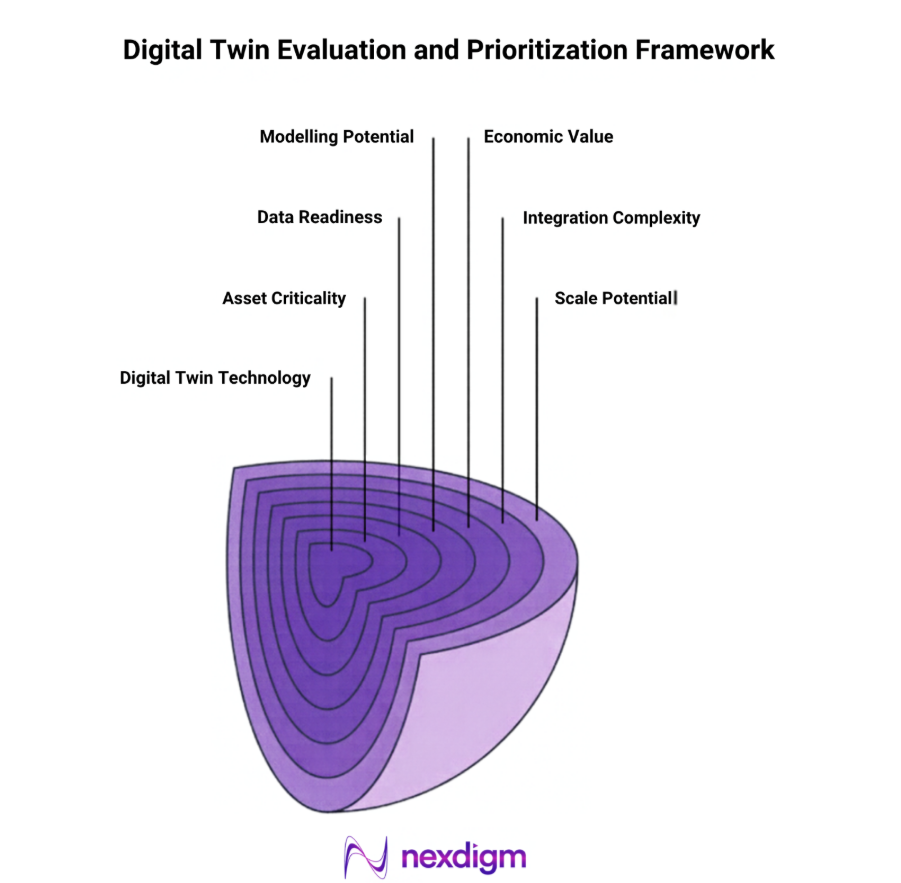
- Asset criticality: Measure replacement value, production dependency, failure consequences, and downtime exposure.
- Data readiness: Assess sensor coverage, telemetry frequency, historical records, connectivity, data quality, and system interoperability.
- Modelling potential: Determine whether the asset’s behaviour can be represented reliably through physics-based, statistical, or machine-learning models.
- Economic value: Quantify potential gains from downtime reduction, maintenance optimization, energy savings, throughput improvement, and engineering-cycle compression.
- Integration complexity: Evaluate PLC, SCADA, MES, ERP, IoT, cloud, cybersecurity, and legacy-system requirements.
- Scale potential: Identify whether the initial twin can be replicated across similar assets, facilities, production lines, or geographic locations.
This prioritization helps separate assets where digital twins can materially improve decisions from deployments driven primarily by technology availability.
Nexdigm Case: Building the Data Foundation for Real-Time Decision-Making
Nexdigm supported an Indian publicly listed retail REIT managing 17 Grade A consumption centres, two hotels, and three office assets covering approximately 9.9 million square feet across 14 cities. Nexdigm centralized fragmented data through Azure Data Factory, Databricks, Azure SQL, and Power BI, enabling real-time insights for business decisions.
The engagement was a data-warehousing transformation rather than a digital-twin deployment, but it illustrates a fundamental requirement for enterprise-scale twins: physical or operational models are only as useful as the data architecture feeding them. For industrial organizations, establishing reliable data pipelines can therefore be as important as selecting the simulation technology itself.
To take the next step, simply visit our Request a Consultation page and share your requirements with us.
Harsh Mittal
+91-8422857704