
A centralized warehouse can simplify inventory management, consolidate stock and create purchasing efficiencies. The economics become less attractive when customer demand spreads across regions and delivery distances begin to dominate the cost structure.
India’s warehousing market is expanding alongside this shift. Industrial and warehousing leasing across the top eight cities reached 36.9 million sq. ft. in 2025, up 16% year-on-year. Delhi NCR accounted for 24% of demand and Chennai 22%, while 3PL providers represented almost one-third of annual leasing. In Q1 2026, leasing reached another 11 million sq. ft., up 22% year-on-year.
The growth is concentrated in markets and micro-markets. That concentration has implications for how companies should position inventory and distribution capacity.
Centralization Works Until Service Distance Starts Costing More
Centralisation works when demand is concentrated and transport economics remain favourable. As customers move farther from the facility, longer routes, higher freight costs and tighter delivery requirements can weaken its advantage.
Regional facilities can improve coverage but add rent, labour, handling, inventory duplication and management costs. The right comparison is therefore the total network cost of each configuration, not warehouse rent alone.
Demand Is Becoming More Geographically Fragmented
Warehousing demand is increasingly tied to specific industrial and consumption clusters.
In 2025, Bhiwandi recorded about 4.9 million sq. ft. of Grade A uptake, while Chakan-Talegaon and Oragadam each recorded more than 2.5 million sq. ft. Delhi NCR and Chennai together accounted for more than 45% of annual leasing across the top eight cities.
The pattern continued into 2026. Delhi NCR accounted for 28% of Q1 leasing and Chennai 21%, while Hoskote-Narsapura in Bengaluru recorded 1.4 million sq. ft. and Bhiwandi around 1.1 million sq. ft.
These clusters matter because warehouse location determines more than property cost. It affects access to manufacturing centres, ports, highways, consumption markets and the delivery radius that can be served economically.
The Case for Regional Nodes
A regional distribution centre becomes commercially attractive when the savings from shorter delivery routes and improved service outweigh the additional fixed and inventory costs.
The economics depend on the characteristics of the demand being served. High-frequency, fast-moving products with dense regional demand are stronger candidates for decentralised stocking. Slow-moving products with dispersed demand may continue to benefit from centralised inventory.
The same network can therefore require different configurations for different product categories. A company may use regional facilities for high-velocity SKUs while retaining a central hub for long-tail inventory.
What a Second Distribution Centre Really Changes
A second DC changes the allocation of inventory as much as it changes transportation.
Stock positioned closer to customers can reduce outbound distances and delivery times, but duplicating inventory across locations increases working capital requirements. Network complexity also rises as replenishment flows, inter-warehouse transfers and facility utilisation need to be coordinated.
The decision becomes particularly important when demand is growing unevenly. A regional facility may be justified in one market while remaining uneconomic in another, even when both markets are experiencing growth.
Large Hub, Regional Hub, or Hybrid Network?
The market supports several viable configurations.
A large central hub can remain appropriate where demand is concentrated, and product variety is high. Regional facilities can work where customer density and shipment frequency justify shorter delivery routes. A hybrid network can combine the two, using regional facilities for high-volume demand while retaining centralised inventory for slower-moving products.
The right footprint can also change over time. A location that is marginal today may become attractive as manufacturing capacity, e-commerce demand or regional consumption develops.
The Footprint Has to Follow Demand Density
Warehouse expansion should follow demand geography, not simply available real estate.
Demand forecasts need to be assessed alongside customer locations, shipment patterns, transport lanes, facility utilisation, rental costs and service requirements. Connectivity to major freight corridors also affects location economics.
Q1 2026 added 12.5 million sq. ft. of supply across the top eight cities, while vacancy reached 16.7%. Yet rents continued to rise in selected high-activity micro-markets.
The issue is therefore not overall capacity, but whether the right capacity is available in the right locations.
How Nexdigm Determines the Right Distribution Footprint
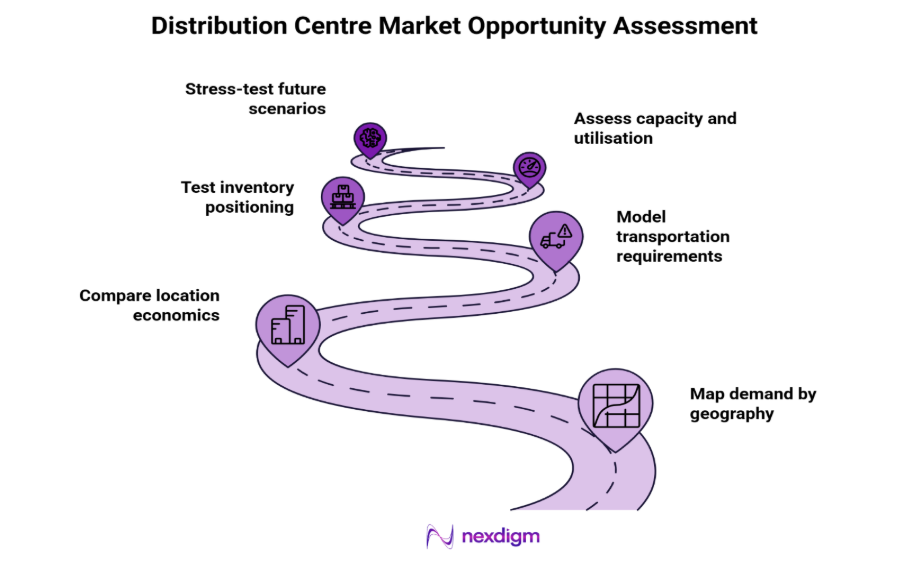
- Map demand by geography
This establishes where the network needs the strongest service coverage. - Compare location economics
Assess potential DC locations against rental or operating costs, labour availability, proximity to suppliers and customers, infrastructure quality, tax considerations and access to major transport corridors - Model transportation requirements
Calculate inbound and outbound transportation costs under alternative network configurations. This shows whether adding a facility reduces line-haul and last-mile costs or simply shifts expenses between different parts of the network. - Test inventory positioning
The analysis considers safety stock, product velocity, replenishment frequency and service-level requirements to estimate the working-capital implications of decentralisation. - Assess capacity and utilisation
his helps distinguish between a genuine capacity shortage and a network that is simply poorly balanced across existing facilities. - Stress-test future scenarios
Model changes in demand, customer geography, product mix, service expectations and transportation costs. Nexdigm can then compare the economics of adding, relocating, consolidating or retaining facilities under different market scenarios.
The output is a network-level view of the trade-offs between cost, coverage, inventory and capacity. A distribution centre market opportunity analysis, this helps determine not simply where a facility could be located, but which footprint is commercially justified and how it should evolve as demand changes.
How Nexdigm Redesigned a Distribution Network
For an Indian subsidiary of a global diagnostics provider serving 200+ distributors through three DCs, Nexdigm analysed demand planning, warehouse utilisation and transportation lanes. The redesign recommended a fourth warehouse and relocation of an existing facility. It delivered 16% cost savings, improved service levels by 7%, and identified an additional 27% supply-chain cost saving.
To take the next step, simply visit our Request a Consultation page and share your requirements with us.
Harsh Mittal
+91-8422857704