

India’s distribution centre market is expanding as manufacturers, retailers, e-commerce businesses, and third-party logistics (3PL) operators strengthen their supply chain networks. According to CBRE’s September 2026 report, Delhi-NCR, Chennai, and Bengaluru accounted for approximately 60% of industrial and logistics leasing during H1 2026. 3PL operators contributed 31% of total absorption, followed by engineering and manufacturing at 26%.
Savills also reported 24.3 million sq. ft. of industrial and logistics absorption in Q3 2026, with Delhi-NCR leading at 20%. These developments highlight the importance of understanding provider presence across major logistics hubs. A structured distribution center vendor landscape assessment helps businesses compare operators, evaluate regional capabilities, and identify suitable partners for their distribution requirements.
Understanding the Distribution Center Provider Landscape
Distribution centre providers operate through different business models, including third-party logistics, integrated warehousing and transportation, dedicated facility management, and specialized fulfilment services. Their competitiveness depends on geographic reach, infrastructure, technology, industry expertise, and service capabilities. Businesses must therefore look beyond provider size and evaluate how effectively each operator serves specific logistics hubs and customer markets.
Dimensions That Shape Provider Competitiveness
When comparing distribution center operators, businesses should examine three fundamental dimensions:
- Geographic Presence: Assess facility locations, proximity to consumption centers, highway connectivity, and access to major transportation corridors.
- Operational Capabilities: Evaluate storage infrastructure, automation, inventory management, order fulfilment, and distribution handling capabilities.
- Industry and Service Expertise: Compare sector specialization, customer requirements, value-added services, and experience managing complex distribution operations.
Together, these factors help organizations distinguish between providers with broad market presence and those offering stronger suitability for specific requirements.
Why Regional Provider Selection Matters for Distribution Networks
By partnering with organizations like Nexdigm, our experts can help businesses evaluate regional distribution centre providers by examining demand patterns, customer proximity, transportation access, infrastructure, and service coverage. Through structured market research and provider benchmarking, our analysis can identify regional capability gaps and assess operator suitability. These insights support informed partner selection and help businesses build distribution networks aligned with operational and growth requirements.
Nexdigm’s Expertise in Distribution Network Strategy
Nexdigm combines market intelligence, industry research, and strategic analysis to help businesses make informed decisions about distribution centre networks. Our distribution center vendor landscape research can cover several focus areas:
- Demand and Supply Assessment: Examine regional warehousing demand, available capacity, and supply-demand gaps to understand market conditions.
- Cost and Commercial Benchmarking: Compare rental trends, operating costs, service charges, and commercial models across distribution centre providers.
- Technology and Infrastructure Evaluation: Assess automation, warehouse management systems, facility standards, and infrastructure readiness.
- Provider Risk Assessment: Review operator concentration, network coverage, operational dependencies, and potential supply chain vulnerabilities.
These insights help businesses evaluate market options, identify suitable providers, and make distribution network decisions with greater clarity.
How Nexdigm Conducts Distribution Centre Provider Assessment
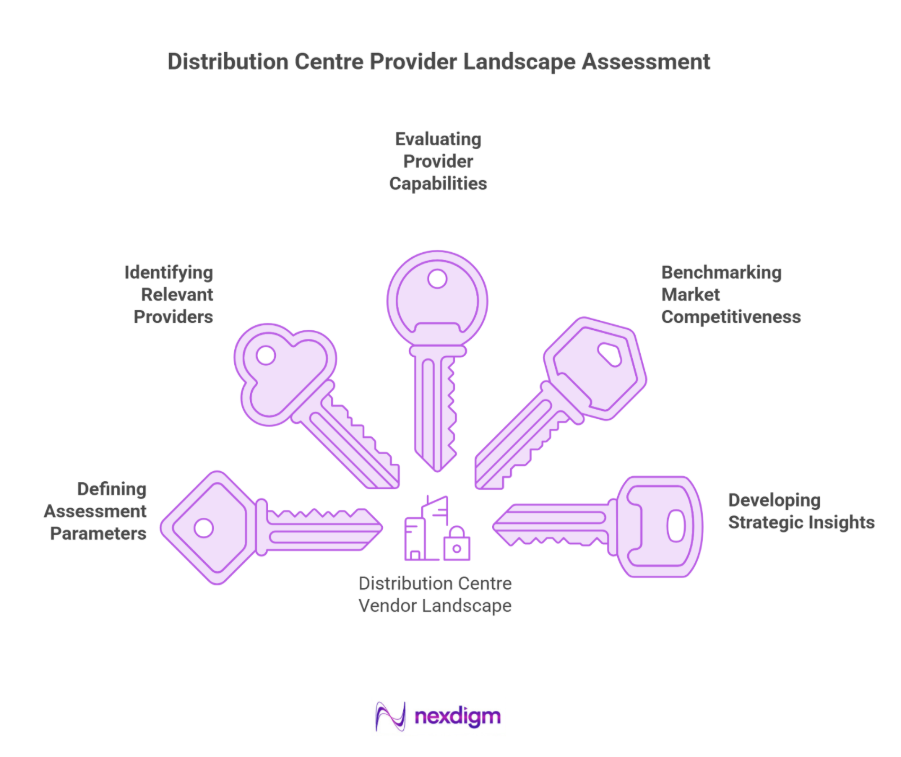
Nexdigm follows a structured research approach to assess distribution centre operators and understand their suitability across key logistics hubs. The process involves:
- Step 1. Defining Assessment Parameters: Establish business requirements covering location, storage capacity, industry needs, service expectations, and cost considerations.
- Step 2. Identifying Relevant Providers: Map distribution centre operators based on regional presence, facility networks, service portfolios, and market positioning.
- Step 3. Evaluating Provider Capabilities: Examine infrastructure, technology, operational expertise, scalability, and value-added services.
- Step 4. Benchmarking Market Competitiveness: Compare providers on commercial terms, geographic coverage, service capabilities, and operational strengths.
- Step 5. Developing Strategic Insights: Consolidate findings into provider comparisons and recommendations to support location planning, partner selection, and distribution network decisions.
This systematic approach helps businesses move from market understanding to informed provider evaluation and sourcing decisions.
Business Impact of Nexdigm’s Distribution Centre Assessment
Nexdigm’s research and benchmarking can help businesses translate provider insights into measurable operational and strategic benefits. These are:
- Improved Cost Efficiency: Identify competitive pricing, evaluate operating costs, and uncover opportunities to optimise warehousing expenditure.
- Better Location Decisions: Select distribution hubs based on regional demand, connectivity, infrastructure, and proximity to customers.
- Stronger Supplier Selection: Compare provider capabilities and commercial terms to identify partners aligned with business requirements.
- Greater Supply Chain Resilience: Recognise regional capacity gaps, provider dependencies, and infrastructure risks to support network continuity.
- Scalable Distribution Networks: Evaluate emerging logistics hubs and provider capabilities to support business expansion and changing distribution needs.
By connecting market intelligence with business priorities, Nexdigm can help organisations build more cost-effective, resilient, and scalable distribution networks.
Nexdigm’s Case
A retail company planning to expand its distribution network sought to identify suitable warehouse partners across key logistics hubs. Nexdigm’s assessment compared provider capabilities, regional coverage, infrastructure, and commercial terms, identifying 19% potential warehousing cost savings and 22% scope for improving regional coverage. These insights supported better partner selection and network planning.
To take the next step, simply visit our Request a Consultation page and share your requirements with us.
Harsh Mittal
+91-8422857704