

Crude oil becomes commercial value only after it is converted into products that a market can absorb. A refinery’s output slate may include gasoline, diesel, jet fuel, LPG, naphtha, fuel oil, bitumen and petrochemical feedstocks. Each product faces different buyers, transport requirements and substitutes. The relevant growth opportunity may therefore sit in one end market, not in aggregate petroleum consumption or refinery throughput.
The IEA’s Oil 2025 outlook illustrates the split between supply and demand. It projected 4.2 million barrels per day of new refining capacity by 2030, partly offset by 1.6 million barrels per day of closures, while medium-term demand growth remains comparatively modest. At the same time, demand composition shifts: aviation and petrochemical feedstocks can grow while efficiency, electric vehicles and fuel substitution restrain some road fuels. New capacity alone does not establish a shortage or justify investment.
Trace Product Yields Into Customers
Start with crude availability, assay and the configuration of existing and planned plants. A simple refinery may yield more residual fuel; a complex conversion refinery can upgrade heavy fractions into transport fuels and petrochemical feedstocks. Model yields by crude grade and unit configuration, then compare them with domestic demand, imports, exports and inventory by product. Apparent consumption should be adjusted for blending, biofuels, bunkering and non-energy use where data allow.
Map end-use drivers separately. Gasoline demand follows vehicle parc, travel and fuel economy; diesel follows freight, construction, agriculture and industrial activity; jet fuel follows passenger and cargo aviation; LPG reflects cooking, heating and petrochemical use; naphtha and other feedstocks track chemical capacity and utilisation. A country can be self-sufficient in crude yet import diesel or jet fuel if refinery yields do not match its product demand. Conversely, a surplus product is not automatically exportable at a margin if ports, specifications or customer access are weak.
Rank Structural Deficits, Not Temporary Spikes
For each product, build a balance through the investment horizon: local production, committed capacity changes, imports, exports and demand under base and downside cases. Identify whether the gap is seasonal, cyclical or structural. Stress-test refinery outage rates, crude differentials, product cracks and transport costs. Compare a new refinery with alternatives such as upgrading units, blending terminals, storage, import infrastructure or a conversion plant serving a particular feedstock market.
For downstream market assessment services, Nexdigm can connect crude and refinery data to downstream industry demand so clients can prioritise products with both a durable demand pool and a route to market. The best prospect may be a product-specific logistics or conversion investment rather than additional crude-distillation capacity.
Downstream Product Opportunity Assessment Framework
A downstream opportunity can be evaluated through four product-level tests:
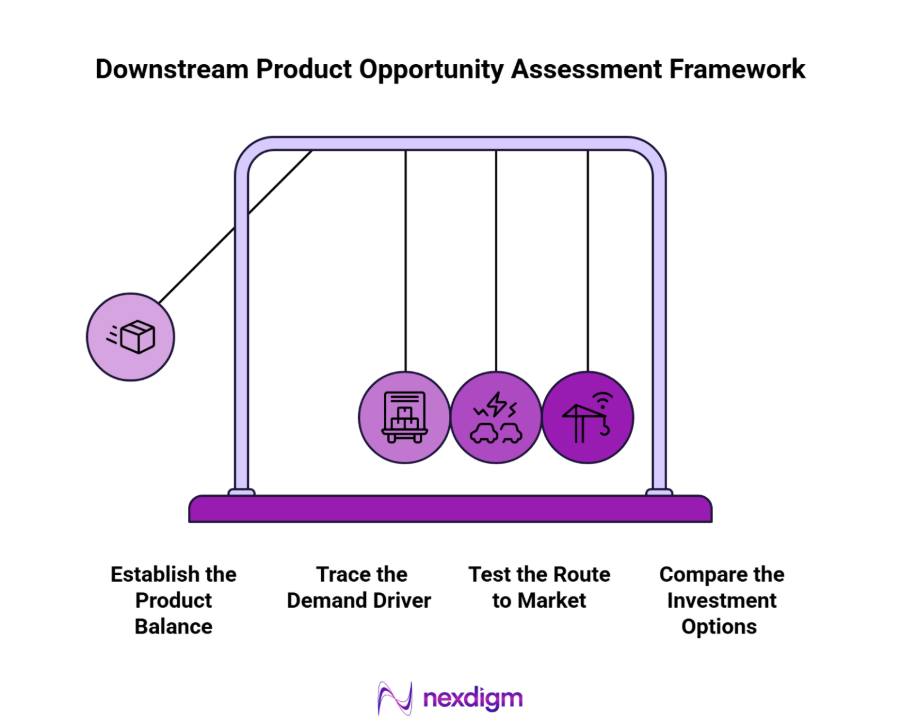
- Establish the Product Balance
Measure current production, demand, imports, exports and committed capacity to determine whether a product is structurally short or oversupplied. - Trace the Demand Driver
Link each product to the physical activity generating consumption, whether vehicle kilometres, freight, aviation, household energy use, industrial production or petrochemical capacity. - Test the Route to Market
Assess specifications, terminals, storage, logistics and customer access to determine whether additional supply can actually reach buyers at a competitive delivered cost. - Compare the Investment Options
Test whether the gap is best addressed through additional refining, a conversion unit, storage, import infrastructure, blending or another downstream asset, using margins and downside scenarios to compare returns.
Nexdigm can apply this framework to identify where product-level shortages are durable enough to support investment and where a smaller infrastructure or conversion opportunity offers a better risk-return profile.
Nexdigm Case Study
Nexdigm assessed gasoline, diesel, jet fuel, LPG and naphtha across three import-dependent markets, combining refinery yields with aviation, industrial and household demand forecasts. The analysis identified persistent jet-fuel and LPG gaps in two locations, while a diesel shortage proved temporary. The client prioritised storage and import infrastructure before evaluating refinery expansion.
To take the next step, simply visit our Request a Consultation page and share your requirements with us.
Harsh Mittal
+91-8422857704