

Refining capacity alone does not reveal where downstream growth will occur. A refinery can process crude efficiently and still face weak demand for its product slate, expensive feedstock or limited access to customers. A stronger assessment follows each product from processing capacity to the sectors, geographies and buyers that consume it.
The International Energy Agency estimates global oil demand grew by 0.65 million barrels per day in 2025, a slower increase than in 2024.
Demand patterns varied by end use: aviation fuel use rose 3.6%, while gasoline and diesel demand were virtually unchanged.
Petrochemical feedstock demand continued to grow, but more slowly than the previous year.
A headline oil-demand forecast can therefore conceal very different prospects for jet fuel, road fuels and chemical feedstocks.
Trace Deficits to Customers and Margins
A product deficit can signal an opportunity, but it does not guarantee value capture. Shortfalls are frequently seasonal, triggered by unplanned refinery outages, or already secured through established import channels. Commercial diligence must first determine whether the deficit is recurring, which buyers absorb the shortfall, and what alternatives they possess.
Converting that demand into revenue depends entirely on supply-chain reach:
- Infrastructure Bottlenecks: Strong local demand (e.g., commercial jet fuel) remains unmonetizable if terminal, pipeline, or airport fueling infrastructure is constrained.
- Competing Feedstocks: Fast-growing petrochemical demand may be captured by competitive local NGLs or waterborne imports rather than regional refinery slates.
Finally, margins must be evaluated by specific route and netback economics, accounting for crude pricing, freight, quality differentials, and blending rules. Global trade directly shapes local capture: overseas imports can erase regional shortages overnight, while export optionality allows refiners to run above domestic absorption.
Downstream growth pools are increasingly reshaped by market substitution:
- Demand Divergence: Electric vehicle adoption and efficiency improvements are curbing road-fuel demand, even as aviation and petrochemical applications continue to expand.
- Structural Market Shifts: Biofuel blending mandates, recycling initiatives, alternative feedstocks, and evolving product standards are fundamentally redefining the addressable market.
- Core Commercial Imperative: Growth volume alone is insufficient. The critical assessment is whether that growth is durable, accessible, and profitable given the company’s existing asset base and distribution channels.
A useful downstream opportunity market assessment consulting process begins with product balances. Estimate local production, consumption, imports, exports and inventories for gasoline, diesel, jet fuel, LPG, naphtha and other relevant products. Then examine the demand behind those balances: vehicle use, freight, aviation, industrial output, petrochemical capacity, household fuel access and power generation.
Framework: Product-to-Customer Opportunity Screen
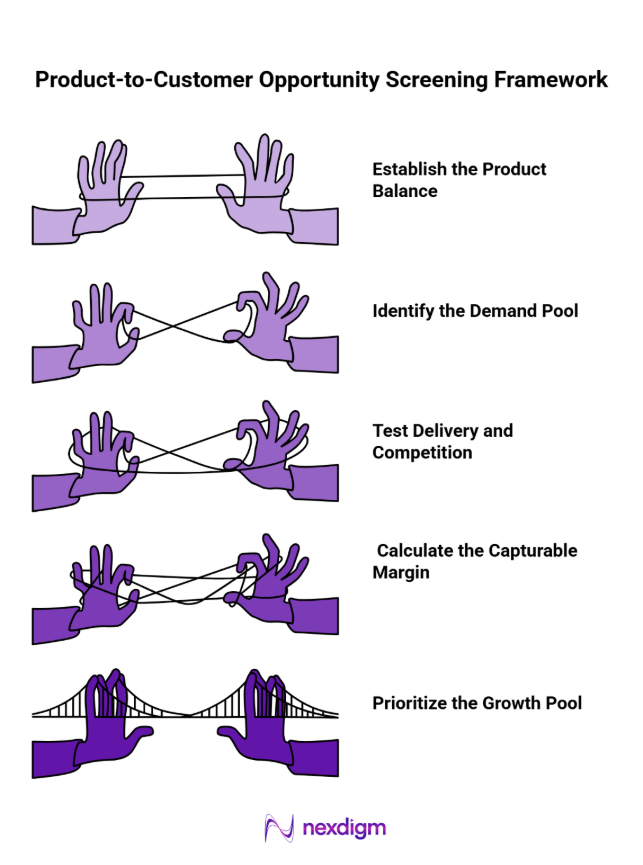
- Establish the Product Balance
Measure production, demand, imports, exports and inventories for each product in the target geography. Separate structural deficits from seasonal or temporary gaps. - Identify the Demand Pool
Link each product to its consuming sectors and buyer groups. Forecast the relevant activity drivers, such as aviation traffic, freight, vehicle use, petrochemical capacity or industrial output. - Test Delivery and Competition
Map the routes from refinery or supply source to customer. Assess storage, terminal, pipeline and transport capacity, as well as competing imports, substitutes and incumbent suppliers. - Calculate the Capturable Margin
Estimate the netback after crude or feedstock cost, processing, freight, quality adjustments, taxes and distribution. Test whether margins remain viable under alternative price and utilization conditions. - Prioritize the Growth Pool
Rank products and customer segments by demand durability, access, margin and the company’s ability to supply. Direct commercial effort toward opportunities that remain attractive after substitution and supply responses are considered.
Nexdigm Case Study
Nexdigm modelled downstream product demand across six markets, linking refinery output with aviation, transport and petrochemical consumption. The scenario identified jet fuel and LPG as the strongest addressable pools, with 18% and 12% demand growth over five years. We recommended prioritizing airport supply contracts and LPG distribution partnerships.
To take the next step, simply visit our Request a Consultation page and share your requirements with us.
Harsh Mittal
+91-8422857704