
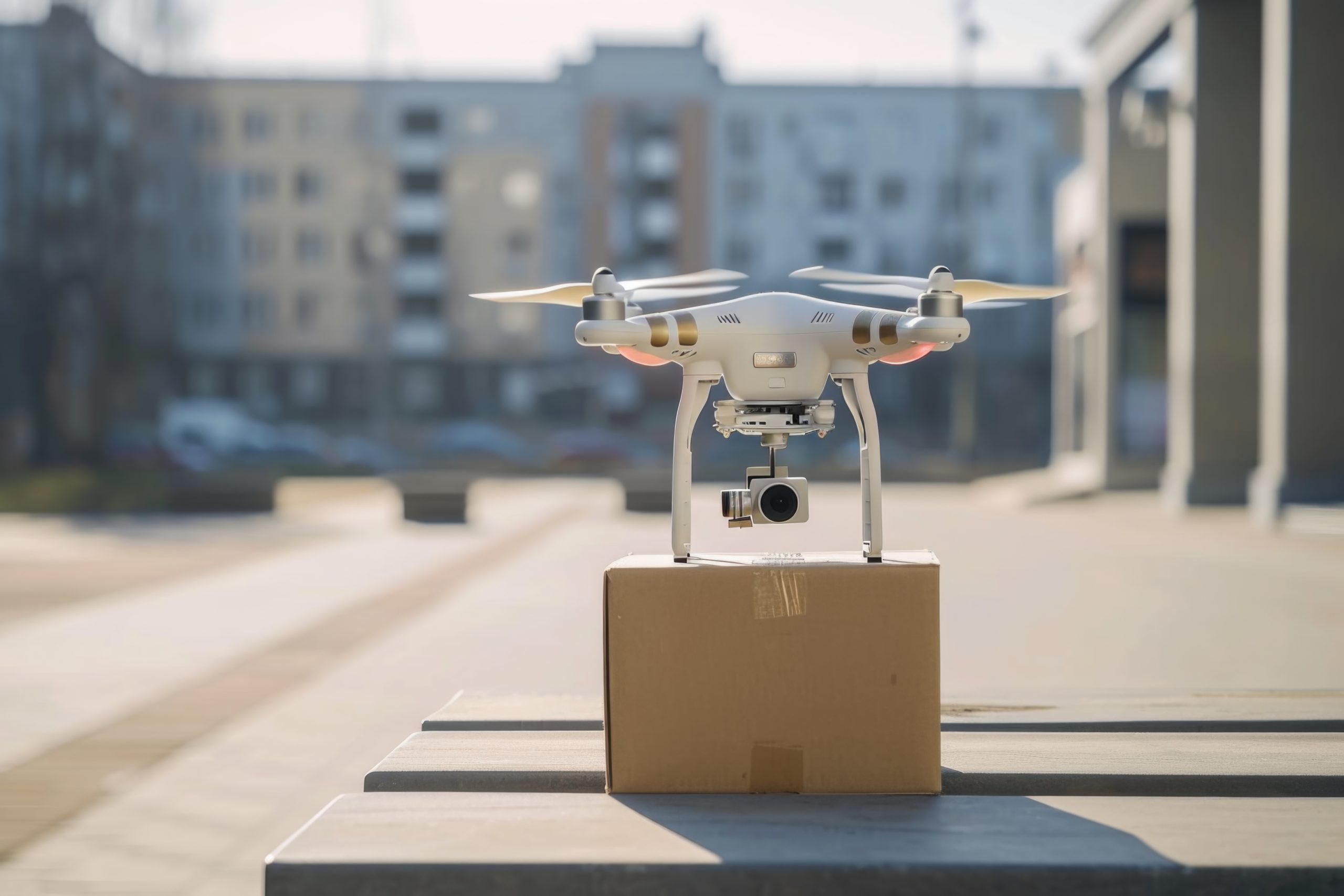
Drone delivery is often presented as a broad alternative to ground transportation, but the economics remain highly route dependent. Most commercial delivery drones carry around 1.5–4 kg over operational round-trip distances of 15–30 km, limiting their competitiveness for conventional parcel networks.
The stronger opportunities emerge where speed, terrain, cargo value, or delivery constraints make traditional transport disproportionately expensive. Healthcare, remote industrial operations, and time-critical logistics therefore present more compelling use cases than routine urban delivery.
The Route Determines Whether Drones Make Sense
Battery energy density remains a fundamental constraint. Lithium-ion batteries provide roughly 250–300 Wh/kg, compared with around 12,000 Wh/kg for hydrocarbon fuels. Increasing payload or range therefore requires larger aircraft, increasing capital, noise, and operating costs.
For logistics providers, the relevant question is whether the drone can materially improve the economics of a particular corridor. A route with difficult terrain, poor road connectivity, or severe congestion may justify aerial delivery even when a conventional van remains cheaper elsewhere.
Healthcare Can Support a Different Value Equation
Healthcare logistics places a premium on time and cargo integrity. A delayed blood unit or spoiled diagnostic sample can carry consequences far beyond its transportation cost.
Potential applications include:
- Emergency transport of blood, plasma, antivenoms, and biologics
- Pathology sample collection from remote clinics
- Temperature-controlled vaccine distribution
- Rapid delivery of AEDs and other critical medical devices
A mountainous route taking several hours by road can potentially be reduced to minutes through direct point-to-point flight. Where the clinical value of faster delivery is high, the economics can support a higher logistics cost per shipment.
Retail Has a Much Harder Cost Equation
Routine consumer delivery is less attractive because ground vehicles consolidate large numbers of shipments. A fully loaded delivery van may deliver 120–180 shipments per run at $1.80–$2.50 per drop, while current autonomous drone operations can cost around $12–$15 per package.
The gap is difficult to overcome unless customers pay for premium 15-minute delivery or road transport is unusually inefficient. Drone delivery therefore has limited economic justification on dense residential routes where vans already achieve high stop density.
Remote Logistics Can Create the Strongest Commercial Case
The economics change when conventional transport involves long detours, difficult terrain, or expensive dedicated vehicles.
Offshore supply flights can potentially replace crewed launch boats costing $800–$2,500 with drone flights costing approximately $120–$250. Mountain clinic deliveries can reduce 3.5–5.5 hours of road travel to roughly 20–35 minutes by VTOL aircraft. Industrial spare-part deliveries to remote utility infrastructure can similarly reduce several hours of off-road travel to around 40 minutes.
In these cases, the drone is not competing with an efficient parcel route. It is replacing a costly response to geographic friction.
Regulation Defines the Addressable Market
Commercial scaling also depends on aviation regulation. Visual Line of Sight (VLOS) requirements can restrict flight distances and increase staffing requirements, while Beyond Visual Line of Sight (BVLOS) operations require additional approvals and safety systems.
Operators need to evaluate:
- Airspace and BVLOS approval requirements
- Detect-and-avoid capabilities
- Permitted population-density and overflight zones
- Takeoff and landing infrastructure
- Weather and wind limitations
- Noise and environmental requirements
A technically feasible route may therefore remain commercially inaccessible until its regulatory pathway is established.
How Nexdigm Screens Drone Delivery Opportunities
Nexdigm evaluates potential drone corridors against operational, economic, geographic, and regulatory constraints. The drone delivery market opportunity assessment focuses on:
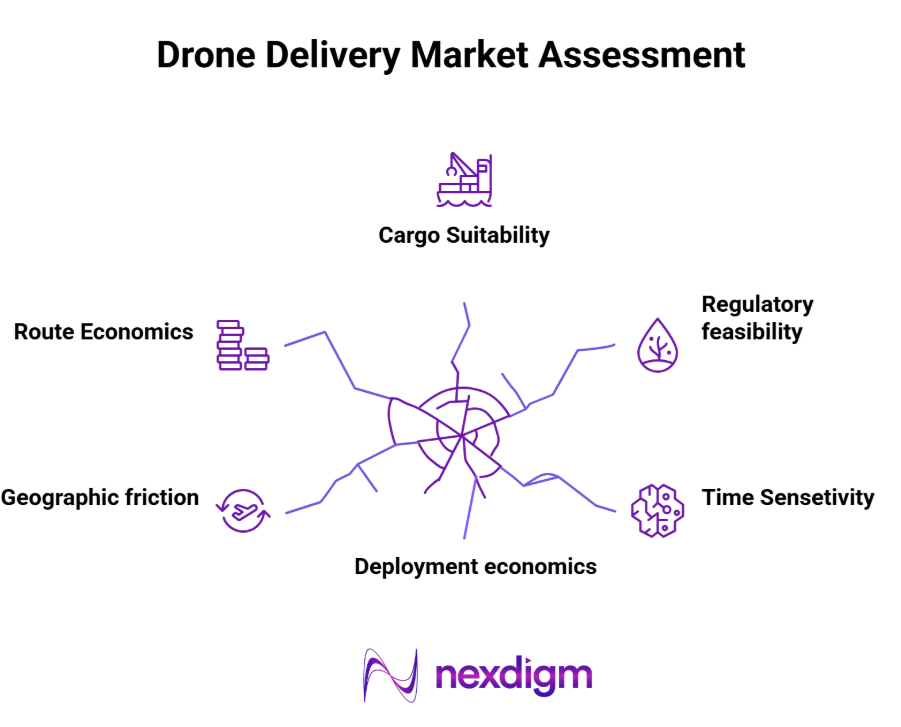
- Route economics: Compare drone and ground delivery costs against distance, travel time, and transport reliability.
- Cargo suitability: Assess payload weight, dimensions, temperature requirements, and shipment value.
- Geographic friction: Map terrain, road conditions, water crossings, congestion, and actual versus direct travel distances.
- Time sensitivity: Quantify the financial or operational value of reducing delivery times.
- Regulatory feasibility: Assess airspace restrictions, BVLOS requirements, landing locations, and approval pathways.
- Deployment economics: Model aircraft utilization, pilot requirements, recovery operations, and expected payback.
This allows operators to distinguish corridors where drones create measurable value from those where they simply add another layer of cost.
How Nexdigm Identified Six Viable Medical Drone Corridors
A healthcare network serving 28 clinics across a rugged 180-km territory handled 34,000 urgent shipments over five years. Ground delivery averaged 3.8 hours, often exceeding six hours during severe weather.
Nexdigm screened 28 corridors and found that only six justified drone deployment.
A phased BVLOS network reduced critical shipment transit to 28 minutes, an 88% reduction, eliminated emergency sample spoilage, and cut first-year operating costs by 41% on the priority routes.
To take the next step, simply visit our Request a Consultation page and share your requirements with us.
Harsh Mittal
+91-8422857704