

A pharmaceutical distributor’s value is determined by how reliably it makes medicines available across the locations and customers it serves. A large network may offer broad market access, but coverage alone does not establish service quality. Warehouse infrastructure, inventory visibility, delivery reliability, regulatory compliance and the ability to handle specialised products all influence whether a distributor is suitable.
India’s pharmaceutical distribution ecosystem includes national distributors, regional stockists, carrying and forwarding agents, wholesale networks and specialised logistics providers. Their operating models differ considerably. A distributor with extensive coverage of conventional medicines may not have the infrastructure needed for biologics, vaccines or other temperature-sensitive products.
Distribution Coverage Is Valuable Only When It Reaches the Required Customers
India’s pharmaceutical distribution network has traditionally been fragmented, with manufacturers supplying products through clearing and forwarding agents, stockists, wholesalers and retailers. A Competition Commission of India market study described a network involving approximately 65,000 stockists and nine lakh private retail pharmacies. Although these are historical figures, they illustrate the scale and complexity of the market.
For buyers, the important question is not simply whether a distributor operates nationally. It is whether the network reaches the locations, hospitals, pharmacies, and institutional customers that matter to the business.
A distributor may have a presence across several states but depend on regional partners for last-mile delivery. Another may have a smaller geographic footprint but stronger relationships with hospitals and pharmacies in specific cities. The appropriate partner depends on the intended distribution model.
Geographic coverage should therefore be assessed alongside product availability, customer reach, replenishment frequency, and the distributor’s ability to serve locations consistently.
Logistics Infrastructure Determines Whether Products Arrive in Suitable Condition
Pharmaceutical logistics involves more than moving products between warehouses. Storage conditions, temperature control, handling procedures, and delivery timelines can affect product integrity. Conventional medicines may require controlled ambient storage, while vaccines, biologics and other temperature-sensitive products need specialised infrastructure.
The differences are particularly important when comparing distributors:
- Ambient distribution: Requires suitable warehouse conditions, stock rotation and protection against inappropriate storage environments.
- Cold-chain distribution: Requires temperature-controlled storage and transportation, monitoring systems and documented handling procedures.
- Hospital and institutional supply: May require scheduled deliveries, order accuracy and the ability to manage urgent replenishment.
- Returns and reverse logistics: Requires processes for handling damaged, expired, recalled or otherwise non-saleable products.
Infrastructure alone does not demonstrate operational reliability. Buyers should also understand how temperature excursions are recorded, how exceptions are managed and whether delivery records provide adequate traceability.
Compliance and Traceability Protect Product Integrity Across the Network
A distributor can have strong geographic coverage and still be unsuitable if its storage and handling practices do not meet the requirements applicable to the products it carries. Pharmaceutical distribution involves regulatory obligations relating to licences, storage, documentation, and product movement.
The World Health Organization’s good storage and distribution practices provide guidance on maintaining product quality through the supply chain. In India, the relevant requirements depend on the product and the activities performed by the distributor.
Buyers should examine the distributor’s applicable licences, warehouse procedures, temperature records, stock traceability, personnel training and processes for handling returns and suspected quality issues. The ability to trace products through the network is particularly important when a recall or quality concern requires rapid identification of affected batches.
For temperature-sensitive medicines, compliance also depends on the consistency of handling across third-party logistics partners and regional distribution points. A central warehouse may have suitable infrastructure, but the same standard needs to be maintained throughout the delivery network.
Service Performance Depends on Inventory Visibility and Replenishment
A distributor’s service quality is reflected in whether the correct product reaches the intended location, in the required quantity and within the expected timeframe. A large catalogue does not necessarily translate into strong fulfilment performance.
The most useful service indicators include order fill rates, delivery lead times, order accuracy, back-order frequency, stock availability, and the handling of urgent requests. Inventory visibility is equally important. Buyers need reliable information on available stock, pending orders, and replenishment timelines to manage purchasing and avoid unnecessary shortages.
Organised distribution is gradually becoming more significant in India. An industry study published by the Indian Pharmaceutical Alliance estimated that organised stockists accounted for around 10% of the market in 2023 and projected that their share could reach 25–30% by 2030. This reflects a potential shift towards larger networks and more structured distribution models, although the projection should not be treated as an established current market share.
Comparing National Networks with Regional Distribution Specialists
The supplier landscape includes organised players such as Entero Healthcare Solutions, alongside national and regional stockists, C&F networks and specialised logistics providers. Their capabilities vary in geographic reach, product categories, customer segments, and infrastructure.
National distributors may offer broader coverage and greater purchasing scale. Regional operators may have stronger local relationships, more established knowledge of specific markets, and greater familiarity with local replenishment patterns. Neither model is automatically superior.
A structured drug distribution vendor mapping exercise connects these differences to the buyer’s actual distribution requirements. For example, a hospital network may prioritise institutional coverage and predictable replenishment, while a pharmaceutical manufacturer may need extensive stockist reach, inventory visibility, and efficient movement across several regions.
Nexdigm’s procurement research can support distributor identification, geographic footprint mapping, service and product portfolio comparisons, and analysis of market structure and logistics capabilities. This helps organisations understand the available distribution ecosystem before commercial selection and operational due diligence.
Pharmaceutical Distribution Vendor Assessment Framework
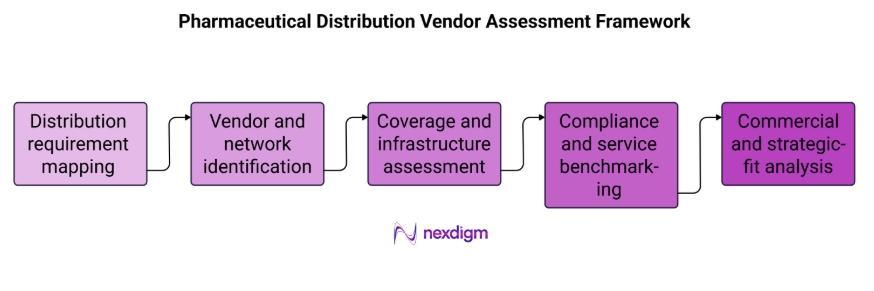
- Distribution requirement mapping: Define target locations, customer segments, product categories, delivery frequency and storage requirements.
- Vendor and network identification: Map national and regional distributors, stockists, C&F networks and specialist logistics providers.
- Coverage and infrastructure assessment: Compare warehouse locations, geographic reach, cold-chain capabilities, transportation networks and inventory systems.
- Compliance and service benchmarking: Examine applicable licences, storage practices, traceability, fulfilment indicators, delivery performance and returns management.
- Commercial and strategic-fit analysis: Compare distribution costs, service coverage, customer concentration, network dependencies and alternative vendor availability.
Case Study: Comparing Pharmaceutical Distribution Networks
A pharmaceutical manufacturer reviewing distribution partners for regional expansion needed to compare coverage and logistics capabilities. Nexdigm’s research mapped 24 distributors across six regions, assessed warehouse networks and product coverage, and identified seven vendors for further commercial and operational evaluation.
To take the next step, simply visit our Request a Consultation page and share your requirements with us.
Harsh Mittal
+91-8422857704