

Pharmaceutical sourcing decisions affect medicine availability, procurement expenditure and continuity of healthcare services. Hospitals, pharmacy chains, distributors and public health institutions must source medicines across a broad range of therapeutic categories, dosage forms and pack sizes. Their purchasing decisions are influenced by supplier availability, product quality, pricing regulations, distribution coverage and the reliability of replenishment.
A sourcing strategy must account for the differences between medicines. A widely manufactured tablet may have several potential suppliers, while a specialised injectable or temperature-sensitive product may depend on a much smaller manufacturing and distribution network. Treating every product category in the same way can create avoidable supply and cost exposure.
Start with Product-Level Demand and Supply Mapping
Healthcare buyers should first understand what they purchase, how frequently it is required and how critical uninterrupted availability is.
A product-level assessment should capture the generic name, strength, and dosage form; the therapeutic category and intended use; annual consumption and purchasing frequency; required packaging and storage conditions; shelf-life and batch-size requirements; seasonal or demand-related fluctuations; and existing supplier coverage alongside alternative availability.
Demand helps distinguish high-volume routine medicines from specialised products with lower consumption but greater continuity requirements. It also supports more accurate forecasting and inventory planning.
Comparing Pharmaceutical Supply Markets
The supply landscape includes domestic manufacturers, importers, distributors and contract manufacturing partners. The appropriate sourcing route depends on the product, destination market, regulatory status and supplier capabilities.
Buyers should examine:
- Number of manufacturers supplying the required formulation.
- Geographic distribution of production facilities.
- API and key intermediate sourcing dependencies.
- Import dependence and exposure to international logistics.
- Distributor and wholesaler coverage.
- Availability of alternative strengths, pack sizes or approved products.
- Lead times and replenishment frequency.
Supply-market concentration deserves particular attention. A medicine may have several brands available in the market, but those brands may rely on the same API producer or manufacturing facility. Supplier counts alone can therefore overstate the diversity of the underlying supply base.
Price Comparison and Regulatory Conditions
Pharmaceutical prices vary by manufacturer, formulation, pack size, distribution channel and applicable regulatory controls. Buyers should compare like-for-like products and account for differences in taxes, packaging, freight, discounts and credit terms.
India’s pharmaceutical pricing system operates under the Drugs (Prices Control) Order, 2013. NPPA fixes ceiling prices for scheduled formulations included in the relevant schedule, while other pricing provisions apply to non-scheduled formulations. In July 2026, the government reported that ceiling prices for 935 formulations were effective as of 23 July 2026.
A sourcing comparison should therefore distinguish between:
- Scheduled medicines subject to applicable ceiling prices.
- Non-scheduled formulations subject to relevant pricing provisions.
- Products with different strengths or pack configurations.
- Branded and generic alternatives with equivalent specifications.
- Domestic and imported products with different landed costs.
The lowest quoted price may not represent the lowest procurement cost once delivery, storage, quality documentation and inventory requirements are considered.
Quality, Regulatory and Distribution Risk
Product quality must remain a non-negotiable sourcing requirement. Buyers should review the supplier’s manufacturing credentials, applicable licences, product registrations, batch documentation and traceability arrangements.
Other areas of risk include:
- Regulatory actions and publicly available compliance history.
- Dependence on a limited number of manufacturing sites.
- Product recalls and supply interruptions.
- Cold-chain and temperature-control requirements.
- Counterfeit or falsified medicine exposure.
- Expiry-related losses and inventory obsolescence.
- Distribution coverage and last-mile availability.
The importance of supplier monitoring is reflected in government procurement and distribution systems. Under the Pradhan Mantri Bhartiya Janaushadhi Pariyojana, the government has reported the use of WHO-GMP-certified suppliers, batch testing through NABL-accredited laboratories and routine facility quality audits. These measures illustrate how supplier credentials and product testing can be integrated into a structured sourcing model.
Building a Sourcing Strategy Around Market Intelligence
Sourcing decisions should reflect the commercial and supply conditions of each product category. A high-volume generic medicine may justify a multi-supplier approach, while a specialised medicine may require closer monitoring of a smaller manufacturer base and its distribution arrangements.
This is where drug sourcing strategy research can provide a stronger market view. It can help identify relevant manufacturers, compare product availability, examine regional pricing conditions and map upstream supply dependencies.
Nexdigm’s procurement research can support pharmaceutical market mapping, supplier profiling, pricing and regional supply comparisons, and analysis of manufacturing and distribution networks. It helps healthcare buyers understand the market before finalising supplier qualification, product approval and purchasing decisions.
Pharmaceutical Sourcing Strategy Framework
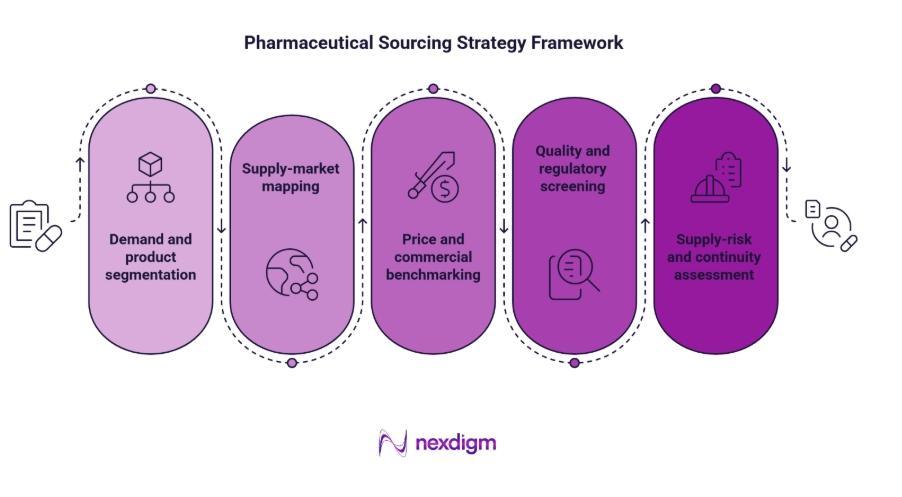
- Demand and product segmentation: Classify medicines by formulation, therapeutic category, purchasing volume, criticality and storage requirements.
- Supply-market mapping: Identify manufacturers, distributors, import channels, production locations and alternative product sources.
- Price and commercial benchmarking: Compare applicable prices, landed costs, pack configurations, order quantities and payment conditions.
- Quality and regulatory screening: Examine product registrations, manufacturing credentials, documentation, traceability and relevant regulatory history.
- Supply-risk and continuity assessment: Evaluate supplier concentration, upstream dependencies, lead times, cold-chain exposure and alternative sourcing options.
Case Study: Reviewing Pharmaceutical Sourcing Options
A hospital network reviewing procurement across essential medicine categories needed to understand price and availability differences. Nexdigm’s research mapped 30 suppliers across 5 regions, compared product portfolios and distribution coverage, and identified 8 categories where limited supplier options or geographic concentration warranted closer review.
To take the next step, simply visit our Request a Consultation page and share your requirements with us.
Harsh Mittal
+91-8422857704