

Dynamic software pricing intelligence helps software businesses align prices with actual usage, consumption patterns, customer value, and evolving cost structures. Through data-driven Pricing Analysis Services, organizations can evaluate usage metrics, consumption tiers, price elasticity, unit economics, and hybrid monetization models.
Combining usage-based pricing analysis, SaaS pricing strategy, and price optimization enables businesses to improve revenue scalability, strengthen customer alignment, enhance pricing transparency, and adapt monetization strategies as software usage, AI workloads, infrastructure costs, and customer requirements evolve across competitive digital markets.
A 2025 industry study found 100 SaaS companies actively adopting or evaluating usage-based models, while one billing platform reported 8 times year-over-year increase in usage-based billings processed, reinforcing the value of specialized Pricing Analysis Services.
Dynamic Software Pricing Analysis for Consumption-Based Business Models
Dynamic software pricing analysis helps businesses align pricing with actual consumption, customer value and evolving usage patterns, enabling sustainable software growth strategies. It comprises several economic dimensions which provide a structured view of consumption-led pricing decisions. They are:
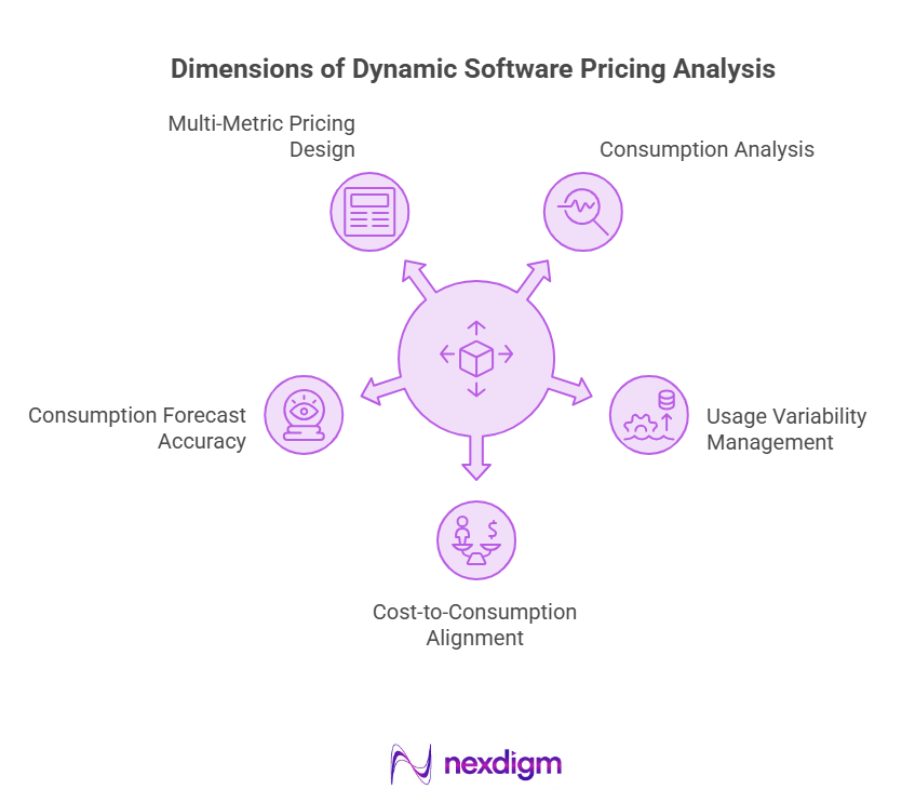
- Consumption Analysis: Pricing analysis evaluates how quickly customer usage scales across time, helping software businesses identify high-growth consumption patterns and establish pricing structures that remain commercially effective as demand accelerates.
- Usage Variability Management: Fluctuations in API calls, compute, storage, transactions, and other consumption measures are assessed to determine pricing approaches that accommodate demand volatility while supporting stable revenue economics.
- Cost-to-Consumption Alignment: Infrastructure and delivery costs are mapped against different consumption levels, enabling software businesses to establish unit rates that protect margins as workloads, processing requirements, and service intensity change.
- Consumption Forecast Accuracy: Historical utilization, seasonality, adoption trends, and customer growth are modeled to improve forecasts of future consumption, helping businesses strengthen revenue planning within variable usage-based pricing environments.
- Multi-Metric Pricing Design: Multiple usage measures such as compute, storage, transactions, users, or data volume are evaluated together to create pricing models better aligned with complex software consumption patterns.
Nexdigm’s Pricing Analysis Expertise for Consumption-Led Software Models
Nexdigm’s expertise helps businesses convert complex consumption patterns into actionable pricing decisions, creating measurable benefits across monetization, profitability, customer alignment, and recurring revenue performance, such as:
- Improved Usage-to-Value Alignment
- Scalable Consumption Monetization
- Stronger Unit Economics
- Optimized Usage-Based Revenue
- Enhanced Pricing Transparency
- Greater Revenue Predictability
By connecting consumption intelligence with strategic pricing analysis, Nexdigm supports software businesses with adaptable pricing models that capture customer value, strengthen revenue economics, and support sustainable growth as usage evolves.
Nexdigm’s Pricing Analysis Architecture for Usage Based Software Models
Nexdigm’s software pricing architecture combines market intelligence with value and revenue economics, creating a structured pathway for assessing changing software consumption through valuable strategies, such as:
- Software Unit Consumption Analysis: Revenue per consumption unit is compared with infrastructure, processing, and servicing costs to develop pricing structures that maintain profitability as software workloads and customer utilization expand.
- Usage Credit Structuring Strategy: Prepaid credits and consumption allowances are designed around expected customer demand, helping businesses improve upfront commitments while enabling flexible utilization across changing software workloads and requirements.
- Value Meter Selection Strategy: Customer outcomes and software utilization patterns are assessed to select pricing meters that closely connect charges with realized value across transactions, workloads, users, or processing volumes.
Nexdigm’s Case
Nexdigm supported a software business in refining its consumption-led pricing model, contributing to a 23% increase in usage-based revenue, 16% improvement in gross margins, and 19% higher expansion revenue, while strengthening monetization scalability, pricing alignment, and customer value realization.
To take the next step, simply visit our Request a Consultation page and share your requirements with us.
Harsh Mittal
+91-8422857704